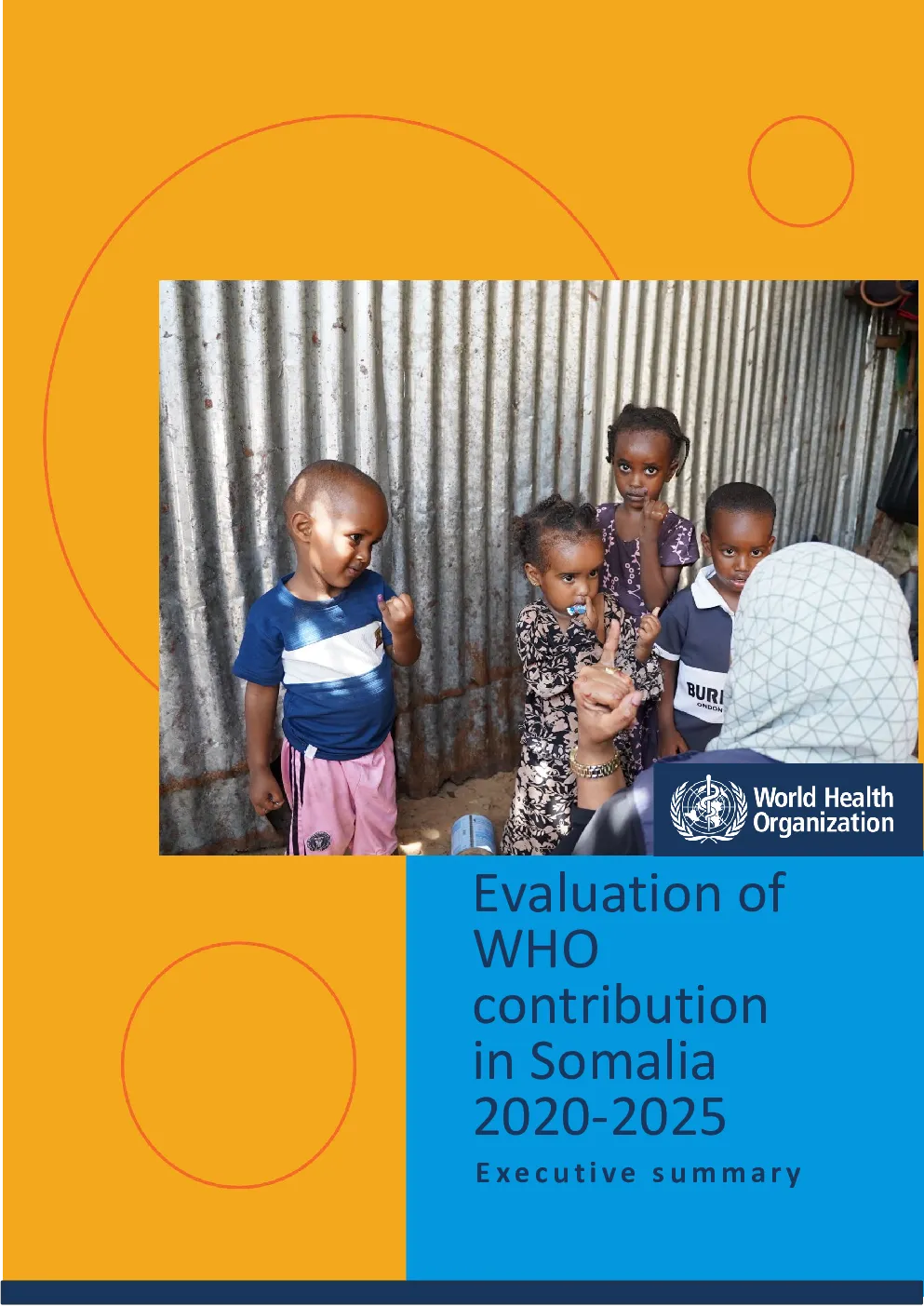
E x e c u t i v e s u m m a r y © World Health Organization 2025. All rights reserved.The content of this document is not final and the text may be subject to editorial revisions before publication. The content of this draft, however, will not undergo substantive changes. The documentmay not be reviewed, abstracted, quoted, reproduced, transmitted, distributed, translated or Cover photo:National Immunization Days campaign in Somalia @WHO / Abdirahman Caaylawe Executive summary I n t r o d u c t i o n This independent evaluation of the contribution of the World Health Organization (WHO) in Somaliaduring the period 2020–2025 assesses country-level results against national priorities, in alignmentwith WHO’s global and regional agendas and the United Nations Sustainable DevelopmentCooperation Framework (UNSDCF). It documents WHO’s key contributions, achievements andstrategic approaches to improving health outcomes in Somalia, and also identifies success factors,gaps and lessons learned. The evaluation is framed by the Thirteenth General Programme of Work ofWHO (GPW 13, 2019–2025) and the Fourteenth General Programme of Work of WHO (GPW 14, 1 . 1C o n t e x t Somalia is classified as both a least developed country and a fragile state. The country remains in aprotracted post-conflict recovery situation and faces chronic food insecurity and recurrent droughts and floods. Since 2007, it has been included in the World Bank list of fragile and conflict-affected countries since 2009(1), and the security situation remains precarious, with Mogadishu classified atlevel 5 under the United Nations (UN) security level system(2). In 2022, WHO declared a grade 3health emergency in Somalia – the highest emergency level recognized by the Organization(3).Decades of large-scale humanitarian assistance have sustained lives, but have also entrenchedparallel service delivery systems, leading to systemic post-delivery aid diversion and prompting high-level reforms(4). The population, estimated at 18.7 million in 2023, is exceptionally young (medianage 15.5 years), with 54% living below the poverty line(5). A compounding crisis of conflict and 1 . 2O b j e c t The object of the evaluation is WHO’s portfolio of work at country level in Somalia from 2020-2025.The WHO Country Cooperation Strategy (CCS) for Somalia (2021–2025) provides the strategic framework guiding WHO’s work in the country(8). It is aligned with the national health anddevelopment agenda, the UNSDCF (2021–2025), GPW 13 and, prospectively, GPW 14. Developedthrough extensive consultations with federal and state health authorities and partners, the CCSarticulates WHO’s mission to promote health, and serve the vulnerable, translating global prioritiesinto country-specific actions. It focuses on four strategic priorities: advancing universal healthcoverage (UHC) through strengthened primary health care; enhancing health security by improvingemergency preparedness and response; promoting healthier populations through multisectoral 1 . 3P u r p o s e ,o b j e c t i v e s a n d s c o p e The purpose of this evaluation is to support organizational learning and accountability for resultsamong external and internal WHO stakeholders. While the CCS results framework provided theprincipal reference, the evaluation also encompassed WHO’s response to emergent needs, includingthe COVID-19 pandemic, outbreaks and humanitarian health emergencies such as floods, droughtsand population displacements. The evaluation covered WHO interventions across all regions of 1 . 4M e t h o d s The evaluation employed a non-experimental design and blended mixed-method, utilization-focusedand theory-based methodological approaches to assess how and why WHO’s interventions inSomalia contributed, or failed to contribute, to expected health outcomes. A reconstructed theory ofchange (ToC) guided the exercise, providing a framework for examining underlying mechanisms,enabling conditions and results pathways. Data collection combined an extensive desk review andsecondary quantitative analysis with primary qualitative methods, including 78 in-depth interviews Nations (UN) agencies, donors, non-governmental organizations (NGOs), the private sector,academia and persons with disabilities. The assessment utilized the evaluation criteria of the Development Assistance Committee of the Organisation for Economic Co-operation andDevelopment, adapting them for the evaluation of humanitarian action(9).It covered relevance, 1 . 5F i n d i n g s Relevance Between 2020 and 2025, WHO’s strategies and interventions in Somalia were broadly aligned withnational and local health priorities, policies and needs. WHO played a central role in providingnormative guidance, technical support and thought leadership, acting as a key normative anchorthat connected global health objectives with Somali strategies. The Organization also demonstratednotable flexibility in responding to evolving humanitarian crises, such as