您的浏览器禁用了JavaScript(一种计算机语言,用以实现您与网页的交互),请解除该禁用,或者联系我们。 [联合国]:冲突及其冲击波:阿拉伯地区女性安全与经济参与的影响 - 发现报告

冲突及其冲击波:阿拉伯地区女性安全与经济参与的影响

2026-01-01 - 联合国 阿杰
报告封面

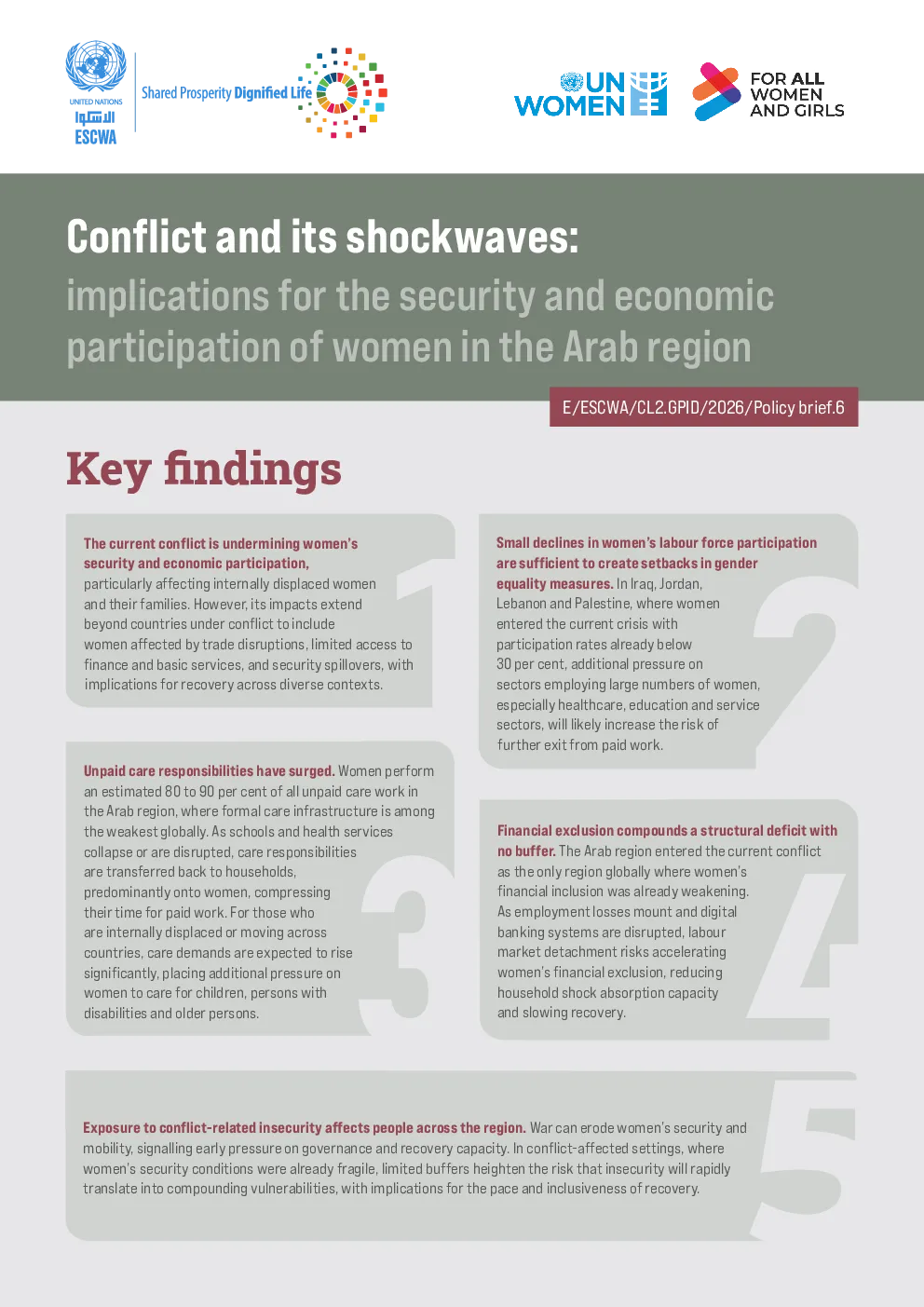
implications for the security and economicparticipation of women in the Arab region E/ESCWA/CL2.GPID/2026/Policy brief.6 Key findings Small declines in women’s labour force participationare sufficient to create setbacks in gender The current conflict is undermining women’ssecurity and economic participation,particularly affecting internally displaced women and their families. However, its impacts extendbeyond countries under conflict to includewomen affected by trade disruptions, limited access tofinance and basic services, and security spillovers, withimplications for recovery across diverse contexts. equality measures.In Iraq, Jordan,Lebanon and Palestine, where womenentered the current crisis withparticipation rates already below30percent, additional pressure onsectors employing large numbers of women,especially healthcare, education and servicesectors, will likely increase the risk offurther exit from paid work. Unpaid care responsibilities have surged.Women performan estimated 80 to 90percent of all unpaid care work inthe Arab region, where formal care infrastructure is amongthe weakest globally. As schools and health servicescollapse or are disrupted, care responsibilitiesare transferred back to households,predominantly onto women, compressingtheir time for paid work. For those whoare internally displaced or moving acrosscountries, care demands are expected to risesignificantly, placing additional pressure onwomen to care for children, persons withdisabilities and older persons. Financial exclusion compounds a structural deficit withno buffer.The Arab region entered the current conflict as the only region globally where women’sfinancial inclusion was already weakening.As employment losses mount and digitalbanking systems are disrupted, labourmarket detachment risks acceleratingwomen’s financial exclusion, reducinghousehold shock absorption capacityand slowing recovery. Exposure to conflict-related insecurity affects people across the region.War can erode women’s security andmobility, signalling early pressure on governance and recovery capacity. In conflict-affected settings, wherewomen’s security conditions were already fragile, limited buffers heighten the risk that insecurity will rapidlytranslate into compounding vulnerabilities, with implications for the pace and inclusiveness of recovery. Introduction The outbreak of the current war in February 2026has rapidly produced headline macroeconomicimpacts across the Arab region: trade andconnectivity disruptions, energy and financialmarket volatility, constrained investment, andmounting pressure on public services. Within thesebroader pressures, one dimension receives lesssystematic attention: the risk that gains in genderequality are eroding. Evidence from previous crisesconsistently shows that deterioration in women’seconomic status deepens household vulnerabilityand slows recovery. The present policy brief identifies early pressurepoints across four interconnected areas: securityconditions, labour market participation, unpaid careresponsibilities, and access to financial services.Using scenario-based simulations applied to theWomen, Peace and Security (WPS) Index, the GlobalGender Gap Index (GGGI), and the ESCWA FinancialInclusiveness Index (FII),1it models the risk of lossof gains under conflict-related stress. The analysisis exploratory rather than predictive: the indices areused as early warning signals of risk, not as real-time measures of current impact or predictors offuturetrajectories. 1. Women’s security at heightened risk Established through Security Council resolution 1325,the WPS agenda provides the normative frameworkfor women’s participation in peace and securitydecision-making, protection from gender-basedviolence, and gender-responsive recovery. Nine ArabStates have adopted national action plans (NAPs)and the League of Arab States has developed aRegional Action Plan, though implementation remainsuneven.2Notably, only 17percent of countries inNorthern Africa and the Middle East have disaster riskreduction (DRR) frameworks inclusive of women, thesecond lowest share globally after Europe and CentralAsia;3where they exist, women are categorizedas vulnerable populations rather than agents ofriskgovernance. advantage rests in part on the security dimension,including community safety, low proximity toconflict and limited political violence – gains that areparticularly vulnerable to the currentwar.4 Table 1 sets out the results of a scenario analysisapplying this assumption to the proximity-to-conflict indicator for five countries directly affectedby the war, simulated using the ESCWA IndicesSimulator for Policymakers in the Arab Region(ISPAR) tool.5The security subindex shows thesharpest losses: the United Arab Emirates falls from8th to 18th in the security ranking; Bahrain andKuwait see their rankings deteriorate to roughlytwice their previous levels; and Qatar drops by17places. At the overall index level, rank changesare