您的浏览器禁用了JavaScript(一种计算机语言,用以实现您与网页的交互),请解除该禁用,或者联系我们。 [印度品牌价值基金会]:印度的小型商用车:实现最后一英里的机动性和城市物流 - 发现报告

印度的小型商用车:实现最后一英里的机动性和城市物流

报告封面

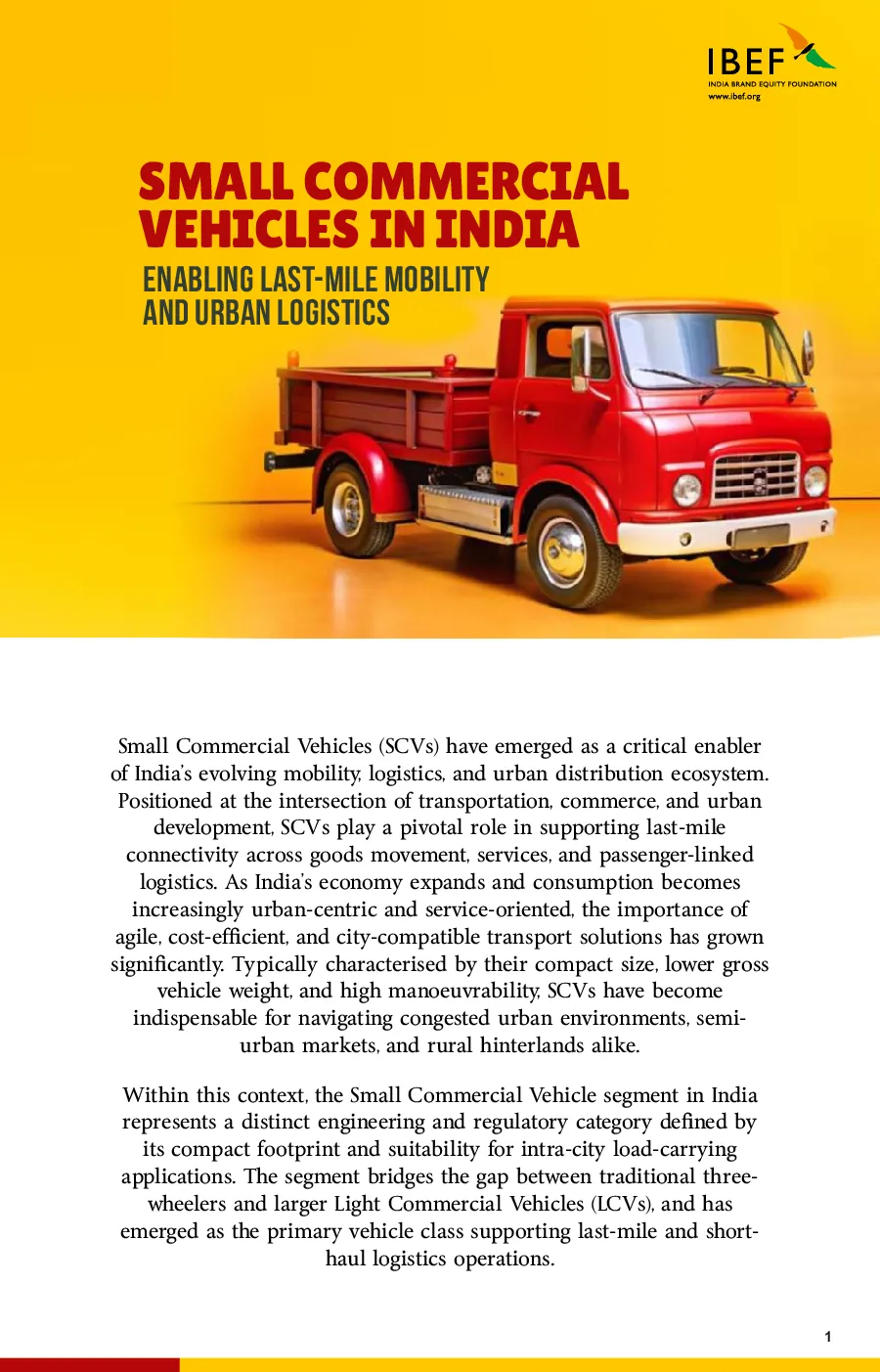
ENABLING LAST-MILE MOBILITYAND URBAN LOGISTICS Small Commercial Vehicles (SCVs) have emerged as a critical enablerof India’s evolving mobility, logistics, and urban distribution ecosystem.Positioned at the intersection of transportation, commerce, and urbandevelopment, SCVs play a pivotal role in supporting last-mileconnectivity across goods movement, services, and passenger-linked Within this context, the Small Commercial Vehicle segment in Indiarepresents a distinct engineering and regulatory category defined byits compact footprint and suitability for intra-city load-carryingapplications. The segment bridges the gap between traditional three- In the Indian regulatory and industrialframework, SCVs are generally classifiedas goods-carrying vehicles with a GrossVehicle Weight (GVW) of up to 3.5 tonnes(3,500kg).The GVW includes theunladen weight of the vehicle, maximumpermissible payload, fuel, and occupants.From a legal standpoint, these vehiclestypicallyfall under the N1 category,coveringmotor vehicles used for the needs,SCVs are optimised for high-frequency,short-distance deliveryoperations. Their operational flexibility,c o m p l i a n c ew i t h u r b a n t r a f fi cregulations, and relatively lower total costofownership have made them the Urbanisation, rising disposable incomes,andthe formalisation of trade havefurtherstrengthened the structuralrelevance of SCVs in India. Governmentinitiativesfocused on infrastructuredevelopment,urban mobility,andlogistics efficiency alongside regulatory Therapid growth of e-commerce,o r g a n i s e dr e t a i l ,f o o d d e l i v e r y,constructionsupport services,andMSME-ledtrade has reshaped demand TheIndian Small Commercial Vehicle(SCV)market has demonstrated strongstructural growth over the past five years,despiteshort-term volume moderationobserved in recent fiscal years. Accordingtothe data by Society of IndianAutomobileManufacturers(SIAM)domesticSCV sales expanded fromapproximately 0.37 million units in FY21 While aggregate SCV volumes moderatedin FY24 and FY25, the decline has beenrelatively contained at around 6% year-on-yearin each of these years.Thismoderationshould be viewed in thecontext of a high base effect following thesharp rebound in FY22–FY23, as well as Inaddition to full-year trends,nine-monthdata for FY26 indicates anencouragingrebound in SCV demandcomparedwith the year-ago period.According to industry figures, SCV salesin the first nine months of FY26 reachedapproximately369,793 units,up from345,194 units in the corresponding periodofFY25,representing an expansion inoverallvolumes after a period ofmoderation. Within this performance, the ratereduction for commercial vehiclesa nde a s i n g fi n a n c i n g c o s t s .T h i sperformancehighlights a return togrowthtrajectory for the SCV market, From a segmental perspective, SCVs in the2–3.5 tonne GVW category continue to around 65%, reflecting sustained demandforhigher payload vehicles capable ofserving organised logistics, constructionsupport, and urban distribution networks. among micro-entrepreneurs and MSME-leddelivery models.The relativeresilienceof the higher GVW sub-segmenthighlights an ongoing shift sales,underlining their position as thebackbone of the light commercial vehiclesegment.While Medium and HeavyC o m m e r c i a lVe h i c l e s( M H C V s )contributed3,73,819 units,reflectingdemandfrom infrastructure,mining,and long-haul logistics, the higher share InFY25,total domestic commercialvehicle (CV) sales in India stood at 9,56,671units, reaffirming the scale and diversity ofthecountry’s freight and mobilityecosystem. Within this landscape, SmallCommercial Vehicles (SCVs) comprisingmini-trucksbelow 2 tonnes GVW andpick-ups in the 2–3.5 tonne GVW range D E M A N DD R I V E R S S H A P I N G The Quick Commerce Revolution Therapid rise of quick commerce hasemergedas one of the most powerfuldemand catalysts for the SCV segment.India’s “instant gratification” consumptionmodel driven by platforms offering 10–20minutedeliveries has created logisticsrequirementsthat are fundamentallydifferentfrom traditional retail or e-commerce.The proliferation of darkstores and micro-fulfilment centres acrossurban neighbourhoods has increased the R a p i dU r b a n i z a t i o n a n d C i t y India’s accelerating urbanisation and thedensificationof city centres havefundamentallyreshaped last-milemobilityrequirements,significantlys t r e n g t he n i n gde m a nd f o r S m a l lCommercialVehicles.As cities expandverticallyrather than horizontally,roadinfrastructurewithin urban cores hasbecomeincreasingly constrained,withnarrow lanes, mixed traffic, and limitedloadingzones.SCVs,owing to theirc o m p a c td i m e n s i o n s ,s u p e r i o rmanoeuvrability, and lower turning radius, MSMEExpansion and First-Time SCVs continue to serve as a cornerstone ofentrepreneurshipand self-employment C o m pleme nt i ngt h i s ,t he Ve h i c leScrappagePolicy is encouraging thereplacement of ageing