您的浏览器禁用了JavaScript(一种计算机语言,用以实现您与网页的交互),请解除该禁用,或者联系我们。 [世界银行]:新物流绩效指标2.0(LPI 2.0):方法论与用户手册 - 发现报告

新物流绩效指标2.0(LPI 2.0):方法论与用户手册

交通运输 2026-04-30 世界银行 Z.zy
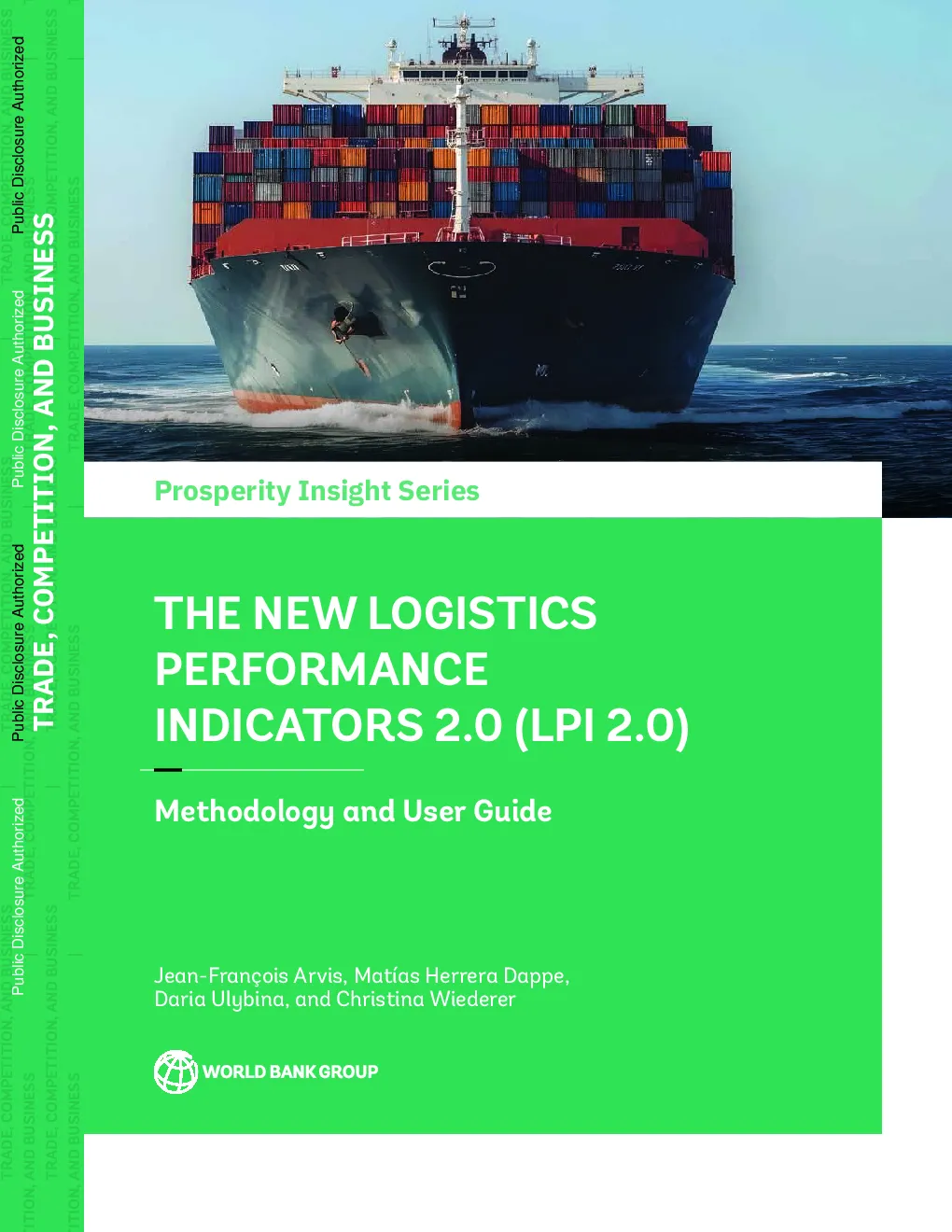
报告封面

THE NEW LOGISTICSPERFORMANCE Methodology and User Guide Jean-François Arvis, Matías Herrera Dappe,Daria Ulybina, and Christina WiedererPublic Disclosure Authorized TRADE, COMPETITION, AND BUSINESSTHE NEW LOGISTICSPERFORMANCE Methodology and User Guide Jean-François Arvis, Matías Herrera Dappe,Daria Ulybina, and Christina Wiederer © 2026 The World Bank1818 H Street NW, Washington DC 20433 Some rights reserved This work is a product of The World Bank. The findings, interpretations, and conclusions expressed inthis work do not necessarily reflect the views of the Executive Directors of The World Bank or the gov- The World Bank does not guarantee the accuracy, completeness, or currency of the data included in thiswork and does not assume responsibility for any errors, omissions, or discrepancies in the information,or liability with respect to the use of or failure to use the information, methods, processes, or conclusions Nothing herein shall constitute or be construed or considered to be a limitation upon or waiver of the Rights and Permissions The material in this work is subject to copyright. Because The World Bank encourages dissemination ofits knowledge, this work may be reproduced, in whole or in part, for noncommercial purposes as long as Attribution—Please cite the work as follows: Arvis, Jean-François, Matías Herrera Dappe, Daria Ulybina,and Christina Wiederer. 2026. The New Logistics Performance Indicators 2.0 (LPI 2.0): Methodology and Any queries on rights and licenses, including subsidiary rights, should be addressed to World Bank Pub-lications, The World Bank, 1818 H Street NW, Washington, DC 20433, USA; fax: 202-522-2625; e-mail: Photos: Cover, Aung Thu Yein Tun/Vecteezy.com; page vi, Roman Bulatov/Vecteezy.com; page 3, Muham-mad Nur/Vecteezy.com; page 11, Siraphol Siricharattakul/Vecteezy.com; page 14, Woranuch Athiwata- A reproducibility package is available for thisbook in the Reproducible Research Repository athttps://reproducibility.worldbank.org/catalog/514 Contents MaritimeAviationPostal Figures 1Supply chain phases in a maritime container voyage2Milestones in the air cargo supply chain3The sequence of standardized postal events4The relationship between turnaround time and import dwell time5Slicing a container voyage into dwell time and lead timeobservations6Elements of ship turnaround time16 Tables 1The six core indicators of the LPI 2.02Supplementary indicators of the LPI 2.03Data sources, coverage, and nature of the LPI 2.0 Acknowledgements This report was prepared by the World Bank’s Trade Policy and Facilitation Unit inthe Trade, Competition, and Business Department, under the guidance of MonaHaddad (former Global Director), Denis Medvedev (Global Director), Aart Kraay(Chief Economist), and Sébastien Dessus (Practice Manager). The project leaders The Logistics Performance Indicators 2.0 (LPI 2.0) benefited from funding fromthe Umbrella Facility for Trade 2.0, a World Bank–administered multidonor trustfund that supports the World Bank’s work on trade through funding that, among Abbreviations Abstract This report presents the methodology for the Logistics Performance Indicators2.0 (LPI 2.0), a data-driven framework developed by the World Bank to mea-sure countries’ trade logistics performance, as well as a user guide. The LPI2.0 replace the original perception-based Logistics Performance Index usedthrough 2023 with objective indicators derived from large-scale shipment-andvessel-level tracking data. The framework measures logistics performance alongtwo core dimensions—connectivity and time— across maritime, aviation, and Thisreport presents the methodology for theLogistics Performance Indicators 2.0 (LPI 2.0), anew framework developed by the World Bank tomeasure countries’ trade logistics performanceusing objective, large-scale supply chain trackingdata. The LPI 2.0 replace the perception-based perceptions toward observed logistics outcomes,the LPI 2.0 provide a more stable, comparable,and data-driven basis for assessing logistics per- The LPI 2.0 measure logistics performance alongtwocore dimensions—connectivity and time—which together capture key aspects of efficiency networks through maritime, aviation, and postalservices without reliance on intermediaries. Timeindicators measure the speed of logistics pro-cesses at critical nodes such as seaports, airports,and postal exchange offices, as well as the disper- Container-level indicators on dwell time, lead time,transshipment, and supply chain initiation and ter-mination are derived from tracking data providedby a major global shipping line. Port turnaroundtime indicators are based on vessel movementdata derived from Automatic Identification Systemsignals. Aviation indicators are constructed using The framework comprises six core indicators, cov-ering connectivity and time for each of the threelogistics modes, complemented by supplementaryindicators that provide greater granularity. Sup-plementary indic