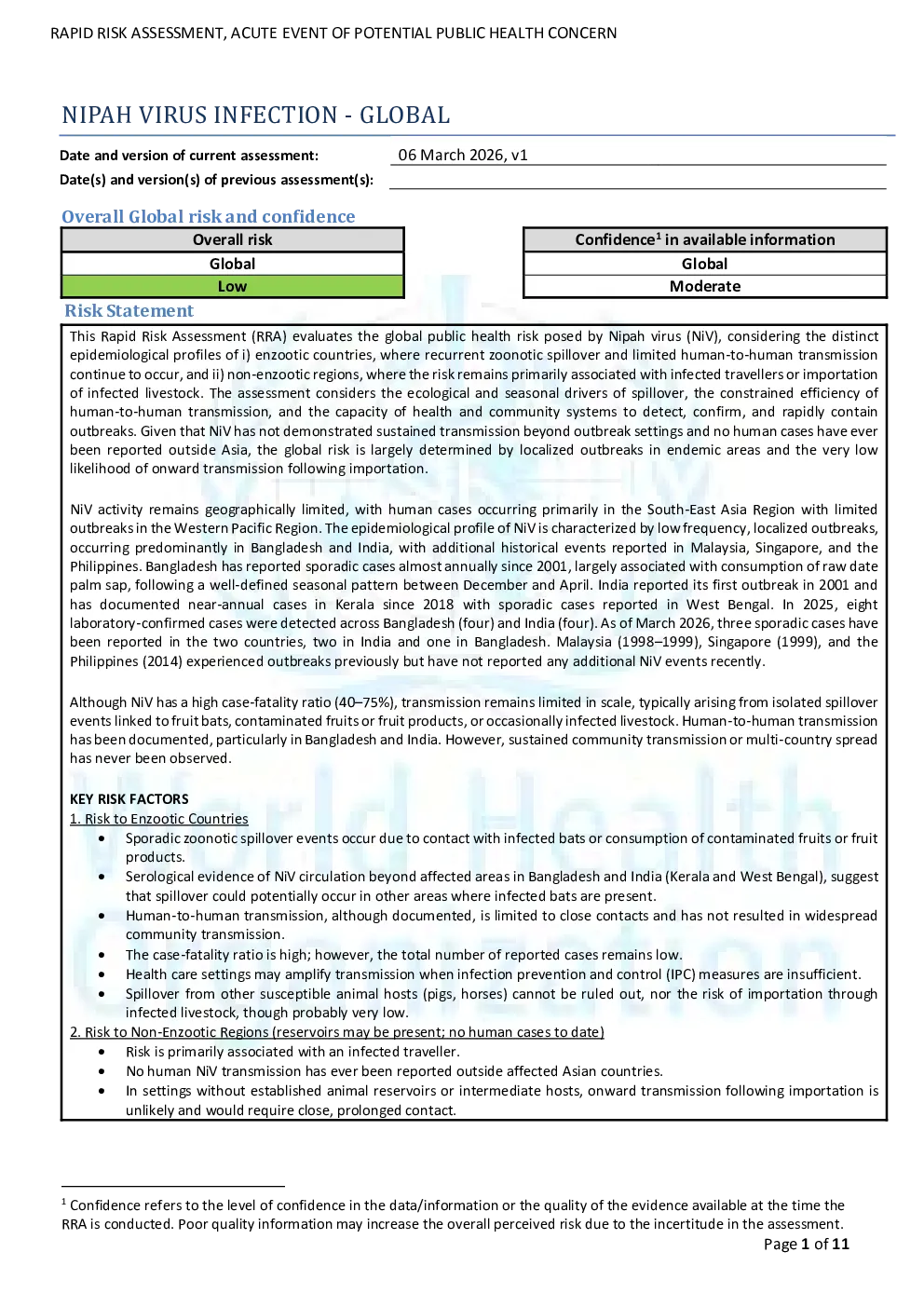
06March 2026,v1 Dateandversionof current assessment:Date(s)and version(s)of previous assessment(s): Risk Statement This Rapid Risk Assessment (RRA) evaluates the global public health risk posed by Nipah virus (NiV),consideringthe distinctepidemiological profiles of i) enzootic countries, where recurrent zoonotic spillover and limited human‑to‑human transmissioncontinue to occur, and ii) non‑enzootic regions, where the risk remains primarily associated with infected travellers or importationof infected livestock. The assessment considers the ecological and seasonal drivers of spillover, the constrained efficiency ofhuman‑to‑human transmission, and the capacity of health and community systems to detect, confirm, and rapidly contain NiV activity remains geographically limited, with human cases occurring primarily in the South-East Asia Region with limitedoutbreaks in the Western Pacific Region. The epidemiological profile of NiV is characterized by low frequency, localized outbreaks,occurring predominantly in Bangladesh and India, with additional historical events reported in Malaysia, Singapore, and thePhilippines. Bangladesh has reported sporadic cases almost annually since 2001, largely associated with consumption of raw datepalm sap, following a well‑defined seasonal pattern between December and April. India reported its first outbreak in 2001 andhas documented near-annual cases in Kerala since 2018 with sporadic cases reported in West Bengal. In 2025, eight Although NiV has a high case‑fatality ratio (40–75%), transmission remains limited in scale, typically arising from isolated spilloverevents linked to fruit bats, contaminated fruits or fruit products, or occasionally infected livestock. Human‑to‑human transmissionhas been documented, particularly in Bangladesh and India. However, sustained community transmission or multi‑country spread KEY RISK FACTORS1. Risk to Enzootic Countries •Sporadic zoonotic spillover events occur due to contact with infected bats or consumption of contaminated fruits or fruitproducts.•Serological evidence of NiV circulation beyond affected areas in Bangladesh and India (Kerala and West Bengal), suggestthat spillover could potentially occur in other areas where infected bats are present.•Human‑to‑human transmission, although documented, is limited to close contacts and has not resulted in widespreadcommunity transmission. 2. Risk to Non‑Enzootic Regions (reservoirs may be present; no human cases to date)•Risk is primarily associated with an infected traveller. •No human NiV transmission has ever been reported outside affected Asian countries.•In settings without established animal reservoirs or intermediate hosts, onward transmission following importation is RAPID RISK ASSESSMENT, ACUTE EVENT OF POTENTIAL PUBLIC HEALTH CONCERN •Historical spread via movement of infected animals (e.g., pigs exported from Malaysia to Singapore in 1999)demonstrates that animal trade–related spillover is possible, however current evidence suggests that the risk underpresent animal‑health and trade practices is likely very low. 3. Risk to Countries Without Known Bat Reservoirs (reservoirs absent; no human cases) •Importation via travellers (and, exceptionally, livestock) may occur and while secondary transmission is possible it isunlikely, given the absence of established animal reservoirs and the need for close contact for human‑to‑human spread. •Travellers to affected areas face a very low but non‑zero risk, particularly if they have direct exposure to fruit bats,consume contaminated food products, or come into contact with other infected animals, including pigs or horses. 5. Risk Determinants•Ecological presence ofPteropodidaebats in enzootic countries. •Presence of potential intermediary hosts that could transmit to humans (e.g., pigs, horses).•Cultural and dietary practices (e.g., consumption of raw date palm sap).•Exposure in health care settings with inadequate IPC measures. 6. Response Capacity•Countries with recurring outbreaks have strengthened their surveillance systems, diagnostics, and clinical management capacity.•No licensed vaccines or specific antiviral treatments are currently available; however, several vaccine and therapeuticscandidates are in development, supported by CEPI and WHO‑aligned research priorities. 7. Confidence in Available InformationOverall confidence is moderate, due to: •Under‑detection of sporadic spillover events in rural areas. •Ongoing uncertainty about the full geographic distribution of bat reservoirs and potential intermediate hosts. Based on current evidence, characterized by rare outbreaks, limited human‑to‑human transmission, no sustained globalspread, and improving response capacity, the overall global public health risk posed by NiV is assessed as Low with a Moderate This rapid risk assessment will be updated as new epidemiological, clinical, or virological information becomes available. RAPID RISK ASSESSMENT, ACUTE EVENT OF P