您的浏览器禁用了JavaScript(一种计算机语言,用以实现您与网页的交互),请解除该禁用,或者联系我们。 [亚开行]:2026年亚太可持续发展目标伙伴关系报告——包容性城市未来:从不平等到机遇(英)2026 - 发现报告

2026年亚太可持续发展目标伙伴关系报告——包容性城市未来:从不平等到机遇(英)2026

信息技术 2026-03-02 亚开行 张东旭
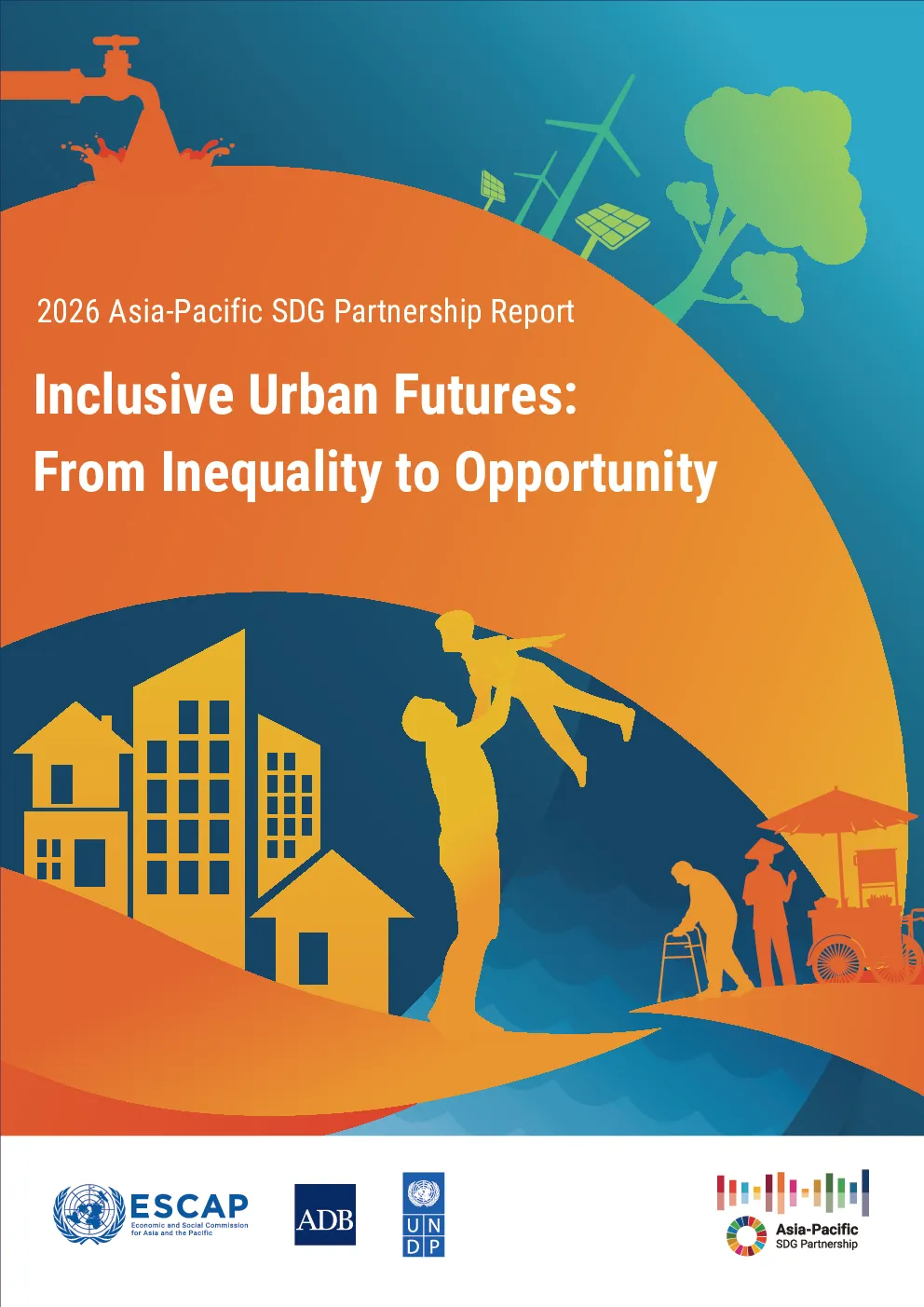
报告封面

Inclusive Urban Futures:From Inequality to Opportunity The Economic and Social Commission for Asia and the Pacific (ESCAP)is the most inclusiveintergovernmental platform in the Asia-Pacific region. The Commission promotes cooperationamong its 53 member States and 9 associate members in pursuit of solutions to sustainabledevelopment challenges. ESCAP is one of the five regional commissions of the United Nations. The ESCAP secretariat supports inclusive, resilient and sustainable development in the regionby generating action-oriented knowledge, and by providing technical assistance and capacitybuilding services in support of national development objectives, regional agreements and theimplementation of the 2030 Agenda for Sustainable Development. The Asian Development Bank (ADB)is a leading multilateral development bank supportinginclusive, resilient, and sustainable growth across Asia and the Pacific. Working with its membersand partners to solve complex challenges together, ADB harnesses innovative financial tools andstrategic partnerships to transform lives, build quality infrastructure, and safeguard our planet.Founded in 1966, ADB is owned by 69 members—50 from the region. The United Nations Development Programme (UNDP)is the leading United Nations organizationfighting to end the injustice of poverty, inequality, and climate change. Working with our broadnetwork of experts and partners in 170 countries, we help nations to build integrated, lastingsolutions for people and planet. Inclusive Urban Futures: From Inequality to Opportunity © 2026 United Nations, Asian Development Bank, United Nations Development Programme Printed in Thailand This work is co-published by the United Nations Economic and Social Commission for Asia andthe Pacific (ESCAP), Asian Development Bank and United Nations Development Programme. This work is available open access by complying with the Creative Commons license createdfor inter-governmental organizations, available at: https://creativecommons.org/licenses/by-nc-nd/3.0/igo/. Publishers must delete the original emblems from their edition and create a newcover design. Photocopies and reproductions of excerpts are allowed with proper credits. For queries related to the open access licence or queries and/or requests not covered by the openaccess licence, please contact the United Nations at permissions@un.org. ISBN 978-92-9277-674-9 (print); 978-92-9277-675-6 (PDF) Publication Stock No. SPR260040-2 DOI:http://dx.doi.org/10.22617/SPR260040-2 Cataloguing-In-Publication Data United Nations, Asian Development Bank, and United Nations Development Programme. InclusiveUrban Futures: From Inequality to Opportunity Bangkok, Thailand: United Nations, 2026 1.Urbaninequality 2.Affordable housing and basic services 3.Informal employment 4.Environmental liveability 5. Climate Change 6. Sustainable Development Goals 9. Asia and thePacific 10. United Nations, Asian Development Bank, and United Nations Development Programme The views expressed in this publication are those of the authors and do not necessarily reflectthe views and policies of ADB or its Board of Governors or the Secretariat of the United Nations(ESCAP and UNDP) or the governments they represent. The United Nations (ESCAP and UNDP)and ADB do not guarantee the accuracy of the data included in this publication and accept noresponsibility for any consequence of their use. Any reference to a commercial entity or productin this publication does not imply endorsement. The designation of or reference to a particular territory or geographic area in this document donot imply the expression of any opinion whatsoever on the part of the Secretariat of the UnitedNations, ADB or its Board of Governors, or the governments they represent, concerning thelegal or other status of any country, territory, city or area, or of its authorities, or concerning thedelimitation of its frontiers or boundaries. This publication follows the United Nations practicein references to countries. Where there are space constraints, some country names have beenabbreviated. ADB recognizes “China” as the People’s Republic of China; “Hong Kong” as HongKong, China; “Kyrgyzstan” as the Kyrgyz Republic; “Vietnam” as Viet Nam; “Bombay” as Mumbai;and “Hanoi” as Ha Noi. For Afghanistan and Myanmar, the data presented generally depict the socio-economic situationbefore August 2021 and February 2021, respectively. The profound changes in the two countriesin 2021 have therefore not been reflected in the data. All queries other than requests for translations and other uses not covered by the CC BY 3.0 IGOlicense can be addressed to any of the co-publishing organizations as follows: Chief Section on Sustainable Development and Countries in Special SituationsOffice of the Executive SecretaryUnited Nations Economic and Social Commission for Asia and the Pacific15th Floor, United Nations Building, Rajadamnern Nok Avenue, Bangkok 10200, Thailandescap-css@un.org Dir