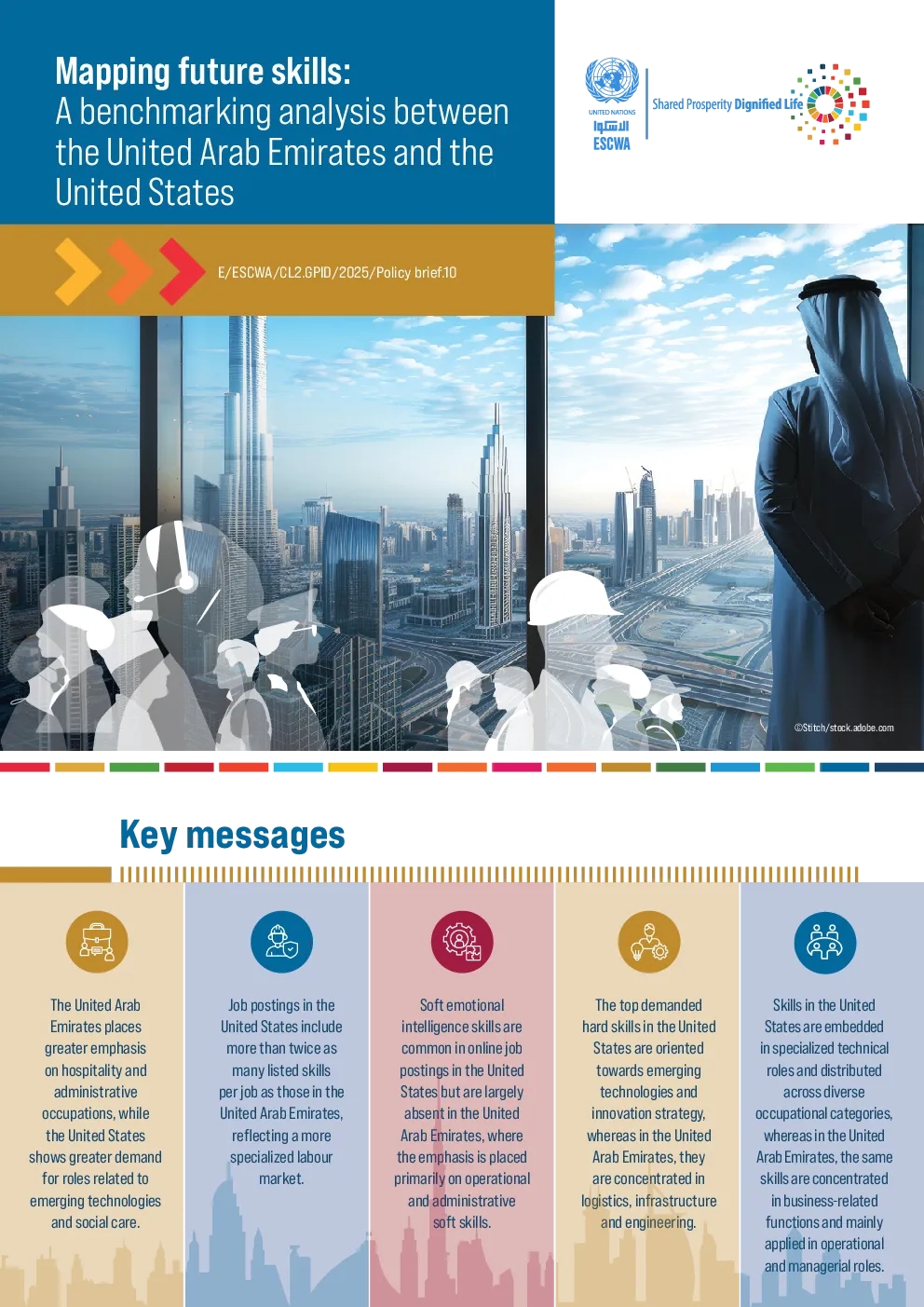
The United Arab Emirates (UAE) and the United States (US) exhibit distinct skill demand patterns, reflecting their different economic structures and priorities. The UAE emphasizes hospitality, administrative, logistics, and infrastructure-related roles, driven by its service-oriented economy, tourism, and large-scale development projects. In contrast, the US shows greater demand for emerging technologies, digital innovation, and social care roles, indicating a more advanced and innovation-driven labor market.
Key differences include:
- Soft skills: The US prioritizes emotional intelligence and higher-order cognitive skills (e.g., empathy, critical thinking), while the UAE focuses on operational and administrative competencies (e.g., budgeting, cleanliness).
- Hard skills: The US demands advanced digital and technological skills (e.g., programming, AI, healthcare), whereas the UAE emphasizes business, marketing, and engineering skills.
- Skill diversity: Job postings in the US list twice as many skills per job (18.2 vs. 9.4), reflecting a more specialized labor market.
Using the Jaccard Similarity Score, the analysis finds soft skills are highly transferable (score: 0.946), while hard skills show broader divergence (score: 0.627). Shared skills (e.g., marketing, data analysis) are embedded in different occupational roles—technical roles in the US vs. operational roles in the UAE.
The UAE's labor market is transitioning toward a knowledge-based economy, with initiatives like the UAE Strategy for Artificial Intelligence 2031. However, gaps remain in digital innovation and psychosocial care, areas where the US leads. The findings suggest tailored upskilling efforts are needed to align the UAE's labor market with global trends.