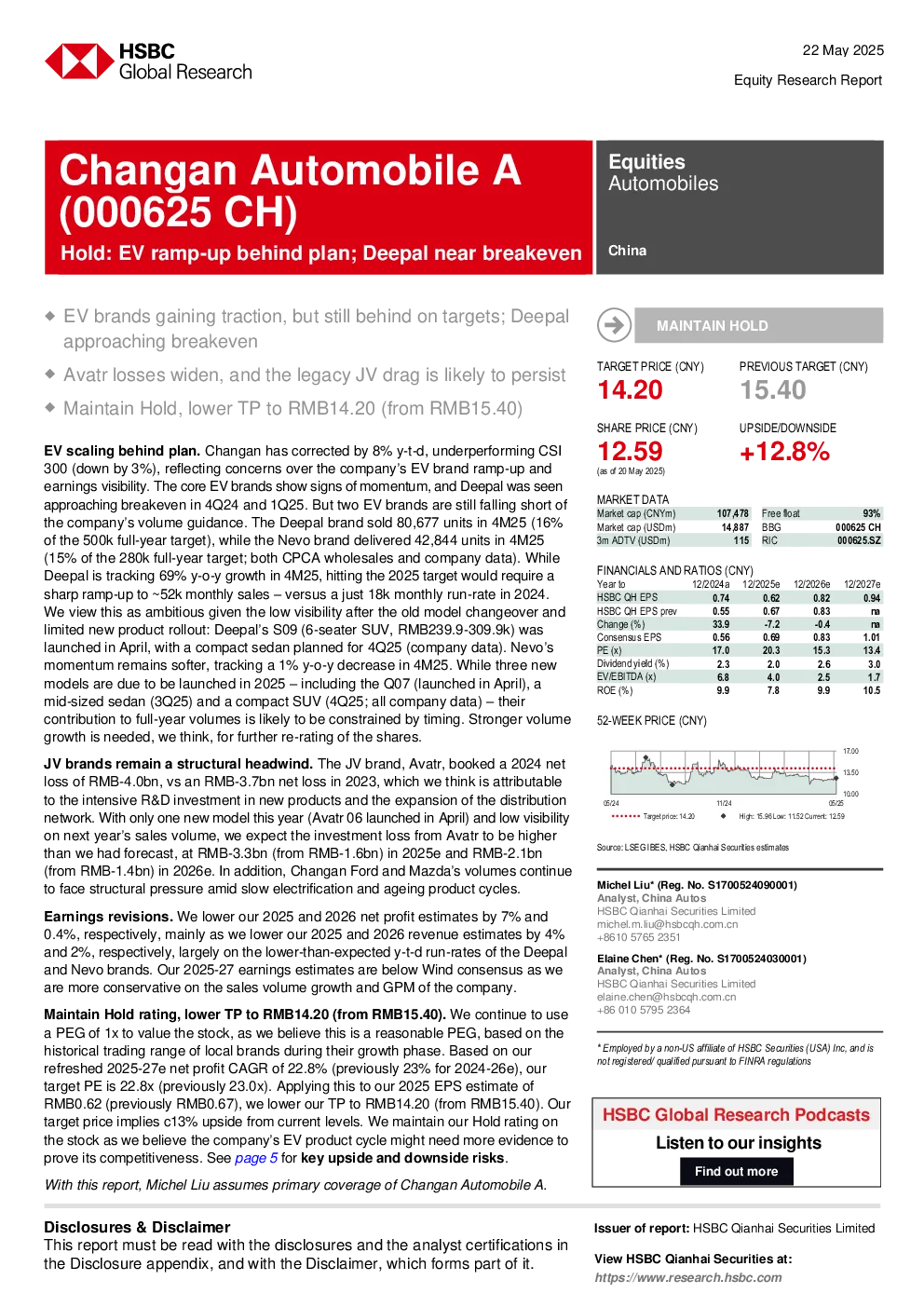
Changan Automobile's EV scaling is behind plan, with Deepal approaching breakeven and two brands falling short of volume guidance. Deepal sold 80,677 units in 4M25 (16% of the 500k full-year target), while Nevo delivered 42,844 units in 4M25 (15% of the 280k full-year target). Deepal's 69% y-o-y growth in 4M25 requires a sharp ramp-up to ~52k monthly sales to hit the 2025 target, which is ambitious given the low visibility after the old model changeover and limited new product rollout. Nevo's momentum remains softer, tracking a 1% y-o-y decrease in 4M25. While three new models are due to be launched in 2025, their contribution to full-year volumes is likely to be constrained by timing.
JV brands remain a structural headwind. The JV brand, Avatar, booked a 2024 net loss of RMB-4.0bn, vs an RMB-3.7bn net loss in 2023, attributable to intensive R&D investment and distribution network expansion. With only one new model this year and low visibility on next year’s sales volume, the investment loss from Avatar is expected to be higher than forecast, at RMB-3.3bn in 2025e and RMB-2.1bn in 2026e. Additionally, Changan Ford and Mazda’s volumes continue to face structural pressure amid slow electrification and ageing product cycles.
Earnings revisions. The 2025 and 2026 net profit estimates are lowered by 7% and 0.4%, respectively, mainly due to lower-than-expected y-t-d run-rates of the Deepal and Nevo brands, lower 2025 and 2026 revenue estimates, and worse economies of scale. This is partly offset by higher 2025-26 investment income from associates. The 2025-27e earnings CAGR is estimated at 22.8%, below Wind consensus, reflecting conservative views on sales volume growth and GPM.
Maintain Hold, lower TP to RMB14.20. The stock is valued using a PEG of 1x, based on the historical trading range of local brands during their growth phase. The target PE is 22.8x, applying to the 2025 EPS estimate of RMB0.62, lowering the TP to RMB14.20. The target price implies c13% upside from current levels. The Hold rating is maintained as the company’s EV product cycle might need more evidence to prove its competitiveness.
Key upside risks: better-than-expected volume ramp-up of key EV new models, higher-than-expected monthly volume growth in ICE brands, higher-than-expected volume growth in joint venture brands, higher-than-expected sales volume growth in the overseas market, and better-than-expected autonomous driving customer traction.
Key downside risks: weaker-than-expected volume ramp-up of EV new brands, weaker-than-expected volume growth in joint venture brands, weaker-than-expected pricing, and sales volume and earnings decrease in the Eastern European market.