您的浏览器禁用了JavaScript(一种计算机语言,用以实现您与网页的交互),请解除该禁用,或者联系我们。 [世界银行]:吉尔吉斯斯坦怎么说?家庭福祉的趋势和观点(英)2026 - 发现报告

吉尔吉斯斯坦怎么说?家庭福祉的趋势和观点(英)2026

文化传媒 2026-06-23 世界银行 陈宫泽凡
报告封面

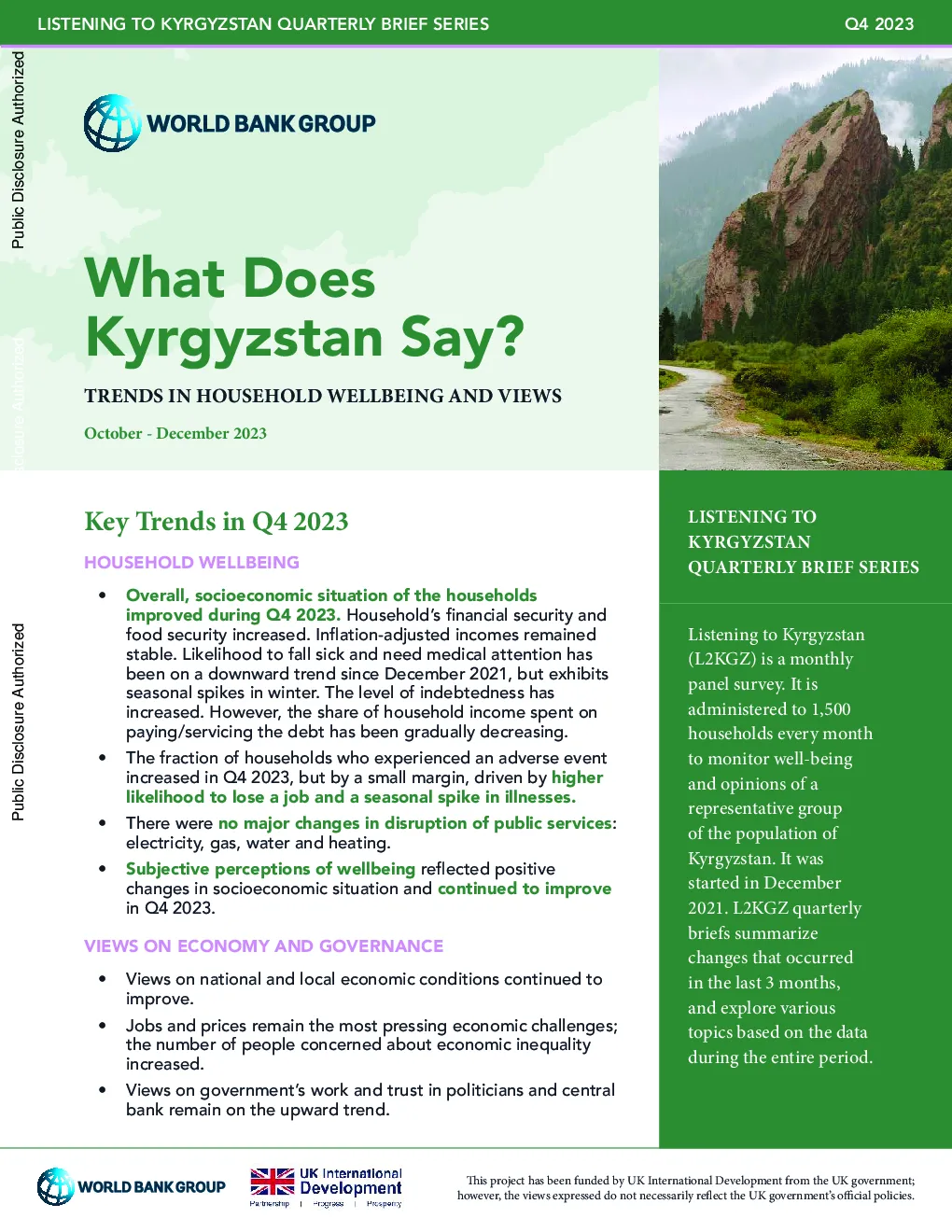
What DoesKyrgyzstan Say?Public Disclosure Authorized TRENDS IN HOUSEHOLD WELLBEING AND VIEWS October - December 2023 LISTENING TOKYRGYZSTAN Key Trends in Q4 2023Public Disclosure Authorized HOUSEHOLD WELLBEING •Overall, socioeconomic situation of the householdsimproved during Q4 2023.Household’s financial security andfood security increased. Inflation-adjusted incomes remainedstable. Likelihood to fall sick and need medical attention hasbeen on a downward trend since December 2021, but exhibits Listening to Kyrgyzstan(L2KGZ) is a monthlypanel survey. It isadministered to 1,500households every monthto monitor well-beingand opinions of arepresentative groupof the population ofKyrgyzstan. It wasstarted in December2021. L2KGZ quarterly •The fraction of households who experienced an adverse eventincreased in Q4 2023, but by a small margin, driven byhigherlikelihood to lose a job and a seasonal spike in illnesses. •There wereno major changes in disruption of public services:electricity, gas, water and heating.•Subjective perceptions of wellbeingreflected positivechanges in socioeconomic situation andcontinued to improvein Q4 2023.Public Disclosure Authorized VIEWS ON ECONOMY AND GOVERNANCE •Views on national and local economic conditions continued toimprove. Changes in Household Wellbeing The L2KGZ briefs focus on several dimensions of household wellbeing: (1) socio-economic outcomes,(2) households’ perceptions of their financial security and poverty relative to others, (3) exposure to SOCIO-ECONOMIC OUTCOMES Figure 1. Changes in Household Income by Source Inflation adjusted incomesremained stable over the lasttwo years. There is a downwardtrend in remittances: inOctober-December 2023remittances accounted forabout 6% of the householdincome, below the all-timeaverage of 10%. Wage incomehas been the main source of Figure 2. Households’ Financial Security Financial security has beenimproving since the inceptionof the survey. The fractionof households who are ableto buy food, pay for utilities,and did not need to reducefood consumption to pay forother needs has continuedto increase in October-December 2023. The fractionof households with savings The fraction of householdsexperiencing each of the 8dimensions of food insecuritycaptured by the surveydecreased between October The likelihood to become sickand need a doctor has beenreducing since the inceptionof the survey in December2021. However, there areseasonal spikes: likelihood tofall sick increased in November- 75% or moreThe fraction of householdsin debt has been increasing.This may be a negativedevelopment, reflectinghouseholds’ inability to coverconsumption needs withoutborrowing. Alternatively, it maybe a consequence of increasedlevel of financial literacy and EXPOSURE TO SHOCKS The L2KGZ survey captures two types of shocks: (1) major life events, ranging from death of a householdmember to loss of a job, to return from migration, (2) disruptions in basic utilities: electricity, water, Kyrgyz families have beenexperiencing decreasingnumber of adverse eventssince the beginning of theL2KGZ survey. This downwardtrend is largely driven by adecreasing likelihood to losea job. However, in the lastquarter of 2023, the fraction offamilies which experienced a Figure 7. Disruptions in Service Provision Note: All HHs participating in the survey have water supply. During Q4 of 2023 Kyrgyz households experienced lower disruptions in water and central gas, compared to theprevious quarter. Electricity disruptions increased in December, however the average duration of blackouts decreased.Only a small fraction of households experienced heating disruption, which lasted on average 2.9 days in October, 6.4days in November and 5.4 days in December. SUBJECTIVE PERCEPTIONS OF WELLBEING The L2KGZ quarterly briefs capture subjective wellbeing with three indicators:perceptions ofwellbeing, perception of socio-economic status and mental health self-assessment. All these The indicator of subjective well-being is based on four questions. The respondents are asked to reporthow financial well-being of their households compare to 30 days ago, and if it is likely to improve or not The indicator of socioeconomic status is based on 4 questions. Respondents are asked to place theirhousehold on a 10-step ladder, where at the bottom are the poorest 10% and at the top the richest 10%at 3 different points in time: now, 5 years ago and 5 years later. The fourth question asks respondents Mental health indicator is based on subjective assessment of mental health from poor to excellent, andanswers to the questions how frequently mental health interferes with work, with personal relationships, BOX 1. WHAT IS A Z-SCORE? TECHNICAL NOTE To understand and analyze concepts which are difficult to quantify, such as well-being or trust,researchers ask multitude of questions, all of which are aimed to capture the same underlyingconcept. Z-scores is one of the methods used to conden