您的浏览器禁用了JavaScript(一种计算机语言,用以实现您与网页的交互),请解除该禁用,或者联系我们。 [亚开行]:中东冲突对亚太地区的影响:最新分析(英) - 发现报告

中东冲突对亚太地区的影响:最新分析(英)

文化传媒 2026-04-01 亚开行 罗鑫涛Robin
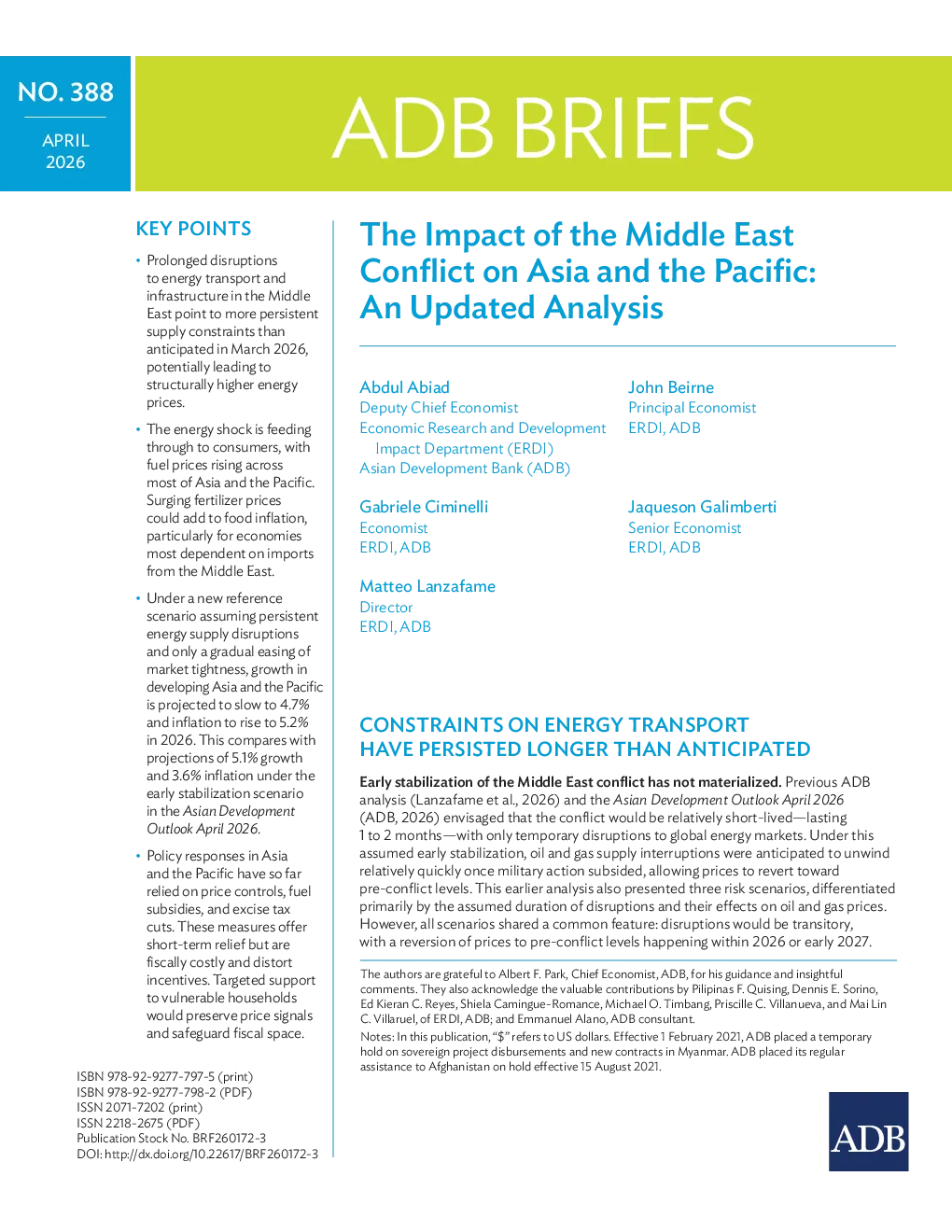
报告封面

KEY POINTS The Impact of the Middle EastConflict on Asia and the Pacific:An Updated Analysis •Prolonged disruptionsto energy transport andinfrastructure in the MiddleEast point to more persistentsupply constraints thananticipated in March 2026,potentially leading tostructurally higher energyprices. Abdul AbiadDeputy Chief EconomistEconomic Research and DevelopmentImpact Department (ERDI)Asian Development Bank (ADB) John BeirnePrincipal EconomistERDI, ADB •The energy shock is feedingthrough to consumers, withfuel prices rising acrossmost of Asia and the Pacific.Surging fertilizer pricescould add to food inflation,particularly for economiesmost dependent on importsfrom the Middle East. Gabriele CiminelliEconomistERDI, ADB Jaqueson GalimbertiSenior EconomistERDI, ADB Matteo LanzafameDirectorERDI, ADB •Under a new referencescenario assuming persistentenergy supply disruptionsand only a gradual easing ofmarket tightness, growth indeveloping Asia and the Pacificis projected to slow to 4.7%and inflation to rise to 5.2%in 2026. This compares withprojections of 5.1% growthand 3.6% inflation under theearly stabilization scenarioin theAsian DevelopmentOutlook April 2026. CONSTRAINTS ON ENERGY TRANSPORTHAVE PERSISTED LONGER THAN ANTICIPATED Early stabilization of the Middle East conflict has not materialized.Previous ADBanalysis (Lanzafame et al., 2026) and theAsian Development Outlook April 2026(ADB, 2026) envisaged that the conflict would be relatively short-lived—lasting1 to 2 months—with only temporary disruptions to global energy markets. Under thisassumed early stabilization, oil and gas supply interruptions were anticipated to unwindrelatively quickly once military action subsided, allowing prices to revert towardpre-conflict levels. This earlier analysis also presented three risk scenarios, differentiatedprimarily by the assumed duration of disruptions and their effects on oil and gas prices.However, all scenarios shared a common feature: disruptions would be transitory,with a reversion of prices to pre-conflict levels happening within 2026 or early 2027. •Policy responses in Asiaand the Pacific have so farrelied on price controls, fuelsubsidies, and excise taxcuts. These measures offershort-term relief but arefiscally costly and distortincentives. Targeted supportto vulnerable householdswould preserve price signalsand safeguard fiscal space. The authors are grateful to Albert F. Park, Chief Economist, ADB, for his guidance and insightfulcomments. They also acknowledge the valuable contributions by Pilipinas F. Quising, Dennis E. Sorino,Ed Kieran C. Reyes, Shiela Camingue-Romance, Michael O. Timbang, Priscille C. Villanueva, and Mai LinC. Villaruel, of ERDI, ADB; and Emmanuel Alano, ADB consultant. Notes: In this publication, “$” refers to US dollars. Effective 1 February 2021, ADB placed a temporaryhold on sovereign project disbursements and new contracts in Myanmar. ADB placed its regularassistance to Afghanistan on hold effective 15 August 2021. ISBN 978-92-9277-797-5 (print)ISBN 978-92-9277-798-2 (PDF)ISSN 2071-7202 (print)ISSN 2218-2675 (PDF)Publication Stock No. BRF260172-3DOI:http://dx.doi.org/10.22617/BRF260172-3 Notes: Daily count of visible commercial ships based on Automatic Identification System (AIS) signals observed until 22 April 2026. Data prior to 26 Februaryare based on Bloomberg’s automated Hormuz Tracker, which covers vessel activity within the Persian Gulf only. From 26 February onward, the series uses datafrom Prem and Lee (2026), which incorporate adjustments to account for “dark mode” transits. Because vessels can move without transmitting their locationuntil they are well away from Hormuz, automated positioning signals were compiled over a large area covering the Gulf of Oman, the Arabian Sea and the RedSea to detect those that may have departed or entered the Persian Gulf. When potential transits are identified, signal histories are examined to determinewhether the movement appears genuine or is the result of spoofing—where electronic interference can falsify the apparent position of a ship. Some transitsmay not have been detected if vessels’ transponders were not switched back on. Iran-linked oil tankers often travel outbound without broadcasting signalsuntil they reach the Strait of Malacca about 10 days after passing Fujairah in the UAE. Other ships may be adopting similar tactics and may not show up ontracking screens for many days. Sources: Bloomberg; Prem, P. and Lee, J. 2026. Hormuz Tracker: Traffic at Near-Halt as Ships Come Under Fire. Bloomberg. 24 April. This assumption now appears optimistic. Developments since earlyMarch point to a materially higher likelihood of more persistentdisruptions to energy markets, with the potential for sustainedsupply constraints and structurally higher prices. energy prices and are contributing to tighter physical supplyconditions. Global shipping costs also appear to have risen sharply(Figure 3, panel B). While comprehensiv