您的浏览器禁用了JavaScript(一种计算机语言,用以实现您与网页的交互),请解除该禁用,或者联系我们。 [美股招股说明书]:摩根士丹利美股招股说明书(2026-03-06版) - 发现报告

摩根士丹利美股招股说明书(2026-03-06版)

2026-03-06 美股招股说明书 徐红金
报告封面

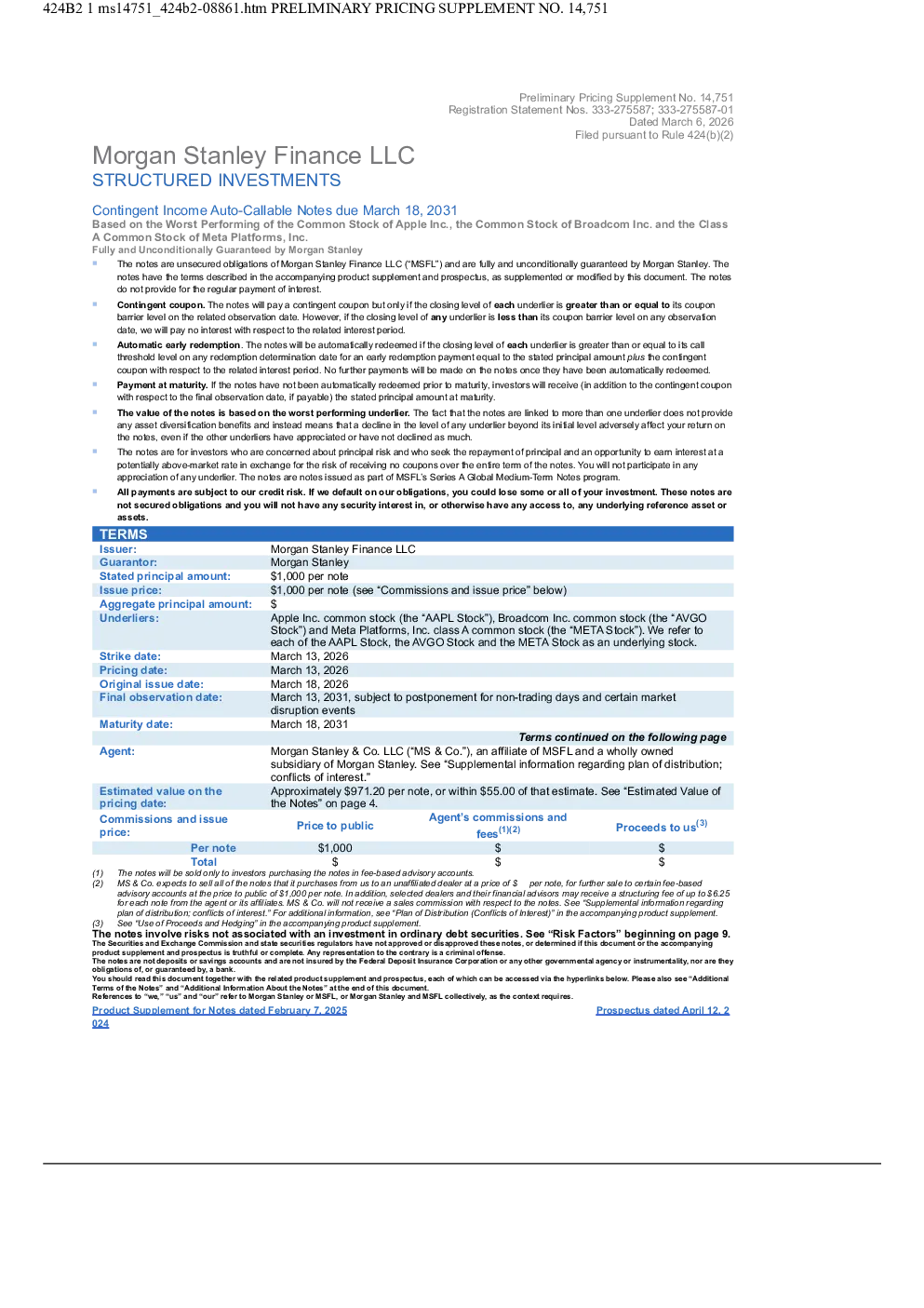
Contingent Income Auto-Callable Notes due March 18, 2031 Based on the Worst Performing of the Common Stock of Apple Inc., the Common Stock of Broadcom Inc. and the ClassA Common Stock of Meta Platforms, Inc. The notes are unsecured obligations of Morgan Stanley Finance LLC (“MSFL”) and are fully and unconditionally guaranteed by Morgan Stanley. Thenotes have the terms described in the accompanying product supplement and prospectus, as supplemented or modified by this document. The notes do not provide for the regular payment of interest.Contingent coupon.The notes will pay a contingent coupon but only if the closing level ofeachunderlier isgreater than or equal toits coupon barrier level on the related observation date. However, if the closing level ofanyunderlier isless thanits coupon barrier level on any observation Automatic early redemption. The notes will be automatically redeemed if the closing level ofeachunderlier is greater than or equal to its callthreshold level on any redemption determination date for an early redemption payment equal to the stated principal amountplusthe contingent ■coupon with respect to the related interest period. No further payments will be made on the notes once they have been automatically redeemed. Payment at maturity.If the notes have not been automatically redeemed prior to maturity, investors will receive (in addition to the contingent coupon Contingent Income Auto-Callable Notes Estimated Value of the Notes The original issue price of each note is $1,000. This price includes costs associated with issuing, selling, structuring and hedgingthe notes, which are borne by you, and, consequently, the estimated value of the notes on the pricing date will be less than What goes into the estimated value on the pricing date? In valuing the notes on the pricing date, we take into account that the notes comprise both a debt component and a performance-based component linked to the underliers. The estimated value of the notes is determined using our own pricing and valuationmodels, market inputs and assumptions relating to the underliers, instruments based on the underliers, volatility and other factors What determines the economic terms of the notes? In determining the economic terms of the notes, we use an internal funding rate, which is likely to be lower than our secondarymarket credit spreads and therefore advantageous to us. If the issuing, selling, structuring and hedging costs borne by you werelower or if the internal funding rate were higher, one or more of the economic terms of the notes would be more favorable to you. What is the relationship between the estimated value on the pricing date and the secondary market price of the notes? The price at which MS & Co. purchases the notes in the secondary market, absent changes in market conditions, including thoserelated to the underliers, may vary from, and be lower than, the estimated value on the pricing date, because the secondarymarket price takes into account our secondary market credit spread as well as the bid-offer spread that MS & Co. would chargein a secondary market transaction of this type and other factors. However, because the costs associated with issuing, selling,structuring and hedging the notes are not fully deducted upon issuance, to the extent that MS & Co. may buy or sell the notes in MS & Co. may, but is not obligated to, make a market in the notes, and, if it once chooses to make a market, may cease doing so Hypothetical Examples The following hypothetical examples illustrate how to determine whether the notes will be automatically redeemed with respect toa redemption determination date, whether a contingent coupon is payable with respect to an observation date and how tocalculate the payment at maturity if the notes have not been automatically redeemed prior to maturity. The following examplesare for illustrative purposes only. Whether the notes are automatically redeemed prior to maturity will be determined by referenceto the closing level of each underlier on each redemption determination date. Whether you receive a contingent coupon will be How to determine whether the notes will be automatically redeemed with respect to a redemptiondetermination date: If the closing level of any underlier is less than its call threshold level on each redemption determination date, the noteswill not be automatically redeemed prior to maturity. On hypothetical observation date #2, because the closing level ofat leastone underlier isless thanits coupon barrierlevel, no contingent coupon is paid on the related coupon payment date. On hypothetical observation date #3, the closing level ofeachunderlier isgreater than or equal toits coupon barrierlevel. Because the closing level ofeachunderlier is alsogreater than or equal toits call threshold level, the notes areautomatically redeemed for an early redemption payment equal to the stated principal amountplusthe contingent coupon If the closing level