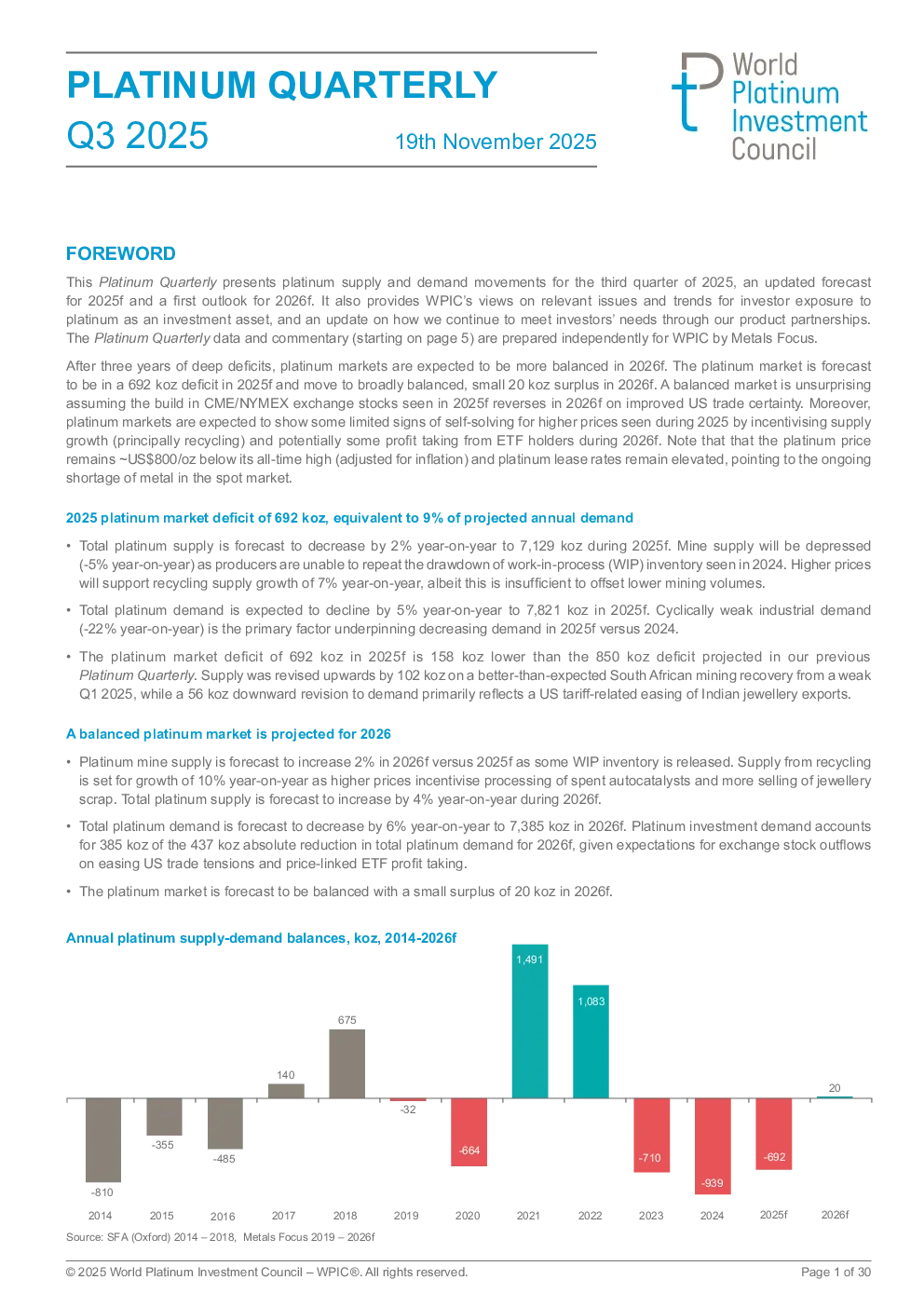
FOREWORD ThisPlatinum Quarterlypresents platinum supply and demand movements for the third quarter of 2025, an updated forecastfor 2025f and a first outlook for 2026f. It also provides WPIC’s views on relevant issues and trends for investor exposure toplatinum as an investment asset, and an update on how we continue to meet investors’ needs through our product partnerships.ThePlatinum Quarterlydata and commentary (starting on page 5) are prepared independently for WPIC by Metals Focus. After three years of deep deficits, platinum markets are expected to be more balanced in 2026f. The platinum market is forecastto be in a 692 koz deficit in 2025f and move to broadly balanced, small 20 koz surplus in 2026f. A balanced market is unsurprisingassuming the build in CME/NYMEX exchange stocks seen in 2025f reverses in 2026f on improved US trade certainty. Moreover,platinum markets are expected to show some limited signs of self-solving for higher prices seen during 2025 by incentivising supplygrowth (principally recycling) and potentially some profit taking from ETF holders during 2026f. Note that that the platinum priceremains ~US$800/oz below its all-time high (adjusted for inflation) and platinum lease rates remain elevated, pointing to the ongoingshortage of metal in the spot market. 2025 platinum market deficit of 692 koz, equivalent to 9% of projected annual demand •Total platinum supply is forecast to decrease by 2% year-on-year to 7,129 koz during 2025f. Mine supply will be depressed(-5% year-on-year) as producers are unable to repeat the drawdown of work-in-process (WIP) inventory seen in 2024. Higher priceswill support recycling supply growth of 7% year-on-year, albeit this is insufficient to offset lower mining volumes. •Total platinum demand is expected to decline by 5% year-on-year to 7,821 koz in 2025f. Cyclically weak industrial demand(-22% year-on-year) is the primary factor underpinning decreasing demand in 2025f versus 2024. •The platinum market deficit of 692 koz in 2025f is 158 koz lower than the 850 koz deficit projected in our previousPlatinum Quarterly. Supply was revised upwards by 102 koz on a better-than-expected South African mining recovery from a weakQ1 2025, while a 56 koz downward revision to demand primarily reflects a US tariff-related easing of Indian jewellery exports. A balanced platinum market is projected for 2026 •Platinum mine supply is forecast to increase 2% in 2026f versus 2025f as some WIP inventory is released. Supply from recyclingis set for growth of 10% year-on-year as higher prices incentivise processing of spent autocatalysts and more selling of jewelleryscrap. Total platinum supply is forecast to increase by 4% year-on-year during 2026f. •Total platinum demand is forecast to decrease by 6% year-on-year to 7,385 koz in 2026f. Platinum investment demand accountsfor 385 koz of the 437 koz absolute reduction in total platinum demand for 2026f, given expectations for exchange stock outflowson easing US trade tensions and price-linked ETF profit taking. •The platinum market is forecast to be balanced with a small surplus of 20 koz in 2026f. The platinum investment case – physical supply tightness comes to the fore Throughout 2025, platinum markets have experienced pronounced demand swings across various geographies. In the first quarter,metal flowed into CME warehouses. In the second quarter Chinese platinum imports were elevated, but coincided with CMEoutflows, and during the third quarter CME exchange stocks again recorded large inflows. The net effect of these outsized flowsof platinum across the globe has highlighted a misplaced confidence that there is an abundance of readily available above groundplatinum stocks within European vaults. Depleting metal stocks have seen platinum’s implied 1-month lease rate, which is the costto borrow metal, increase to an average of 15% in Q3 2025 (before any credit spread), up from an average of 10% in Q2 2025 and1% on average in 2024. Assuming demand for leasing has not increased, one of the main drivers of higher lease rates is a lack of physical supply. Either themetal is not available to be leased, or the holders of platinum are unwilling to lease the metal at current rates. It appears vaultedplatinum stocks have been depleted on the back of several years of consecutive market deficits which has in turn reduced themetal’s physical availability. Furthermore, trade tensions and competition for platinum have locked metal up in geographies whereit is unavailable to be lent out. This speaks to a growing narrative around critical mineral supply security across both the industriallevel but also more broadly at a national level. Higher lease rates should be supportive of higher platinum prices, as buyers reconsider their procurement strategies to switch fromleasing to outright purchasing or to also include some defensive purchasing. Platinum prices increased by 16% during Q3 2025.Notably, and alongside the fundamentals, p