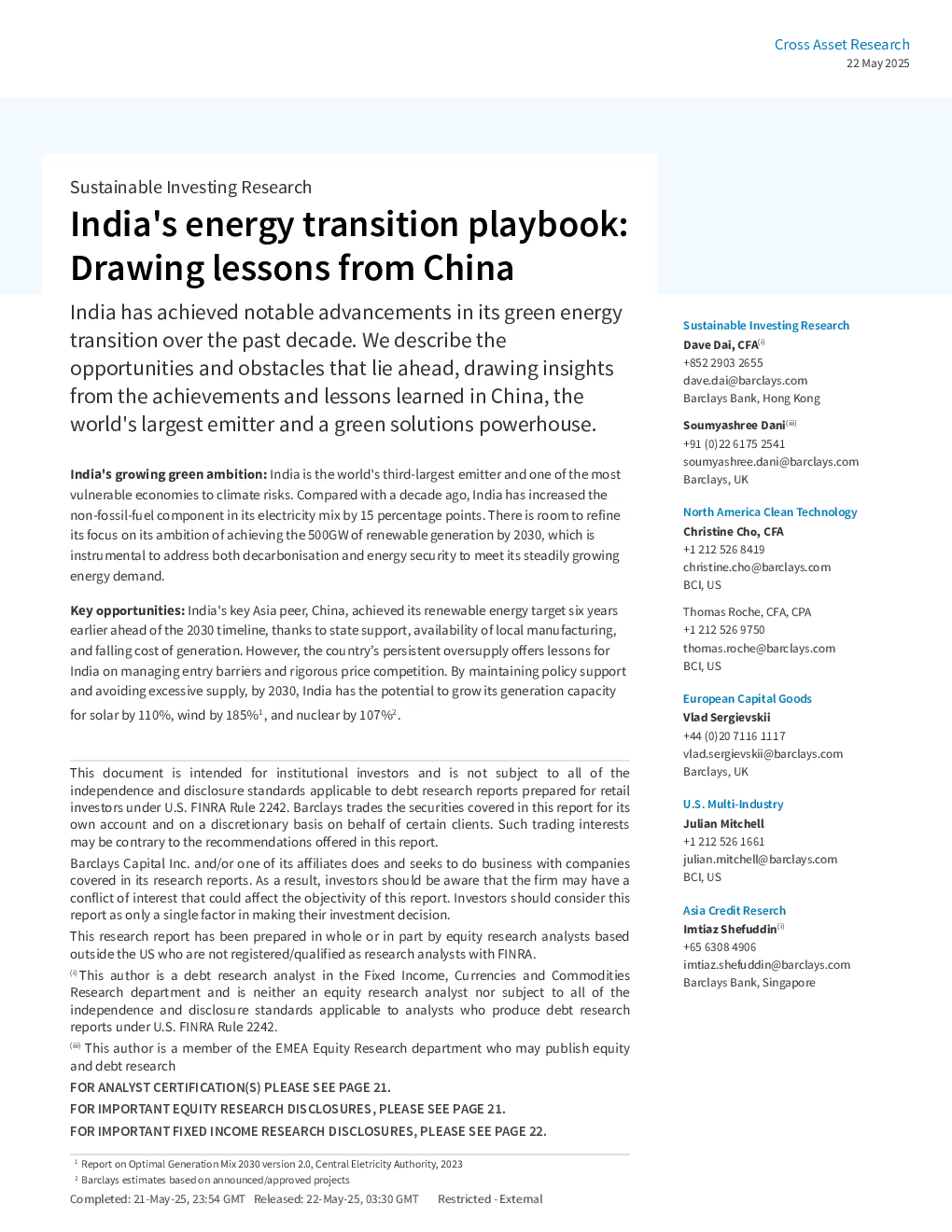
India's green energy transition is progressing well, with non-fossil fuels now accounting for 47% of its total power capacity. However, India faces challenges in achieving its 500GW renewable generation target by 2030, including slower gas demand growth, continued coal power expansion, and underinvestment in power transmission.
Key Opportunities:
- Solar: India's solar manufacturing is expanding rapidly, supported by government incentives like the PLI scheme and DCR scheme. The country has the potential to grow its solar capacity by 110% by 2030.
- Wind: While India's wind power growth has lagged behind solar, it has the potential to accelerate, supported by established manufacturing and new offshore wind tenders. The country has the potential to grow its wind capacity by 185% by 2030.
- Nuclear: India's nuclear power program is gaining momentum, with accelerating approvals and a clear technology roadmap. The country has the potential to grow its nuclear capacity by 107% by 2030.
Challenges:
- Gas: India's gas demand growth is slower than expected, and the country remains heavily reliant on imports for oil and gas. Achieving the target of generating 15% of primary energy from natural gas by 2030 may be challenging.
- Coal: Despite its commitment to decarbonization, India continues to expand its coal power capacity, supported by rich domestic resources and cheap costs. The country added 5.8GW of coal capacity in 2024, accounting for 82% of global additions.
- Power Grid: India's power grid infrastructure needs significant investment to integrate the growing number of renewable energy projects. The expected budget for 2024-25 is INR256mn, which is only 10% of the CEA's aggregate estimate for integrating 500GW of renewable energy.
Lessons from China:
- Solar and Wind: China's experience with solar and wind power shows that state support, local manufacturing, and falling generation costs are crucial for success. However, China also faces challenges with oversupply and price competition.
- Nuclear: China's nuclear renaissance, supported by imported technology and subsequent domestic manufacturing, shows the importance of technology localization and project execution.
- Gas and Coal: China has reduced its dependence on coal power and is exploring ways to balance decarbonization and energy security. India can learn from China's experience with emission trading schemes and national taxonomies to bring the cost of emissions into market pricing and financing.
Overall, India has the potential to achieve its green energy targets, but it needs to address the challenges and learn from the experiences of other countries like China.