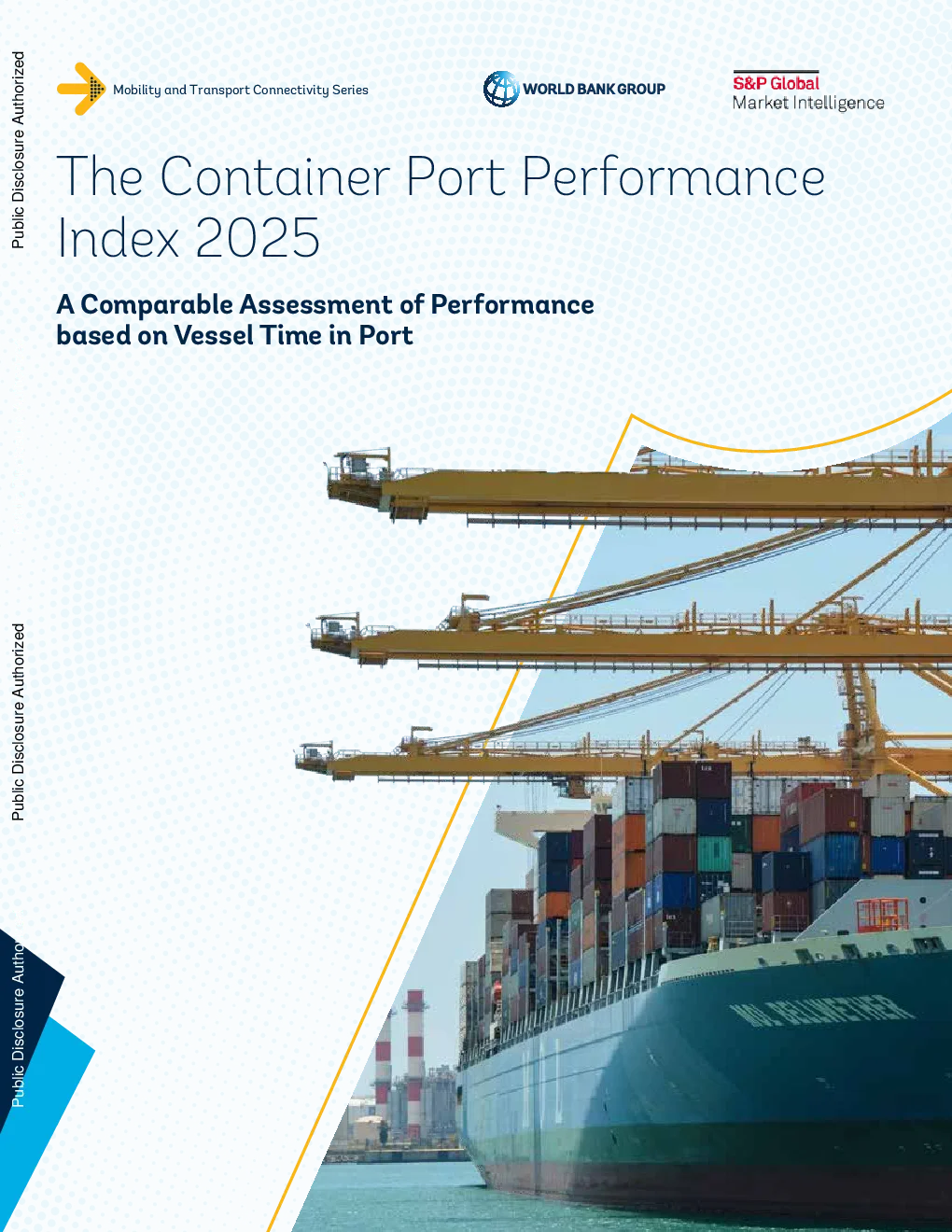
The Container Port Performance Index (CPPI) 2025 assesses container port performance based on vessel time in port, providing a global benchmark for comparison across ports, regions, and income groups. The index shows a slight deterioration in global average CPPI in 2025, indicating longer vessel turnaround times, driven by varying regional patterns.
Key findings:
- Regional and income-related differences persist: Ports in upper-middle-income and high-income economies generally outperform those in lower-income economies, benefiting from better infrastructure, higher crane intensity, and more advanced digital systems. However, higher income does not guarantee immunity from disruption, as seen during the COVID-19 pandemic in Europe and North America.
- Top performers and improvers: Fuzhou, Dalian, Salalah, Mawan, and Chiwan rank as the top performers, while Port Elizabeth, Khalifa Bin Salman Port, Posorja, Göteborg, and Muhammad Bin Qasim are the leading improvers between 2020 and 2025.
- Lessons for improvement: High-performing ports share key characteristics: minimizing time absorption, maintaining resilience during volatility, effective coordination and governance, and leveraging digitalization for efficiency and resilience.
- Two-way relationship with supply chain stress: The CPPI time series demonstrates a strong correlation between vessel time in port and global supply chain stress indicators. Supply chain stress leads to lower port performance through schedule unreliability, vessel bunching, and congestion, while poor port performance exacerbates supply chain stress by reducing available shipping capacity and propagating delays.
- Burst congestion: The report highlights the rise of "burst congestion," short, intense episodes caused by the temporal clustering of vessel arrivals, which can quickly overwhelm port capacity. Ports with higher baseline efficiency are better equipped to handle these surges.
- Recommendations: Strengthening port performance is crucial for enhancing global supply chain resilience. This includes expanding capacity, attracting private investment, improving operations, and leveraging digital tools to minimize vessel time in port and avoid becoming a source of stress transmission.
Overall, the CPPI 2025 emphasizes the critical role of ports in the global trade system and provides valuable insights for policymakers and stakeholders to improve port performance and enhance supply chain resilience.