您的浏览器禁用了JavaScript(一种计算机语言,用以实现您与网页的交互),请解除该禁用,或者联系我们。 [欧洲疾病预防控制中心]:迈向可持续发展目标3.3目标的进展概述 欧盟/欧洲经济区在艾滋病、结核病、病毒性肝炎和性传播感染方面的目标,2025年 - 发现报告

迈向可持续发展目标3.3目标的进展概述 欧盟/欧洲经济区在艾滋病、结核病、病毒性肝炎和性传播感染方面的目标,2025年

2024-01-31 - 欧洲疾病预防控制中心 Joken Hu
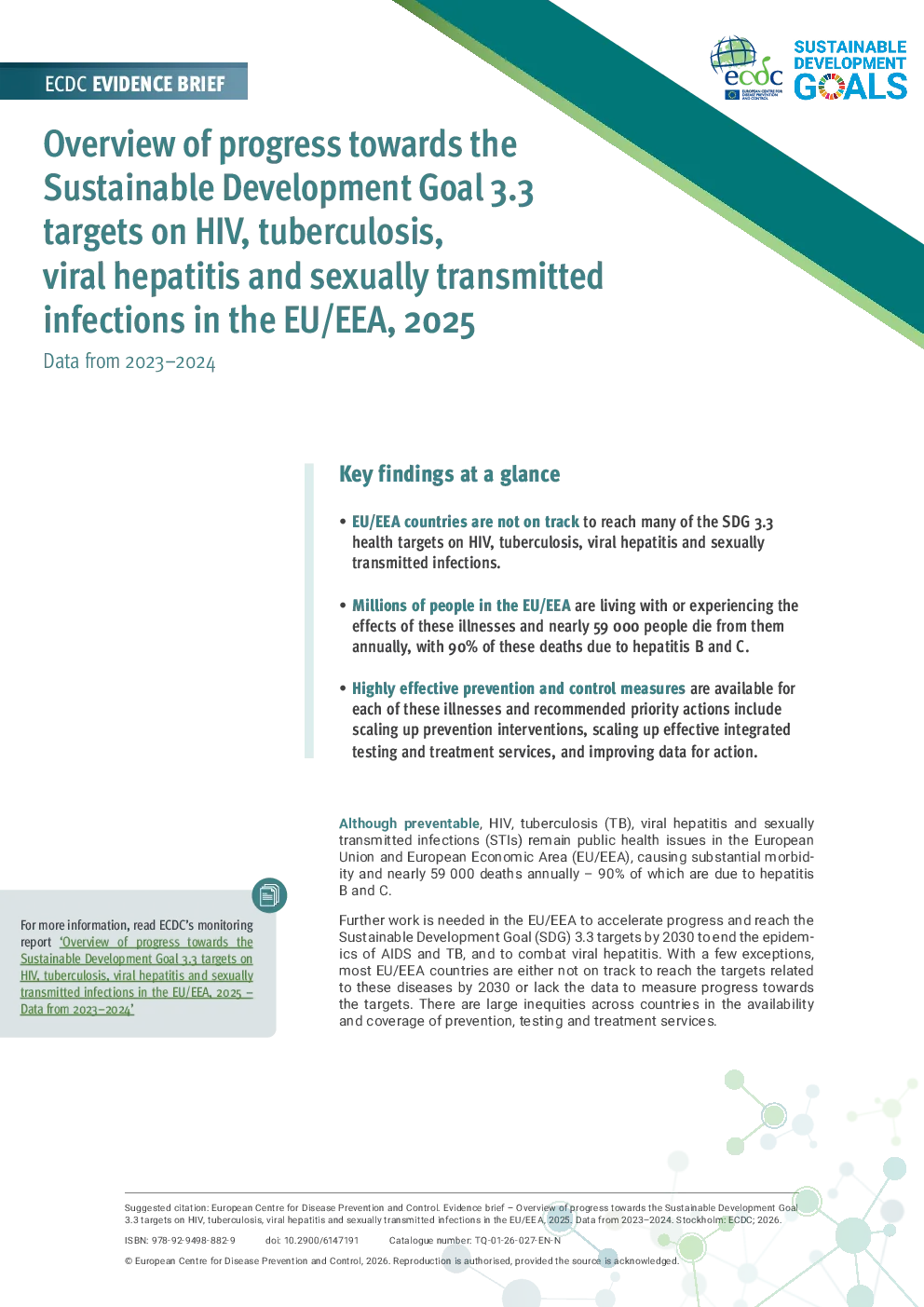
报告封面

Overview of progress towards theSustainable Development Goal 3.3targets on HIV, tuberculosis,viral hepatitis and sexually transmittedinfections in the EU/EEA, 2025 Data from 2023–2024 Key findings at a glance •EU/EEA countries are not on trackto reach many of the SDG 3.3health targets on HIV, tuberculosis, viral hepatitis and sexuallytransmitted infections. •Millions of people in the EU/EEAare living with or experiencing theeffects of these illnesses and nearly 59000 people die from themannually, with 90% of these deaths due to hepatitis B and C. •Highly effective prevention and controlmeasuresare available foreach of these illnesses and recommended priority actions includescaling up prevention interventions, scaling up effective integratedtesting and treatment services, and improving data for action. Although preventable, HIV, tuberculosis (TB), viral hepatitis and sexuallytransmitted infections (STIs) remain public health issues in the EuropeanUnion and European Economic Area (EU/EEA), causing substantial morbid-ity and nearly 59000 deaths annually – 90% of which are due to hepatitisB and C. Further work is needed in the EU/EEA to accelerate progress and reach theSustainable Development Goal (SDG) 3.3 targets by 2030 to end the epidem-ics of AIDS and TB, and to combat viral hepatitis. With a fewexceptions,most EU/EEA countries are either not on track to reach the targets relatedto these diseases by 2030 or lack the data to measure progress towardsthe targets. There are large inequities across countries in the availabilityand coverage of prevention, testing and treatment services. For more information, read ECDCʼs monitoringreport ʻOverview of progress towards theSustainable Development Goal 3.3 targets onHIV, tuberculosis, viral hepatitis and sexuallytransmitted infections in the EU/EEA, 2025 –Data from 2023−2024ʼ Progress summary •Incidence estimates for HIV and TB have declined but still have not reachedthe reduction targets. While incidence data are lacking for viral hepatitisand STIs, incidence estimates for hepatitis B and C are not declining andare increasing for gonorrhoea and syphilis in many EU/EEA countries. In the EU/EEA 500000 Nearly 5000001cases of HIV, TB, hepatitisB, hepatitis C, chlamydia, gonorrhoea andsyphilis are reported annually. •Although progress has been made in the area of prevention, the EU/EEAhas not met the targets for implementing highly effective public healthinterventions. •The EU/EEA is on track to meet the testing and treatment targets for HIVand has reached the TB detection rate target; however, treatment successfor TB remains well below the target of 90% of patients being successfullytreated. 800000 Approximately 800000 peopleare living with HIV2. •Vast numbers of people are still living with undiagnosed hepatitis B and C inthe EU/EEA, putting them at risk of severe consequences and mortality.The limited data available indicate major shortfalls related to hepatitis Bvirus (HBV) and hepatitis C virus (HCV) testing and treatment. 3.2 million Approximately 3.2 million people areliving with hepatitis B3. •Progress for STIs cannot be assessed due to limited data availability. 1.8 million Recommended priority actions Approximately 1.8 million people areliving with hepatitis C4. Priority actions that must be taken to reach the SDG 3.3 targets and reducemorbidity and mortality associated with these infections in the EU/EEA are to: •Scale up prevention interventions;•Scale up effective integrated testing and treatment services; and•Improve data for action. 12024 estimates22024 estimate32022 estimate42019 estimate Incidence (new infections) EstimatedHIV incidencehas decreased by 20% since 2010 but still has notreached the 2025 target of a 75% reduction. EstimatedTB incidencehas decreased by 37% since 2015 but still has notreached the 2025 target of a 50% reduction. EU/EEA-level data on the incidence ofchronic hepatitis B and C incidenceare insufficient to measure progress towards the target, but reported diag-noses of acute hepatitis B are increasing. EU/EEA-levelincidence estimates for STIsare not available; however, thenumber of reported syphilis and gonorrhoea diagnoses is increasing. Prevention Although efforts are being made to implement prevention measures acrossthe region, this progress still falls short of the targets that have been set forthe following indicators: •Pre-exposure prophylaxis (PrEP) to prevent HIV acquisition;•Provision of needles and syringes through exchange programmes to pre-vent viral hepatitis and HIV;•Opioid agonist treatment to prevent viral hepatitis and HIV;•Condom use to prevent HIV, hepatitis and STIs;•TB preventive treatment for childhood contacts; and•HBV vaccination. Testing and treatment In the EU/EEA, 7% of people living withHIVremain unaware of their status,5% of those diagnosed are not on HIV treatment and 6% of those on treat-ment have not reached viral suppression.5This means that, overall, one insix p