中国汽车:2026北京车展观察——中国是战场还是跳板?
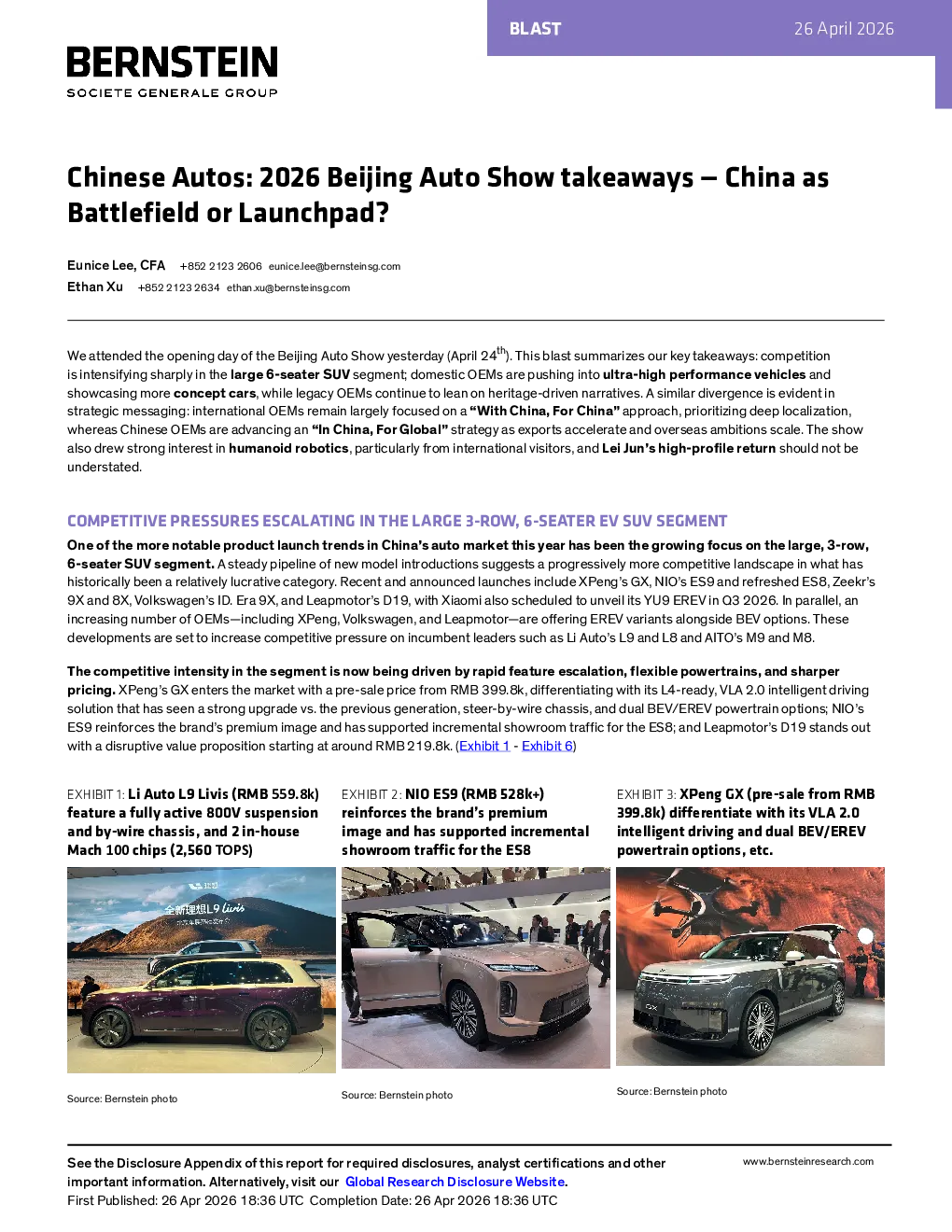
Eunice Lee, CFA+852 2123 2606eunice.lee@bernsteinsg.comEthan Xu+852 2123 2634ethan.xu@bernsteinsg.com We attended the opening day of the Beijing Auto Show yesterday (April 24th). This blast summarizes our key takeaways: competitionis intensifying sharply in thelarge 6-seater SUVsegment; domestic OEMs are pushing intoultra-high performance vehiclesandshowcasing moreconcept cars, while legacy OEMs continue to lean on heritage-driven narratives. A similar divergence is evident instrategic messaging: international OEMs remain largely focused on a“With China, For China”approach, prioritizing deep localization,whereas Chinese OEMs are advancing an“In China, For Global”strategy as exports accelerate and overseas ambitions scale. The showalso drew strong interest inhumanoid robotics, particularly from international visitors, andLei Jun’s high-profile returnshould not beunderstated. COMPETITIVE PRESSURES ESCALATING IN THE LARGE 3-ROW, 6-SEATER EV SUV SEGMENT One of the more notable product launch trends in China’s auto market this year has been the growing focus on the large, 3-row,6-seater SUV segment.A steady pipeline of new model introductions suggests a progressively more competitive landscape in what hashistorically been a relatively lucrative category. Recent and announced launches include XPeng’s GX, NIO’s ES9 and refreshed ES8, Zeekr’s9X and 8X, Volkswagen’s ID. Era 9X, and Leapmotor’s D19, with Xiaomi also scheduled to unveil its YU9 EREV in Q3 2026. In parallel, anincreasing number of OEMs—including XPeng, Volkswagen, and Leapmotor—are offering EREV variants alongside BEV options. Thesedevelopments are set to increase competitive pressure on incumbent leaders such as Li Auto’s L9 and L8 and AITO’s M9 and M8. The competitive intensity in the segment is now being driven by rapid feature escalation, flexible powertrains, and sharperpricing.XPeng’s GX enters the market with a pre-sale price from RMB 399.8k, differentiating with its L4-ready, VLA 2.0 intelligent drivingsolution that has seen a strong upgrade vs. the previous generation, steer-by-wire chassis, and dual BEV/EREV powertrain options; NIO’sES9 reinforces the brand’s premium image and has supported incremental showroom traffic for the ES8; and Leapmotor’s D19 stands outwith a disruptive value proposition starting at around RMB 219.8k. (Exhibit 1 - Exhibit 6) EXHIBIT 1:Li Auto L9 Livis (RMB559.8k)feature a fully active 800V suspensionand by-wire chassis, and 2 in-houseMach100chips (2,560TOPS) EXHIBIT 2:NIO ES9 (RMB 528k+)reinforces the brand’s premiumimage and has supported incrementalshowroom traffic for the ES8 EXHIBIT 3:XPeng GX (pre-sale from RMB399.8k) differentiate with its VLA 2.0intelligent driving and dual BEV/EREVpowertrain options, etc. EXHIBIT 5:BYD Da Tang (pre-sale fromRMB250k) features 2nd gen bladebattery and ultra-fast charging, hasalready received over 30k orders withinthe first 24 hours of launch These supply side pressures are even more notable when viewed against the underlying demand backdrop.China’s overall newSUV market reached around 11.5mnunits in 2024–25, but the mid-large and large SUV segment accounted for only about 1.9mnunitsin 2025, even though it has delivered strong growth (+27% yoy) and a robust 25% CAGR over 2021–25 versus 5% for the broader SUVmarket. Also, electrification penetration in this segment is already high, with BEV penetration at around 23% and PHEV/EREV penetrationreaching roughly 55% in 2025. This suggests that much of the early adoption and substitution demand has already been captured, limitingincremental growth from pure powertrain switching. Meanwhile, the RMB300k+ SUV market—the core addressable price band for mostlarge 6-seater models—has remained essentially flat at around 1.9–2.0mnunits over the past two years. While a more optimistic scenarioassumes that roughly half of RMB250k–300k buyers could trade up, lifting the implied market size to 2.5mnunits, this upside is conditionaland likely to be competed away by the growing number of entrants. (Exhibit 7 - Exhibit 10) EXHIBIT 7:In China, SUV sales have largely outperformed the broader auto market over the past decade; new SUV salesreached around 11.5mnunits in 2024–25, accounting for approximately 49% of total vehicle sales EXHIBIT 8:Mid-large and large SUVs reached 1.9mnunits in2025 (+27% YoY) and have significantly outpaced the overallSUV market in recent years, growing at a 25% CAGR over2021–25 versus 5% for the segment overall EXHIBIT 9:The mid-large and large SUV segment has seenhigh EV penetration, with BEV penetration reaching 23% andPHEV & EREV reaching 55% in 2025 A VISIBLE GAP STILL: AI-DEFINED FUTURES VS. HERITAGE-LED NARRATIVES While Chinese OEMs such as BYD and Xiaomi are aggressively showcasing AI-defined, ultra-high performance vehicles—alongsidea growing number of forward-looking concept cars—legacy OEMs continue to lean heavily on heritage-driven narratives. Mercedes(covered by Stephen Reitman), for example, promin