加拿大丰业银行美股招股说明书(2026-03-12版)
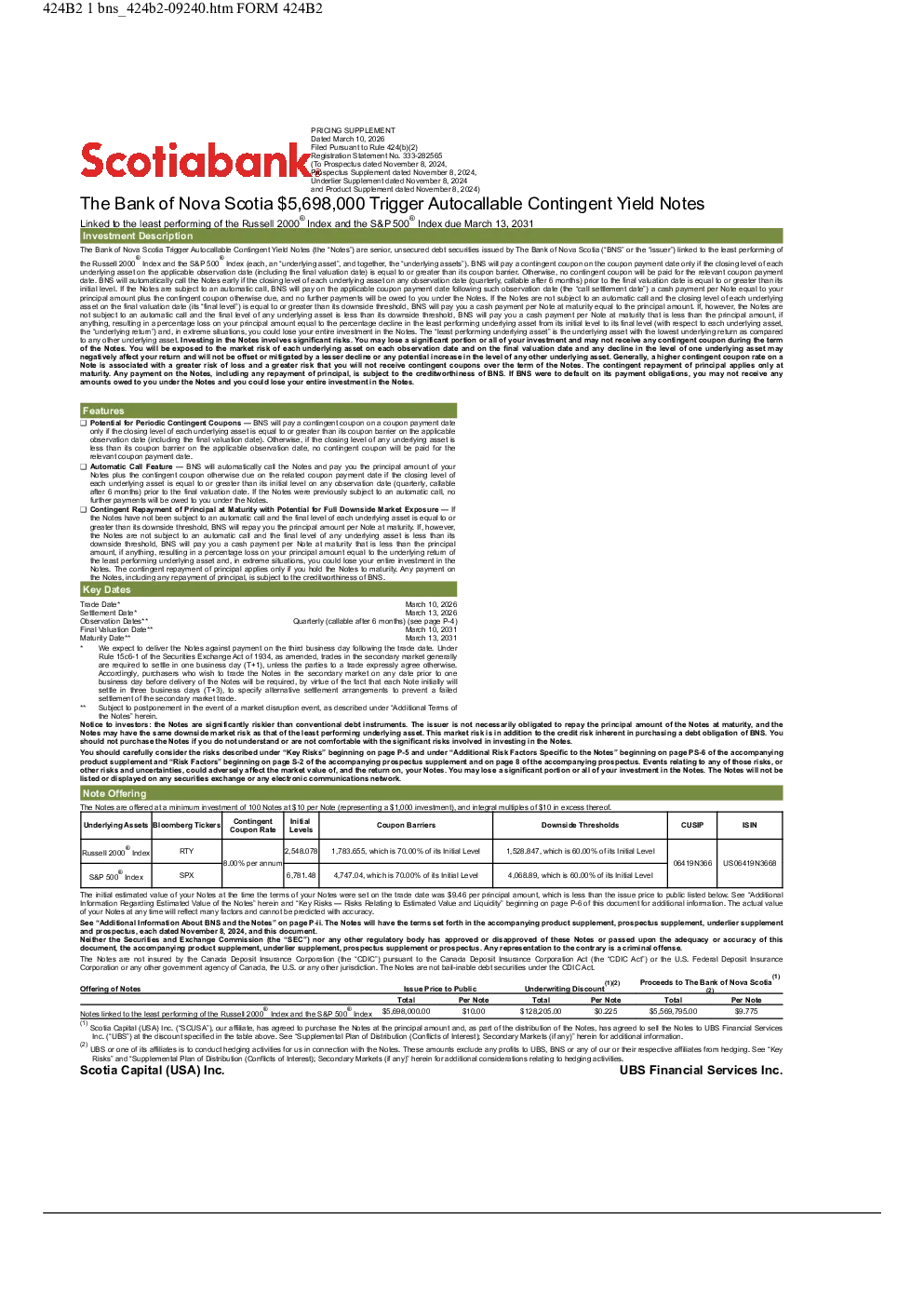
The Bank of Nova Scotia $5,698,000 Trigger Autocallable Contingent Yield Notes Linked to the least performing of the Russell 2000®Index and the S&P 500®Investment Description The Bank of Nova Scotia Trigger Autocallable Contingent Yield Notes (the “Notes”) are senior, unsecured debt securities issued by The Bank of Nova Scotia (“BNS” or the “issuer”) linked to the least performing ofthe Russell 2000®Index and the S&P 500® Index (each, an “underlying asset”, and together, the “underlying assets”). BNS will pay a contingent coupon on the coupon payment date only if the closing level of eachunderlying asset on the applicable observation date (including the final valuation date) is equal to or greater than its coupon barrier. Otherwise, no contingent coupon will be paid for the relevant coupon paymentdate. BNS will automatically call the Notes early if the closing level of each underlying asset on any observation date (quarterly, callable after 6 months) prior to the final valuation date is equal to or greater than itsinitial level. If the Notes are subject to an automatic call, BNS will pay on the applicable coupon payment date following such observation date (the “call settlement date”) a cash payment per Note equal to yourprincipal amount plus the contingent coupon otherwise due, and no further payments will be owed to you under the Notes. If the Notes are not subject to an automatic call and the closing level of each underlyingasset on the final valuation date (its “final level”) is equal to or greater than its downside threshold, BNS will pay you a cash payment per Note at maturity equal to the principal amount. If, however, the Notes arenot subject to an automatic call and the final level of any underlying asset is less than its downside threshold, BNS will pay you a cash payment per Note at maturity that is less than the principal amount, ifanything, resulting in a percentage loss on your principal amount equal to the percentage decline in the least performing underlying asset from its initial level to its final level (with respect to each underlying asset,the “underlying return”) and, in extreme situations, you could lose your entire investment in the Notes. The “least performing underlying asset” is the underlying asset with the lowest underlying return as comparedto any other underlying asset.Investing in the Notes involves significant risks. You may lose a significant portion or all of your investment and may not receive any contingent coupon during the term Features ❑Potential for Periodic Contingent Coupons— BNS will pay a contingent coupon on a coupon payment dateonly if the closing level of each underlying asset is equal to or greater than its coupon barrier on the applicableobservation date (including the final valuation date). Otherwise, if the closing level of any underlying asset isless than its coupon barrier on the applicable observation date, no contingent coupon will be paid for the ❑Automatic Call Feature— BNS will automatically call the Notes and pay you the principal amount of yourNotes plus the contingent coupon otherwise due on the related coupon payment date if the closing level ofeach underlying asset is equal to or greater than its initial level on any observation date (quarterly, callableafter 6 months) prior to the final valuation date. If the Notes were previously subject to an automatic call, no ❑Contingent Repayment of Principal at Maturity with Potential for Full Downside Market Exposure— Ifthe Notes have not been subject to an automatic call and the final level of each underlying asset is equal to orgreater than its downside threshold, BNS will repay you the principal amount per Note at maturity. If, however,the Notes are not subject to an automatic call and the final level of any underlying asset is less than itsdownside threshold, BNS will pay you a cash payment per Note at maturity that is less than the principalamount, if anything, resulting in a percentage loss on your principal amount equal to the underlying return of Rule 15c6-1 of the Securities Exchange Act of 1934, as amended, trades in the secondary market generallyare required to settle in one business day (T+1), unless the parties to a trade expressly agree otherwise.Accordingly, purchasers who wish to trade the Notes in the secondary market on any date prior to onebusiness day before delivery of the Notes will be required, by virtue of the fact that each Note initially will **Subject to postponement in the event of a market disruption event, as described under “Additional Terms ofthe Notes” herein. Notice to investors: the Notes are significantly riskier than conventional debt instruments. The issuer is not necessarily obligated to repay the principal amount of the Notes at maturity, and theNotes may have the same downside market risk as that of the least performing underlying asset.This market risk is in addition to the credit risk inherent in purchasing a debt obligation of BNS. Youshould not purch