您的浏览器禁用了JavaScript(一种计算机语言,用以实现您与网页的交互),请解除该禁用,或者联系我们。 [世界银行]:一个女孩可以梦想:分析莫桑比克女孩和妇女的愿望、性别规范和影响者 - 发现报告

一个女孩可以梦想:分析莫桑比克女孩和妇女的愿望、性别规范和影响者

文化传媒 2025-11-13 世界银行 话唠
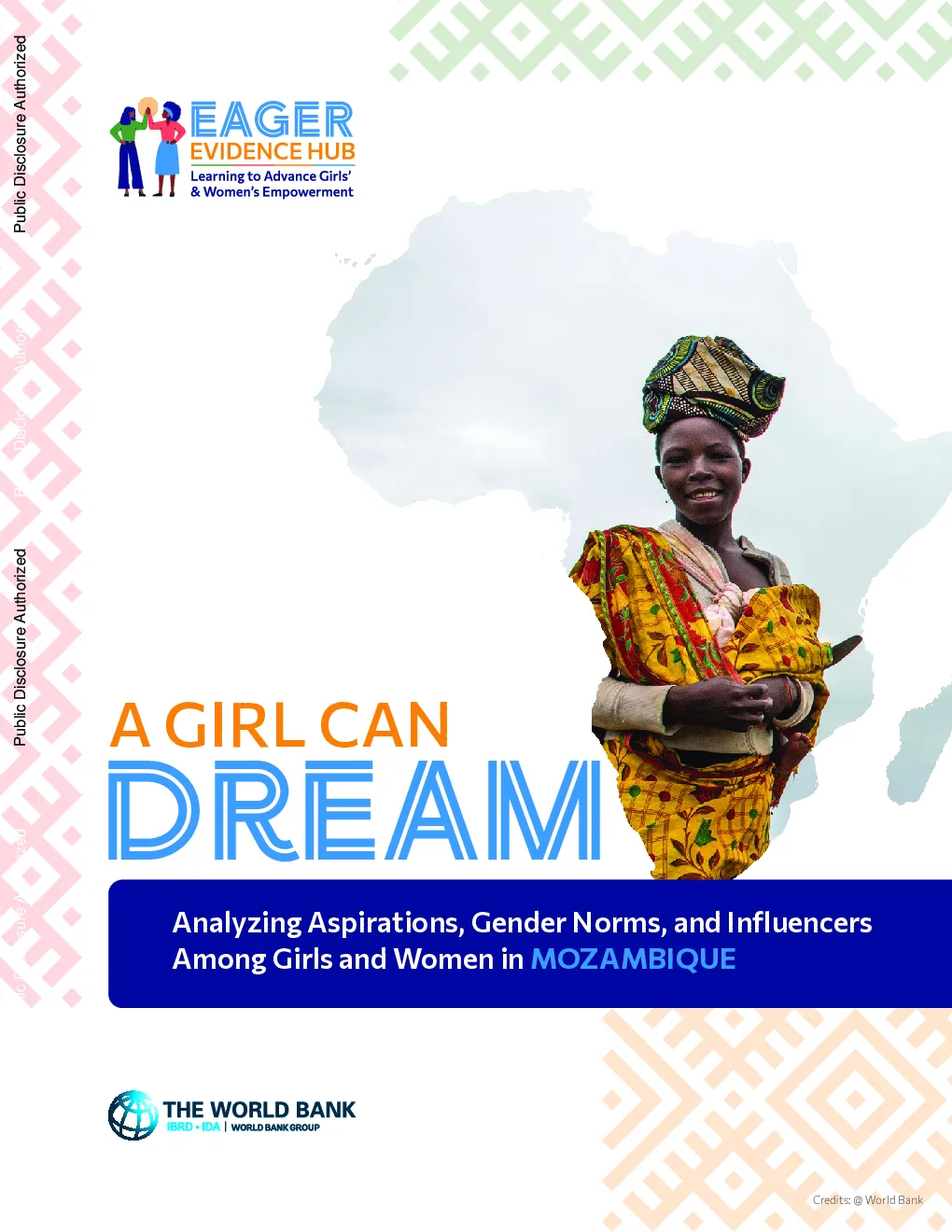
报告封面

DrEAM Analyzing Aspirations, Gender Norms, and InfluencersAmong Girls and Women inMOZAMBIQUE East Africa Girls’ Empowerment and Resilience (EAGER)is a World Bank regional program aiming toincrease girls’ and women’s educational attainment, labor earnings, and decision-making power in Eastand Southern Africa. The EAGER Evidence Hub conducts rigorous research to generate new evidence on Acknowledgments:This report was written by Alexandre Chauque, Sreelakshmi Papineni, AbhilashaSahay, and Sara Troiano. Anna Barbeta, Paula Gonzalez Martinez, Sakina Shibuya, and Luz Curazo providedexcellent research assistance. Aniceto Da Fonseca Matias led field management for the quantitativesurvey, and Sophia Friedson-Ridenour led the qualitative data collection. The authors are grateful to theGovernment of Mozambique, represented by the Ministry of Youth and Sports (MJD) and the Ministry KEY MESSAGES ◆Insights into Girls’ Dreams, Decision-making, and Community Influences.The survey explores girls’ and young women’s (ages 15-35 years) aspirations and the barriersto achieving them. It examines social norms - or perceptions of what is consideredacceptable in terms of women’s empowerment - both personally and within their ◆Breaking Barriers is Key to Fulfil High Aspirations.Most Mozambican girls aspire toattain a level of education higher than what they currently achieve. However, somevulnerablegirls,especiallyinruralMozambique,donotevendreamoffinishingsecondaryschool. To have greater impact, education programs must go beyond resource access ◆There is a Mismatch between Available Jobs and the Skills of Women.More womenaspire to public sector jobs in education and health than the market can provide.Many women are not aware of the steps needed to reach their professional goals.Career guidance and entrepreneurship support may help to align women’s goals with ◆Restrictive Gender Norms are Deep-Rooted.Many Mozambican girls and youngwomen still accept traditional gender roles, believing men should have more rights andresources. Gender norms programs to both girls and boys must tackle these ingrained ◆Fear of Judgment Holds Girls Back.Many girls hesitate to pursue higher-earningeconomicopportunities in male-dominated sectors due to fear of communitydisapproval — yet the survey shows societal norms are more progressive than they ◆A Supportive Family Environment is Key to Girls’ Empowerment.Mothers, fathers,and spouses heavily influence girls’ and young women’s decisions in Mozambique.Empowerment programs must engage these key figures, transforming them into WHAT IS THIS RESEARCH ABOUT? In Sub-Saharan Africa, multiple interrelated challenges hinderthe potential of girls and young women.1 Girls and womenare more likely to live in poverty than men, have less accesstoeducation and health services,and rarely benefit fromproductive economic opportunities. Restrictive social normsexacerbate material constraints by defining what is considered Knowing what beneficiaries aspire to is crucial to ensure thatprograms meet their goals. Similarly, vulnerable populations maynot have the information they need to match their aspirationswith opportunities that exist around them. Typically, vulnerablepopulations tend to under-aspire as the reality of poverty keeps Recognizing that girls’ and women are often influenced by theirsocial environment, the research also interviews the peoplearound them, to compare girls’ aspirations and attitudes to theircommunity’s expectations and social norms, and to identify However, how often do we ask Mozambican girls and womenwhat they really want? To inform the design and implementationof gender equality interventions in Mozambique, this researchasks vulnerable girls and women (aged 15-35 years) about their WHY IS THIS RESEARCH RELEVANT TO MOZAMBIQUE? A girl born in Mozambique has only a 46% chance of completingprimaryeducation,and just a 13%chance of completingsecondary education.4She is 62% likely to grow up in ruralareas, with limited access to services, in contexts of widespreadpoverty. She has a 46% chance of getting pregnant in her interventions,and increased efforts against gender-basedviolence (GBV). The Ministry of Youth and Sports has launchedlarge-scale programs likeEu Sou Capazfor adolescent girls,andEmpregafor young female workers, focusing on critical Severalinitiatives from development partners and localassociationscomplement government’s efforts.A recentmappingof girls and women’s empowerment programs inMozambiquerevealed that at least 30 organizations areinvestingin this agenda through programs of significantscale (above 1,000 beneficiaries). Yet, programming is highlyfragmented, with some significant policy gaps, and multipleinterventionstargeting the same provinces with similar When she reaches working age, she may be working, but typicallyin low-quality jobs in the informal sector. Since earnings are low,there is a 40% chance that her job income will not be enough tofree her and h