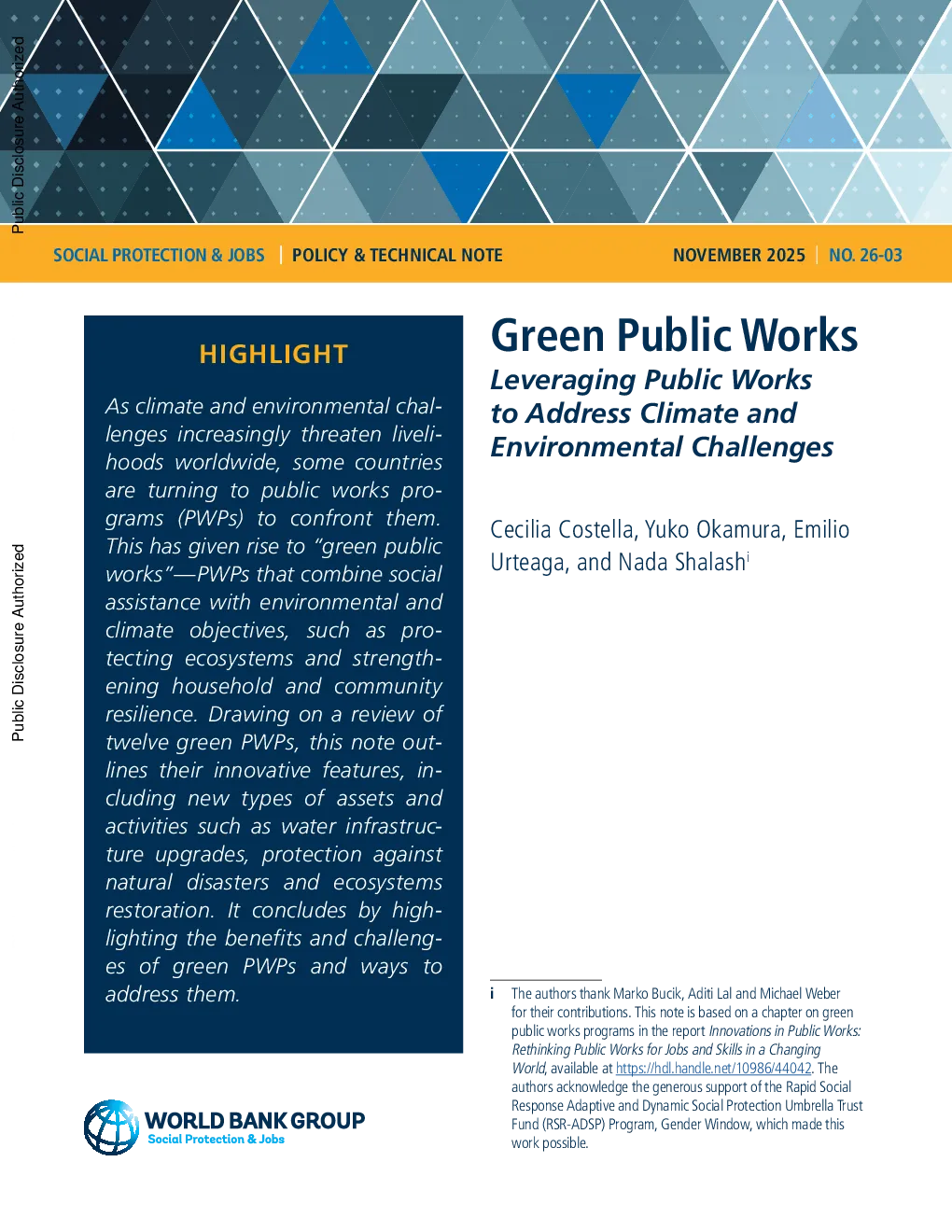
Green Public Works (GPWs) are programs that combine social assistance with environmental and climate objectives to address climate and environmental challenges. They can generate environmental, climate, and socioeconomic benefits simultaneously and at scale, providing a safety net while advancing climate and environmental goals.
Five sets of climate and environmental goals that GPWs can align with:
- Reducing climate vulnerability and supporting climate-resilient livelihoods
- Enhancing disaster preparedness and disaster risk reduction
- Protecting people against externalities of climate change or environmental policies and measures
- Enabling green jobs and labor markets transformation
- Supporting ecosystems and natural resources preservation
Benefits of GPWs:
- Wages: Provide income to participants, helping to reduce vulnerability and enhance preparedness for shocks.
- Skills: Equip participants with the ability to better manage climate-sensitive and natural-resource-dependent economic activities.
- Assets: Create public assets that deliver positive climate and environmental outcomes, such as preserved or restored ecosystems, disaster-resilient infrastructure, reduced or captured CO2/GHG emissions, sustainable agricultural productivity, and reduced dependence on climate-sensitive livelihoods.
Examples of GPWs:
- India: Mahatma Gandhi National Rural Employment Guarantee Scheme (MGNREGS): The largest PWP in the world, focusing on environmental sustainability and water conservation.
- Ethiopia: Productive Safety Nets Program (PSNP): A flagship social assistance program focused on poverty reduction, food security, disaster risk reduction, and climate resilience.
- Malawi: Climate-Smart Enhanced PWP (CS-EPWP): Focuses on integrated watershed management to reduce climate risks and promote sustainable agricultural productivity.
- Fiji: Jobs for Nature 2.0 (JFN2): Aims to create jobs in rural areas and reduce environmental degradation through activities like mangrove and seagrass planting, waterways restoration, and forest restoration.
Key factors for the effectiveness of GPWs:
- Relevant targeting: Understanding vulnerability to poverty, climate, and environmental risks is crucial for selecting target areas and populations.
- Policy integration and collaboration: Effective policy and institutional coordination are essential, requiring collaboration between public authorities, multiple sectors, and local communities.
- Enhancing skills transfers: Providing training in environmental management, conservation, and green technologies can significantly increase long-term benefits.
- Relevant scale: Most green PWPs remain small and fragmented, while larger programs demonstrate greater sustainability and impact.
- Level of wages and timing of works: Wages and benefits are crucial for enhancing household resilience, and the timing and duration of works should be aligned with periods of greatest vulnerability.
- Impacts and technical quality of assets: Programs need to align asset choices clearly with climate objectives and ensure sound technical standards and expertise.
Challenges and Lessons for Scale-Up:
- Achieving results at scale requires technical support for design and implementation, as well as robust and sustainable financing mechanisms.
- Understanding the long-term impacts and cost-effectiveness of GPWs is crucial for improving future programming.
Conclusion:
Green Public Works offer a promising avenue for achieving social, climate, and environmental objectives at scale. By addressing factors such as relevant targeting, policy integration, skills transfers, scale, wage levels, and asset quality, policymakers can unlock the full potential of GPWs to build a more sustainable and resilient future.