您的浏览器禁用了JavaScript(一种计算机语言,用以实现您与网页的交互),请解除该禁用,或者联系我们。[奥雅纳]:Playful cities design guide: play for anyone, anywhere - 发现报告

Playful cities design guide: play for anyone, anywhere

2024-02-21-奥雅纳J***
Playful cities design guide: play for anyone, anywhere

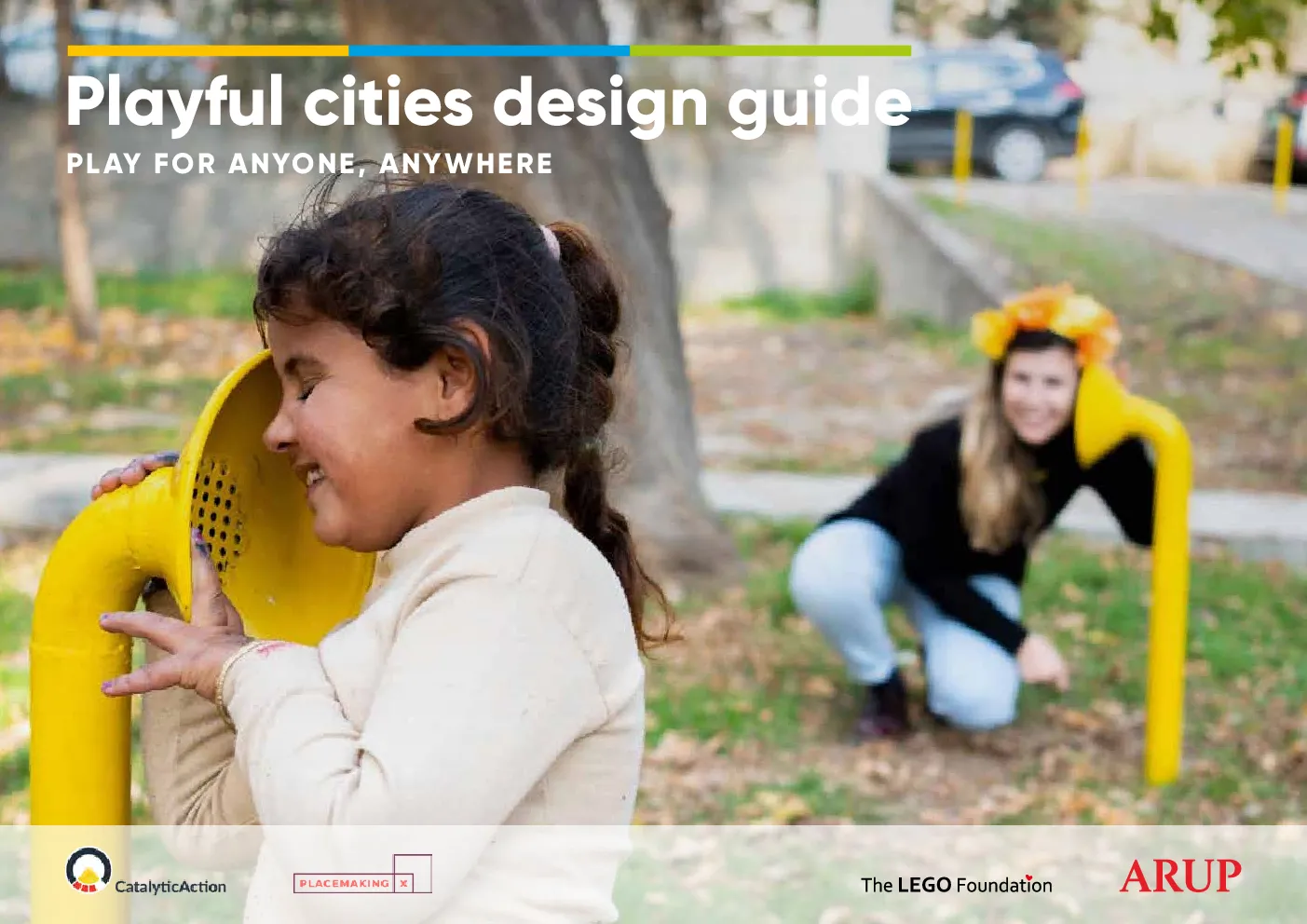
Aknowledgements COLLABORATIVE WORKSHOPS PARTICIPATIONAND FEEDBACK Candiracci, Sara et al. 2023. Playful Cities Design Guide:Play for anyone, anywhere. London: Arup. This publication is the result of the collaborationbetween Arup, the LEGO Foundation, CatalyticAction,and PlacemakingX. We also thank Ingka Group (IKEA)for their support. The publication was created thanksto the contribution of external childhood developmentand play experts and numerous urban practitioners thatcontributed with their knowledge, practical experiences,and examples. For this we are very grateful, as thisfruitful collaboration is a step forward to creating ashared language of play for all in urban spaces, and thebenefits this generates for the whole society. Amowi Phillips, Mmofra FoundationGuillermo Bernal, Fundación Placemaking MexicoLuciana Renner, Fundación Placemaking MexicoEthan Kent, PlacemakingXAzbah Anzari, Peacemakers PakistaniCarolina Carrasco, Espacio LúdicoJosé Miguel Gómez, Espacio LúdicoGretchen Wilson-Prangley, PlayAfricaZviko Kanyoka, PlayAfricaJia Ping Lee, Pollin8Leticia Lozano, MACIA EstudioRaquel Teixeira dos Santos, B-City & Space for PlayBoopsie Maran, Places for GoodAnnabel Nyole,Public Space NetworkHeba Elhanafy, Charter Cities Institute Playful Cities Design Guide © May 2023 ISBN 978-0-9929501-7-0 AUTHORS Dr Sara Candiracci,Associate Director, ArupTeam Lead and Co-AuthorRiccardo Luca Conti, Director, CatalyticActionCo-AuthorJoana Dabaj, Director, CatalyticActionCo-AuthorDr Dasha Moschonas, Urban designer, ArupCo-AuthorDr Brenna Hassinger-Das, Assistant Professor, PaceUniversityCo-AuthorJacopo Donato, Designer, CatalyticActionIllustration and graphic design CASE STUDIES Joana Dabaj,Ghina Kanawati, CatalyticActionGiuseppe Grant, orizzontaleBinke Lenhardt, CrossboundariesRenet Korthals Altes, Space for PlayMarcos Coronel, PICO Colectivo EDITOR COLLABORATIVE WORKSHOPS LEADAND TESTING Julien Clin, Arup FRONT COVER PICTURE Viviana Cordero, Huasipichanga - PlacemakingXGiulia Gualtieri, Huasipichanga - PlacemakingXAnna Bradley, STIPO - PlacemakingX Hermel Inclusive Park ©CatalyticAction IntroductionAbout this guideWho is this guide for?How to use this guide? Key MessagesWhy play for anyone, and anywhere The role of urban planning and design CONTENT INTRODUCTION5 About this guide5 Who is this guide for?6 How to use this guide?7 KEY MESSAGES Why play for anyone, and anywhere8 The role of urban planning and design10 PROMOTING PLAY IN CITIES 14 Skills15 City spaces26 CATALOGUE OF PLAY IDEAS108 Key MessagesWhy play for anyone, and anywhere The role of urban planning and design for everyone, anywhere. It provides a richcompendium of play elements and practicalexamples that can be adapted and used indifferent design processes and socio-culturalcontexts to trigger and support play as a crucialelement of our everyday life. and community interactions. Also, playful spaces canenable pro-social behaviours that yield substantialbenefits for people of all ages. These social andenvironmental benefits are of paramount importancein the age of climate change and social unrest.2 Aboutthis guide Play includes a wide variety of activities which can beunpredictable, spontaneous, irrational, and risky, andwhich are often unanticipated by urban practitioners,policymakers, and other users. By illustrating theforms that play may take in cities, this Guide revealspeople’s creativity, curiosity, imagination, movement,interactions, learning and emotions in using urbanspace. This is the motivation of play – thepossibility of configuring alternateways of being-in-the-world1“ This new publication addresses three questions: Where can we add play in our cities,and what kinds of spatial elements cansupport playful experiences? Tara Woodyer, Ludic Geographies: Not Merely Child’s Play How can we design for play that isinclusive of different age groups,abilities, and identities? ThePlayful Cities Design Guide - Play for Anyone,Anywhereis a resource that complements the PlayfulCities Toolkit and provides practical and inspirationalideas to help urban practitioners and city authoritiesto imagine and embed small-scale play elements forchildren, youths, and adults in city design and planning. How can play help us to develop adiverse range of skills, as well as toconnect to our urban and naturalenvironment? The Playful Cities Toolkit (2021) was developed byArup and the LEGO Foundation in partnership withthe Real Play Coalition. It provides a framework forunderstanding the complexity and importance of playin cities, for guiding the design process for play-basedinterventions, and for measuring these interventions’impact. The most liveable cities are places where people of allages and abilities are active and visible in the publicrealm, spend time playing outdoors, are able to movearound, and are in contact with nature. Design forplay has the power to generate diverse experiencesof the city that may lead to new way