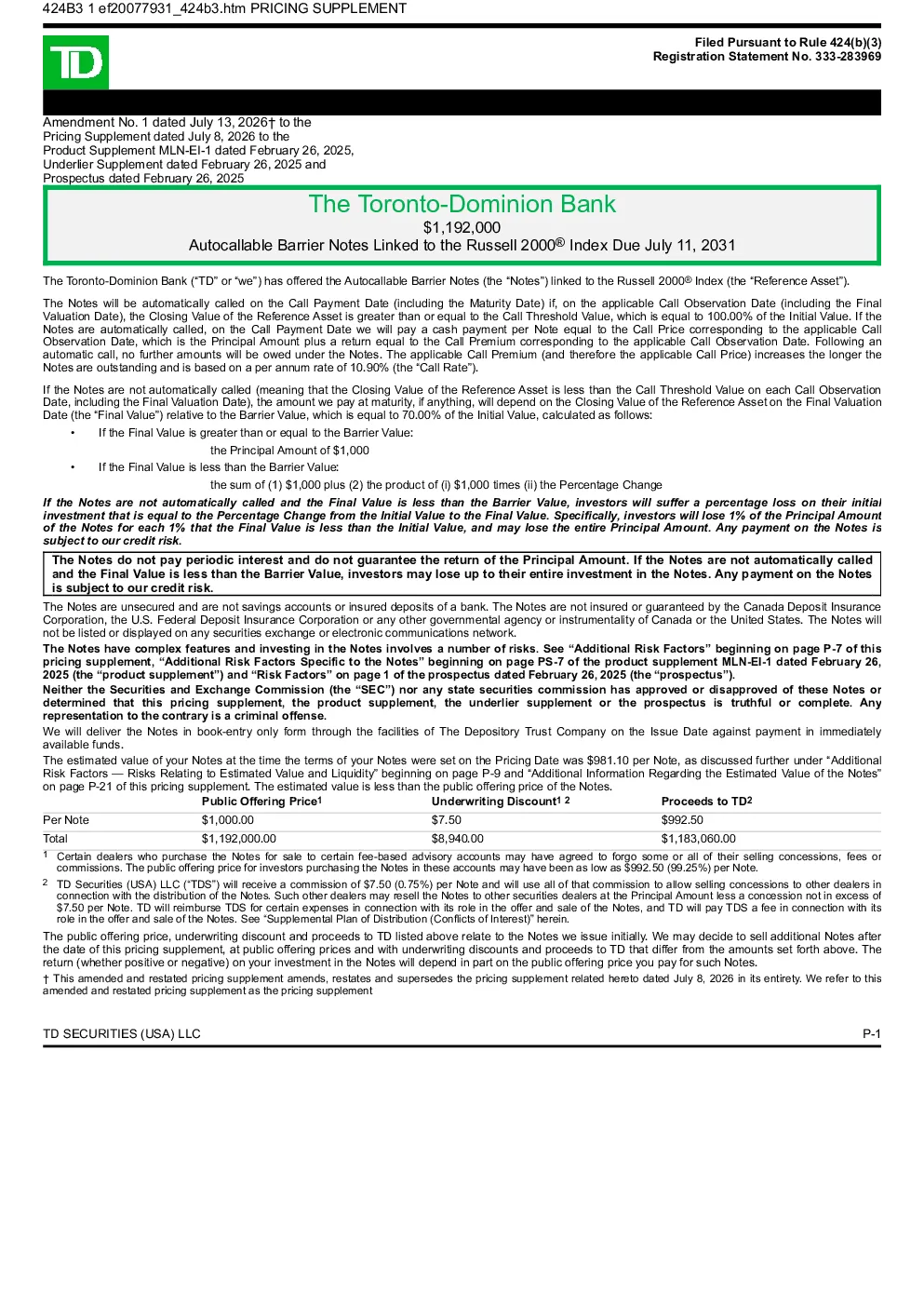
The Toronto-Dominion Bank (TD) has offered Autocallable Barrier Notes linked to the Russell 2000® Index, with a maturity date of July 11, 2031. The Notes will be automatically called if the index value reaches or exceeds a 100% call threshold on any call observation date, including the final valuation date. Upon automatic call, investors receive a cash payment equal to the principal amount ($1,000) plus a call premium based on a 10.90% annual call rate. If the Notes are not called, the payment at maturity depends on the final index value relative to a 70% barrier value: $1,000 if above the barrier, or a reduced amount if below it, potentially resulting in a total loss of the principal investment.
Key features and risks:
- Return structure: The Notes do not pay periodic interest, and the maximum positive return is limited to the call premium. If not called, investors may lose their entire investment.
- Automatic call mechanism: The Notes are called automatically if the index value meets or exceeds the call threshold, with the call price increasing over time due to the call premium.
- Maturity payment: If not called, the payment at maturity is $1,000 if the index value is above the barrier, or a calculated amount based on the percentage decrease below the initial value if below the barrier.
- Credit risk: Payments are subject to TD's credit risk, and a downgrade in TD's creditworthiness could negatively impact the Notes' market value.
- Liquidity risk: The Notes are unsecured and not insured, with limited secondary market liquidity and potential for significant losses if sold before maturity.
- Taxation: The U.S. tax treatment is uncertain, with potential for ordinary income or short-term capital gains treatment of the call premium. Canadian non-resident holders may face withholding taxes on interest and capital gains.
- Index risks: The Notes are linked to the Russell 2000® Index, which reflects price returns only and is subject to market risks and potential changes in its composition.
- Hedging activities: TD's hedging activities and conflicts of interest with the calculation agent and reference asset issuers may affect the Notes' value.
Examples of potential outcomes:
- Example 1: If the index value is above the call threshold on the first call observation date, the Notes are called, and investors receive $1,109 per Note, representing a 10.90% return.
- Example 2: If the index value is above the call threshold on the third call observation date, the Notes are called, and investors receive $1,218 per Note, representing a 21.80% return.
- Example 3: If the index value is above the call threshold on the final valuation date, the Notes are called, and investors receive $1,545 per Note, representing a 54.50% return.
- Example 4: If the index value is below the call threshold on all call observation dates and above the barrier value at maturity, investors receive $1,000 per Note, with a 0.00% return.
- Example 5: If the index value is below the call threshold on all call observation dates and below the barrier value at maturity, investors suffer a loss equal to the percentage decrease in the index value from the initial value.
Conclusion: The Notes offer the potential for higher returns compared to traditional debt securities but come with significant risks, including the possibility of total loss, limited liquidity, and uncertain tax treatment. Investors should carefully consider these risks and seek professional advice before investing.