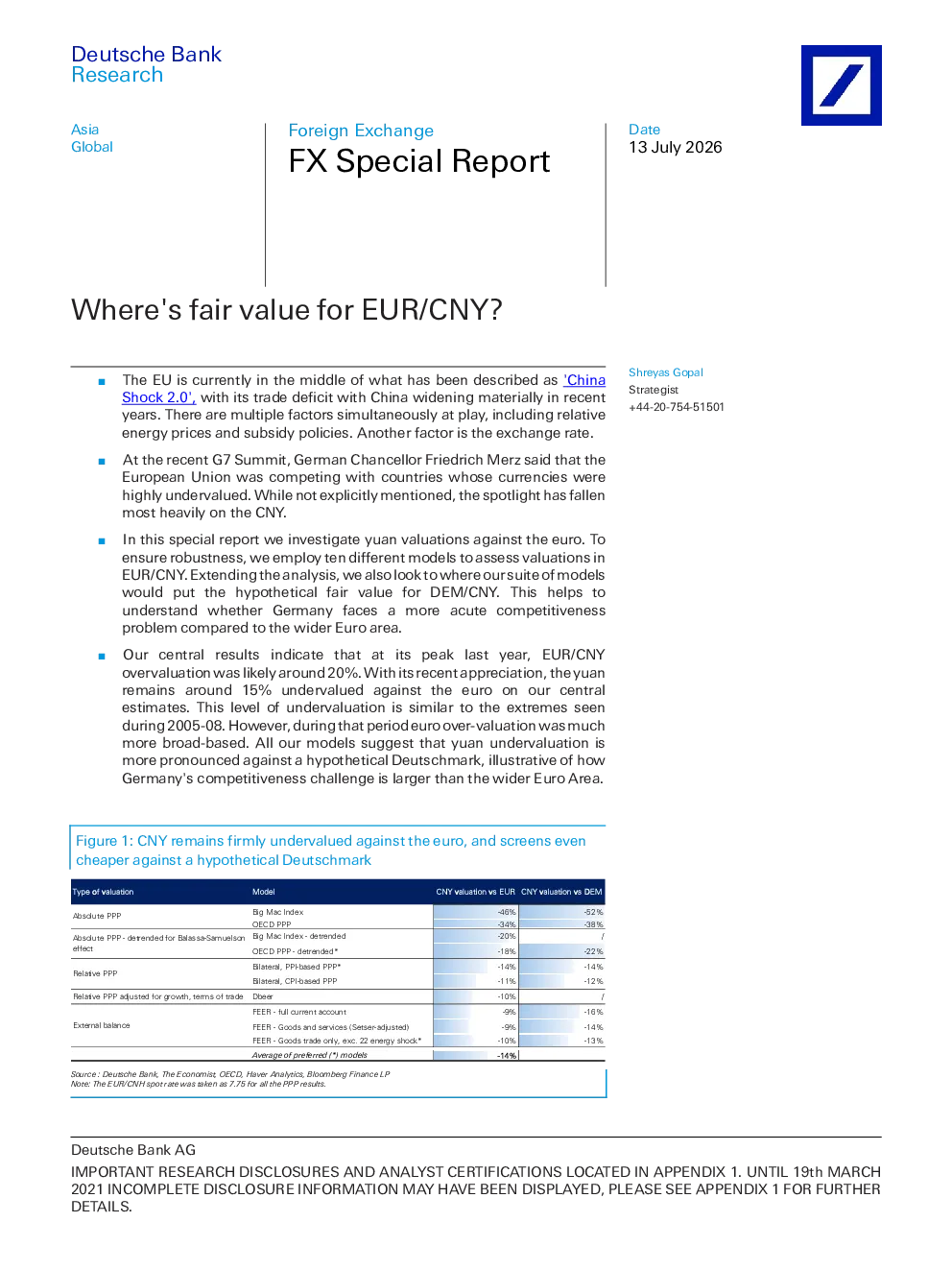
The EU is experiencing a widening trade deficit with China, partly attributed to factors like energy prices, subsidy policies, and the exchange rate. German Chancellor Friedrich Merz highlighted the issue of undervalued currencies, particularly the CNY, at the G7 Summit.
The report investigates CNY valuations against EUR and a hypothetical DEM using ten different models, categorized into Purchasing Power Parity (PPP) and external balance models.
Purchasing Power Parity (PPP) Models:
- Absolute PPP: The Big Mac Index suggests a CNY undervaluation of around 45% against EUR, while the OECD's PPP metric points to approximately 35% undervaluation.
- Relative PPP: Using CPI and PPI data, the report finds a CNY undervaluation of around 14% against EUR. A more comprehensive model (DBeer) suggests an 8% undervaluation.
- Trends: The report notes that CNY undervaluation, previously trending downwards, has reversed since 2022, with recent valuations around 20% undervalued against EUR.
External Balance Models (FEER):
- Full Current Account: The benchmark FEER model indicates a mild overvaluation of EUR and a CNY undervaluation of around 7.5% based on a trade-weighted index (TWI).
- Adjusted Models: Excluding income balances and using adjusted trade data, the report finds a CNY undervaluation of around 8% against EUR.
- Germany-specific Analysis: The gap between Germany's external balance and its historical average widens when considering the full current account, suggesting a more pronounced CNY undervaluation against a hypothetical DEM compared to EUR.
Conclusion:
Despite recent appreciation, the CNY remains around 15% undervalued against EUR. All models indicate a more significant undervaluation against a hypothetical DEM, highlighting Germany's greater competitiveness challenge compared to the wider Euro Area. Further strengthening of the CNY would marginally help address Europe's competitiveness struggles.