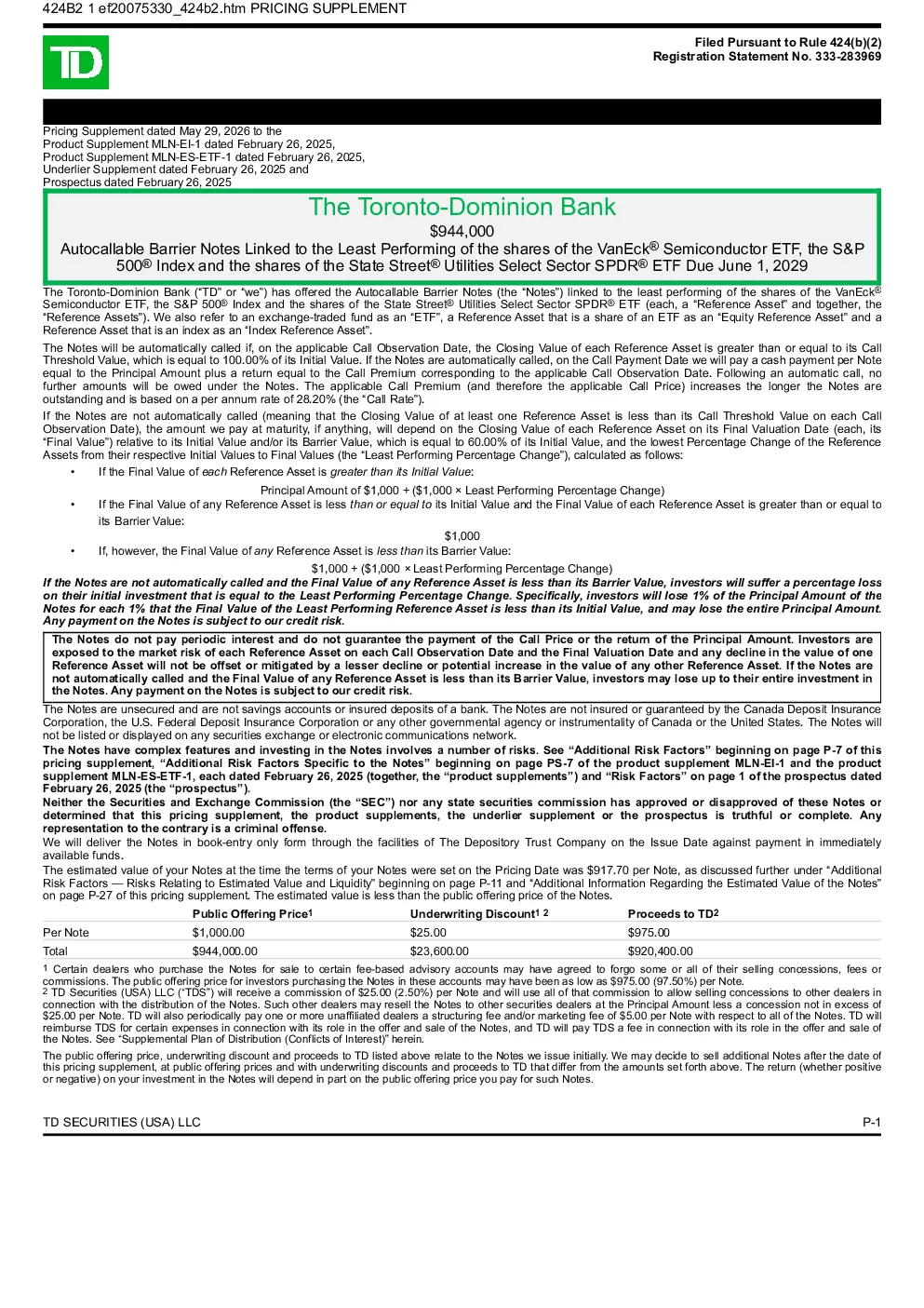
The Toronto-Dominion Bank (TD) has offered Autocallable Barrier Notes linked to the least performing of three reference assets: the VanEck® Semiconductor ETF, the S&P 500® Index, and the State Street® Utilities Select Sector SPDR® ETF. The Notes will automatically be called if the closing value of each reference asset on the applicable Call Observation Date is greater than or equal to its call threshold value (100% of its initial value). If called, the payment per Note will be equal to the principal amount ($1,000) plus a call premium based on a 28.20% annual rate.
If the Notes are not automatically called, the payment at maturity will depend on the final values of the reference assets relative to their initial values and their barrier values (60% of the initial value). Specifically:
- If the final value of each reference asset is greater than its initial value: Principal Amount + (Principal Amount × Least Performing Percentage Change)
- If the final value of any reference asset is less than or equal to its initial value but greater than or equal to its barrier value: Principal Amount ($1,000)
- If the final value of any reference asset is less than its barrier value: Principal Amount + (Principal Amount × Least Performing Percentage Change)
Investors may suffer a percentage loss on their initial investment if the Notes are not automatically called and the final value of any reference asset is less than its barrier value. The Notes do not pay periodic interest and do not guarantee the payment of the call price or the return of the principal amount.
Key risks associated with the Notes include:
- Return Characteristics: Potential loss of principal, no interest payments, reinvestment risk, and limited return if called.
- Reference Asset Characteristics: Market risks of each reference asset, exposure to the least performing asset, lower correlation between assets increasing loss risk, lack of affiliation with index sponsors or investment advisers, and potential adjustments to equity reference assets.
- Estimated Value and Liquidity: Estimated value is less than the public offering price, based on internal funding rate and models, and secondary market prices may be significantly lower.
- Hedging Activities and Conflicts of Interest: Potential conflicts of interest between investors and the calculation agent, limited anti-dilution protection, and risks related to hedging activities and business relationships with reference asset issuers.
- General Credit Characteristics: Investors are subject to TD’s credit risk, and changes in credit ratings or spreads may adversely affect the market value of the Notes.
- Taxation: Significant aspects of the tax treatment of the Notes are uncertain, particularly for U.S. holders, with potential for different characterizations and withholding taxes.
The Notes are unsecured and not insured or guaranteed by any governmental agency. Investing in the Notes involves complex features and numerous risks, as detailed in the additional risk factors and related documents.