您的浏览器禁用了JavaScript(一种计算机语言,用以实现您与网页的交互),请解除该禁用,或者联系我们。 [世界银行]:《蒙古经济更新》,2026年4月:保持稳定和韧性——特别关注:利用集聚提高乌兰巴托的生产力 - 发现报告

《蒙古经济更新》,2026年4月:保持稳定和韧性——特别关注:利用集聚提高乌兰巴托的生产力

文化传媒 2026-04-30 世界银行 张兵
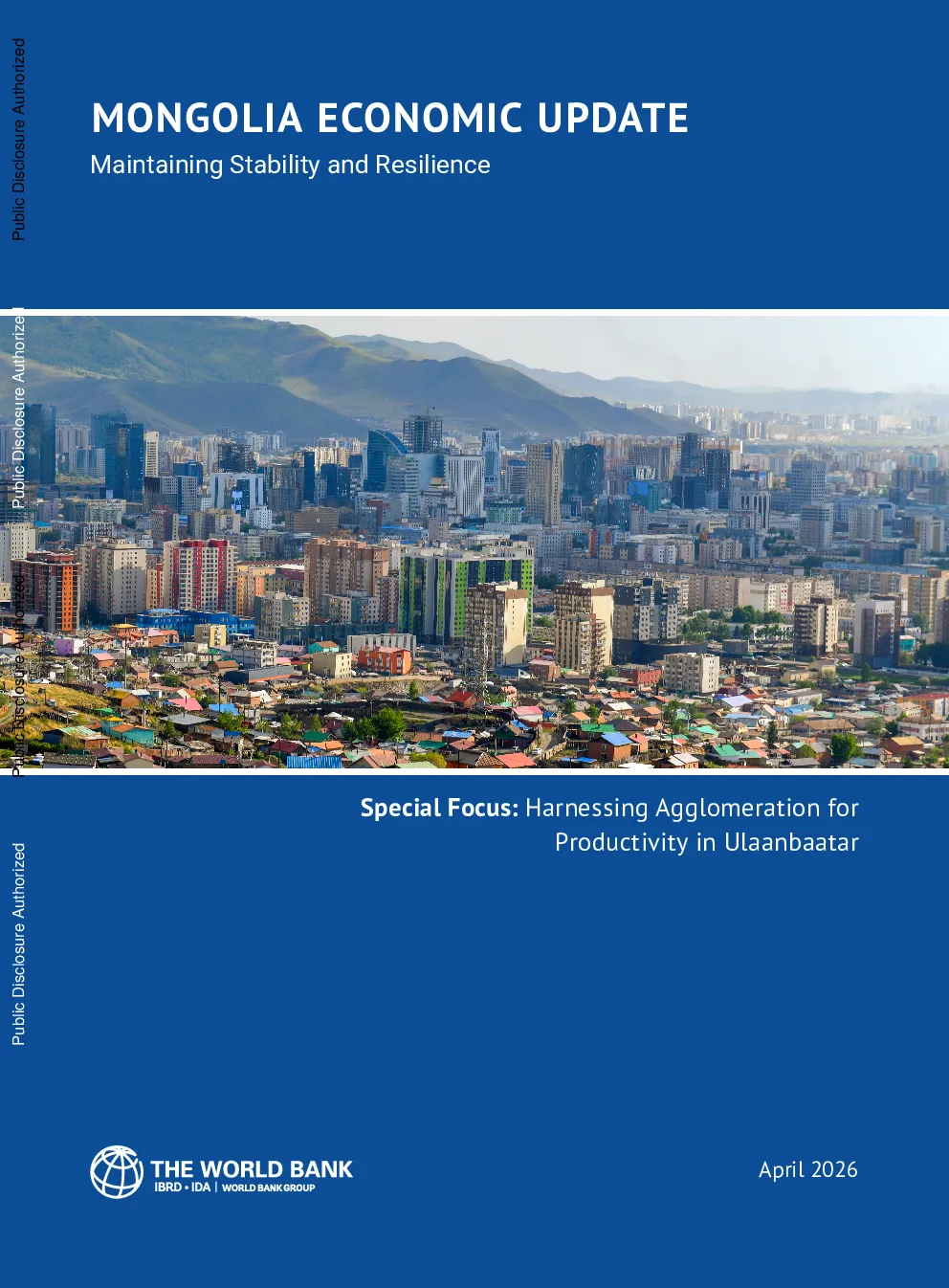
报告封面

Maintaining Stability and Resilience Special Focus:Harnessing Agglomeration for MONGOLIA Maintaining Stability and Resilience © 2026 International Bank for Reconstruction and Development / The World Bank1818 H Street NWWashington DC 20433Telephone: 202-473-1000 This work is a product of the staff of the World Bank with external contributions. The findings, interpretations,and conclusions expressed in this work do not necessarily reflect the views of the World Bank, its Board of The World Bank does not guarantee the accuracy, completeness, or currency of the data included in this workand does not assume responsibility for any errors, omissions, or discrepancies in the information, or liabilitywith respect to the use of or failure to use the information, methods, processes, or conclusions set forth. Theboundaries, colors, denominations, links/footnotes, and other information shown in this work do not imply any Nothing herein shall constitute or be construed or considered to be a limitation upon or waiver of the privilegesand immunities of the World Bank, all of which are specifically reserved. Rights and Permissions TThe material in this work is subject to copyright. Because the World Bank encourages dissemination of itsknowledge, this work may be reproduced, in whole or in part, for noncommercial purposes as long as full Any queries on rights and licenses, including subsidiary rights, should be addressed to the World BankPublications, the World Bank Group, 1818 H Street NW, Washington, DC 20433, USA; fax: 202-522-2625; e-mail: Cover photo and pictures: © Batbaatar Jambal / Baku’s Picture. Used with the permission of Batbaatar Jambal.Further permission required for reuse. Design: Baku’s Design CONTENTS ABBREVIATIONS ACKNOWLEDGEMENTS This edition of the Mongolia Economic Update (MEU) was led by Undral Batmunkh(Economist) and Jose Luis Diaz Sanchez (Senior Economist), with contributions fromErdenebulgan Ganbat (Consultant) and Mijiddorj Lkhagvasuren (Consultant), under theguidance of Mara K. Warwick (Division Director), Habib Nasser Rab (Practice Manager), TaeHyun Lee (Country Manager), and Elitza Mileva (Lead Economist). The team is grateful to The special focus chapter (Chapter 2) of this MEU is an adaptation from a forthcoming WorldBank Policy Research Working Paper“Beyond the Urban Sweet Spot: Firm-Level Evidence ofOver-Agglomeration in Mongolia’s Capital”,authored by Jose Luis Diaz Sanchez and MijiddorjLkhagvasuren as part of a collaboration between the World Bank and Bank of Mongolia.Chyi-Yun Huang (Senior Urban Specialist) and Xiao Wu (Urban Development Analyst) The findings, interpretations, and conclusions expressed in this update are those of theWorld Bank staff and do not necessarily reflect the views of the Executive Board of theWorld Bank or the governments they represent. For information about the World Bank and its activities in Mongolia, please visithttps://www.worldbank.org/en/country/mongolia.For questions and comments on the contents of this publication, please contact Undral EXECUTIVE SUMMARY Chapter 1: Recent Economic Developments and Outlook Despite trade disruptions and elevated geopolitical tensions, Mongolia’s economic growthremained strong in 2025, reaching 6.9 percent.Growth was driven mainly by a strongrebound in agriculture following dzud-related losses, alongside solid mining performance.The latter was led by copper production at Oyu Tolgoi (OT), a key mine, which offset These developments supported household incomes, private consumption, and exports. Private consumption remained robust, contributing to inflation averaging 8.6 percent, withadditional pressures from higher food and energy prices. However, consumption graduallylost momentum over the year amid softening labor market conditions and slower growthin real incomes and consumer credit (Figure ES.2). Net exports also contributed strongly togrowth, thanks to higher copper exports. Fixed investment was supported by state owned A stronger trade balance and lower services deficit narrowed the current account deficit.At the same time, weaker FDI inflows were partly offset by increased external borrowing,supporting reserve accumulation. Merchandise export growth was broadly flat. A sharpdecline in coal revenues, driven by lower prices, offset a strong rebound in copper exports;these were supported by higher prices and increased production at the OT mine. Meanwhile,imports contracted, reflecting weaker demand for durable and capital goods amid tighter Amid revenue shortfalls, fiscal policy followed a rule-based adjustment, weighing onbudget-financed investment.Total revenue declined to 35.3 percent of GDP, down froma historic high of 39.2 percent in 2024. The decline was mainly due to a sharp drop incoal prices that reduced mining-related revenues, while non-mining revenues also softenedamid weak trade-related activity. To comply with fiscal rules, budget spending fell markedlyto 33.8 percent of GDP in 202