您的浏览器禁用了JavaScript(一种计算机语言,用以实现您与网页的交互),请解除该禁用,或者联系我们。 [ABI Research]:2025 AI汽车设计范式白皮书 - 发现报告

2025 AI汽车设计范式白皮书

交运设备 2025-11-14 ABI Research 浮云
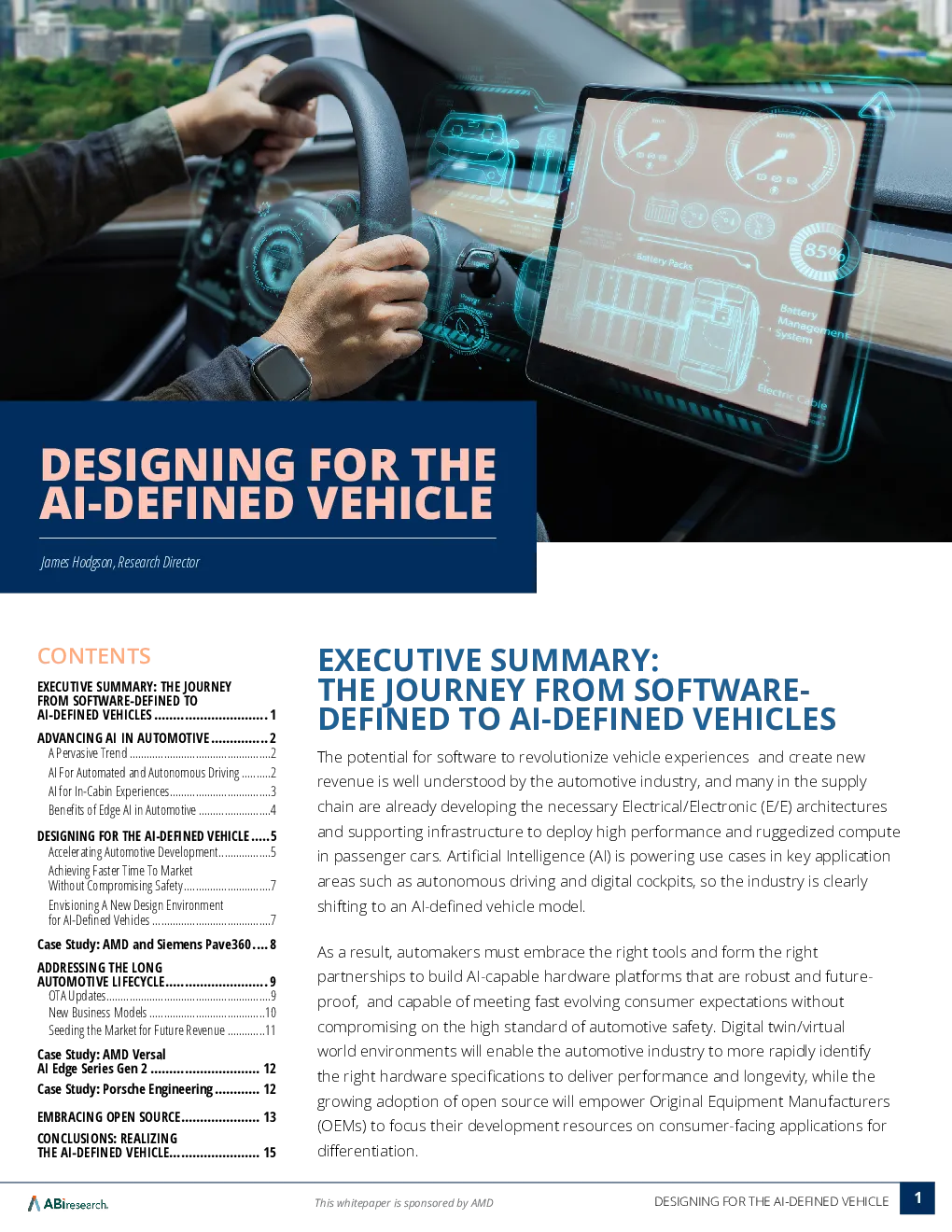
报告封面

James Hodgson, Research Director EXECUTIVE SUMMARY:THE JOURNEY FROM SOFTWARE-DEFINED TO AI-DEFINED VEHICLES CONTENTS EXECUTIVE SUMMARY: THE JOURNEYFROM SOFTWARE-DEFINED TOAI-DEFINED VEHICLES..............................1 ADVANCING AI IN AUTOMOTIVE...............2A Pervasive Trend.................................................2AIFor Automated and Autonomous Driving..........2AIfor In-Cabin Experiences...................................3Benefits of Edge AI in Automotive.........................4 The potential for software to revolutionize vehicle experiences and create newrevenue is well understood by the automotive industry, and many in the supplychain are already developing the necessary Electrical/Electronic (E/E) architectures DESIGNING FOR THE AI-DEFINED VEHICLE.....5Accelerating Automotive Development..................5Achieving Faster Time To MarketWithout Compromising Safety..............................7Envisioning A New Design Environmentfor AI-Defined Vehicles.........................................7 Case Study: AMD and Siemens Pave360....8ADDRESSING THE LONGAUTOMOTIVE LIFECYCLE...........................9OTAUpdates.........................................................9New Business Models........................................10Seeding the Market for Future Revenue.............11Case Study: AMD VersalAIEdge Series Gen 2.............................12Case Study: Porsche Engineering............12EMBRACING OPEN SOURCE.....................13CONCLUSIONS: REALIZINGTHE AI-DEFINED VEHICLE........................15 As a result, automakers must embrace the right tools and form the rightpartnerships to build AI-capable hardware platforms that are robust and future-proof, and capable of meeting fast evolving consumer expectations withoutcompromising on the high standard of automotive safety. Digital twin/virtual ADVANCING AI IN AUTOMOTIVE A PERVASIVE TREND AI is reshaping how people live, work, and enjoy their free time. The widespread adoption of AI inautomotive is set to transform how cars are designed and manufactured, how they will navigatefrom A to B, the experience that they deliver to drivers and passengers on their journeys, andthe way in which cars will be maintained throughout their lifecycle. Some of this transformation The rise of AI in the automotive industry coincides with an existing and equally impactful trendthat is already reshaping the passenger vehicle market—the Software-Defined Vehicle (SDV),with automakers looking to pivot away from hardware-based customization to software-based The rapid growth in AI performance has also unleashed an equally rapid era of innovation inAI-powered use cases and applications for the automotive market, with some already emergingas priorities for OEMs in the next 3 to 5 years. As a result, the automotive industry must build AI FOR AUTOMATED AND AUTONOMOUS DRIVING The most impactful AI application in the automotive market will be autonomous driving adoption.Early signs of automated and autonomous vehicle adoption are already emerging in the market,and as the technology scales, it offers the potential to give drivers back valuable time currently From the outset of the autonomous vehicle revolution, AI has been an essential enablingtechnology. Initially, this was focused on scaling the performance of the modular perceptionstack—the system of algorithms and models that process sensor data to detect, classify, andtrack objects for decision-making and navigation. This system also includes sensor fusion, driving commands/maneuvers. The shift from CNNs to Vision Transformers (ViTs) and now toend-to-end models in automotive is driven by the need for greater flexibility, global contextunderstanding, and streamlined perception-to-decision pipelines, enabling more accurate,scalable, and efficient autonomous driving systems. This evolution is intended to reduce manualfeature engineering and improve performance across diverse driving scenarios. Advocates of the Whether in modular approaches, end-to-end approaches, or hybrids of the two, AI is clearly anessential enabling technology to deliver scalable systems that can operate in multiple contexts AI FOR IN-CABIN EXPERIENCES One of the most visible areas of the impact of AI in automotive will be in the cabin, whereGenerative Artificial Intelligence (Gen AI) will create a more natural interface between the driver When shaping their digital cockpit experiences, automakers have taken inspiration from theworld of smartphones, imitating the smartphone’s features and services, and its application and This has not translated well into the cockpit environment. At best, navigating from one app tothe next through a touchscreen display located at arm’s length and in the driver’s peripheralvision is awkward. Indeed, many of the services and features that OEMs invest in to shape theircockpit experience go underutilized, hidden from the driver within sub-menus of sub-menusacross separate applications. The to