您的浏览器禁用了JavaScript(一种计算机语言,用以实现您与网页的交互),请解除该禁用,或者联系我们。 [斯坦福]:2025斯坦福新兴技术评论:十项关键技术及其政策影响分析报告 - 发现报告

2025斯坦福新兴技术评论:十项关键技术及其政策影响分析报告

综合 2025-02-26 斯坦福 Good Luck
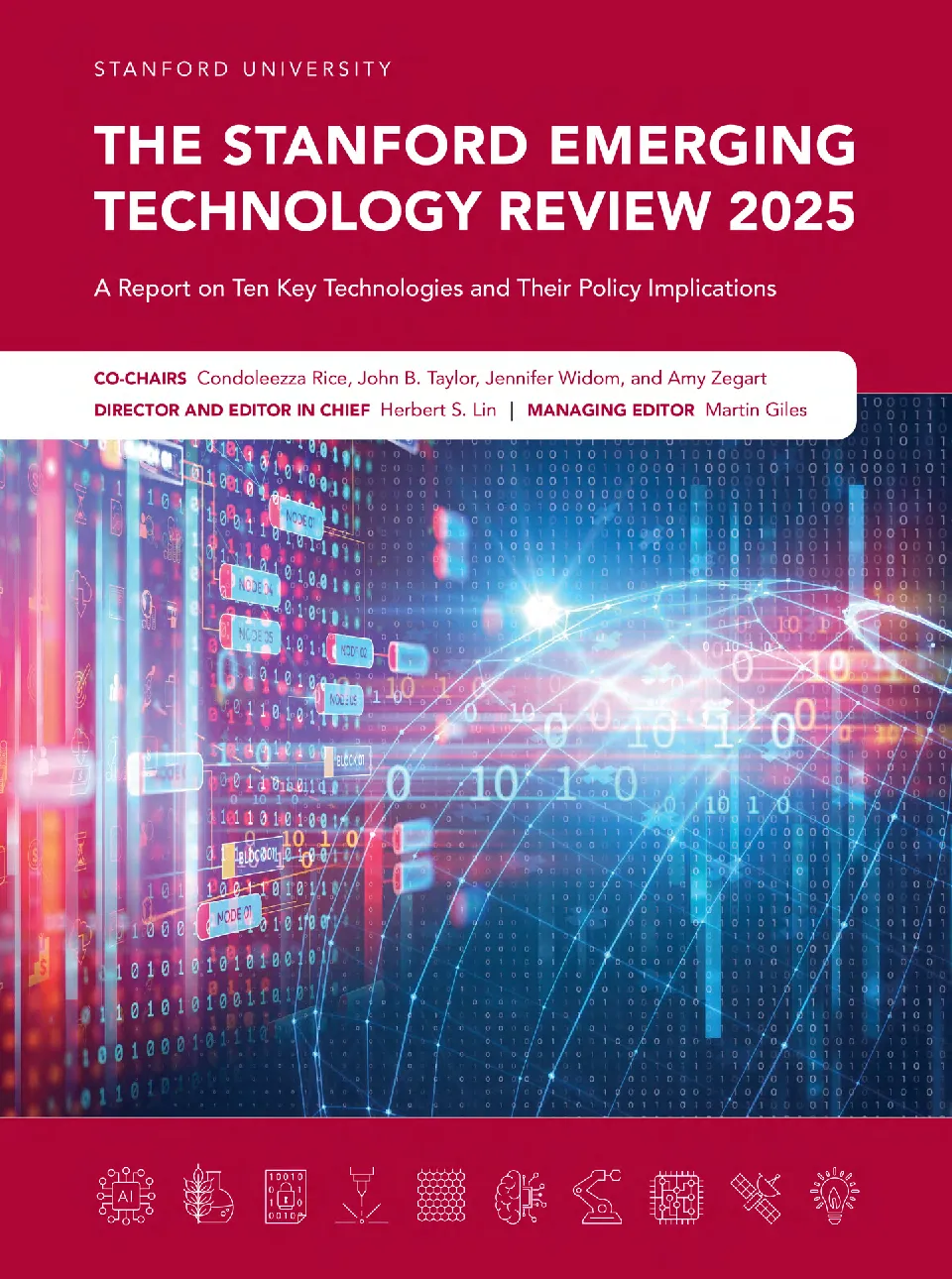
报告封面

THE STANFORD EMERGINGTECHNOLOGY REVIEW 2025 A Report on Ten Key Technologies and Their Policy Implications CO-CHAIRS Condoleezza RiceJohn B. TaylorJennifer WidomAmy Zegart DIRECTOR AND EDITOR IN CHIEFHerbert S. Lin MANAGING EDITORMartin Giles Stanford UniversityStanford, California CONTENTS FOREWORD4 01Artificial Intelligence 21 EXECUTIVE SUMMARY10 INTRODUCTION18 03Cryptography 53 11Crosscutting Themes andCommonalities156 12Technology Applications byPolicy Area174 Economic Growth174National Security176Environmental and EnergySustainability177Health and Medicine179Civil Society180 Key Observations About How TechnologiesEvolve over Time157Common Innovation Enablers andInhibitors164 CONCLUSION182 FOREWORD In every era, technological discoveries bring bothpromise and risk. Rarely, however, has the worldexperienced technological change at the speed andscale we see today. From nanomaterials that are fiftythousand times smaller than the width of a humanhair to commercial satellites and other private-sector technologies deployed in outer space, break-throughs are rapidly reshaping markets, societies,and geopolitics. What’s more, US technology policyisn’t the unique province of government like it usedto be. Instead, inventors and investors are makingdecisions with enormous policy consequences, evenif they may not always realize it. Artificial intelligence(AI) algorithms are imbued with policy choices aboutwhich outcomes are desired and which are not.Nearlyevery new technology,from bioengineer-ing new medicines to building underwater researchdrones, has both commercial and military applica-tions. Private-sector investment, too, simultaneouslygenerates both national advantages and vulnerabil-ities by developing new capabilities, supply chains,anddependencies and by pursuing commercialopportunities that may not serve long-term nationalinterests. government offices are likely to set trajectories forthe United States and the world for years to come. Now more than ever, understanding the landscapeofdiscovery and how to harness technology toforge a better future requires working across sectors,fields, and generations. Universities like Stanfordhave a vital role to play in this effort. In 2023, welaunched the Stanford Emerging Technology Review(SETR), the first-ever collaboration between StanfordUniversity’s School of Engineering and the HooverInstitution. Our goal is ambitious: transforming tech-nology education for decision makers in both thepublic and private sectors so that the United Statescan seize opportunities, mitigate risks, and ensurethe American innovation ecosystem continues tothrive. This is our latest report surveying the state of tenkey emerging technologies and their implications. Itharnesses the expertise of leading faculty in scienceandengineering fields,economics,internationalrelations, and history to identify key technologicaldevelopments,assess potential implications,andhighlight what policymakers should know. Whileengineers and executives need to betterunderstandthe policy world,government lead-ersneed to better understand the engineeringandbusiness worlds.Otherwise,public policiesintended to protect against societal harms may endup accelerating them, and efforts to align innova-tion with the national interest could end up harmingthat interest by dampening America’s innovationleadership and the geopolitical advantages thatcome with it. This report is our flagship product, but it is just oneelement of our continuous technology educationcampaign for policymakers that now involves nearlyone hundred Stanford scholars across forty depart-ments and research institutes. In the past year, SETRexperts have briefed senior leaders across the USgovernment—in Congress and in the White House,Commerce Department, Defense Department, andUS intelligence community. We have organized andparticipated in fifteen Stanford programs, includingmultiday AI and biotechnology boot camps for con-gressional staff; SETR roundtables for national mediaand officials from European partners and allies; and In these complex times, the only certainties arethat uncertainty is rampant and the stakes are high:Decisions made today in boardrooms, labs, and workshops convening leaders across sectors in semi-conductors, space technology, and bioengineering.And we are just getting started. 2.Academia’s role in American innovation isessential—and at risk. The US innovation ecosystem rests on three pillars:the government, the private sector, and the acad-emy. Success requires robust research and develop-ment (R&D) in all three. But they are not the same,and evidence increasingly suggests that universities’role as the engines of innovation is at a growing risk. Our efforts are guided by three observations: 1.America’s global innovation leadershipmatters. American innovation leadership is not just impor-tant for the nation’s economy and security. It is thelinchpin for maintaining a dynamic global technol-ogy innovation