您的浏览器禁用了JavaScript(一种计算机语言,用以实现您与网页的交互),请解除该禁用,或者联系我们。 [-]:为什么中国仍在建设新煤炭:审视中国长期能源路径的合理性 - 发现报告

为什么中国仍在建设新煤炭:审视中国长期能源路径的合理性

化石能源 2026-03-02 - - 嗯哼
报告封面

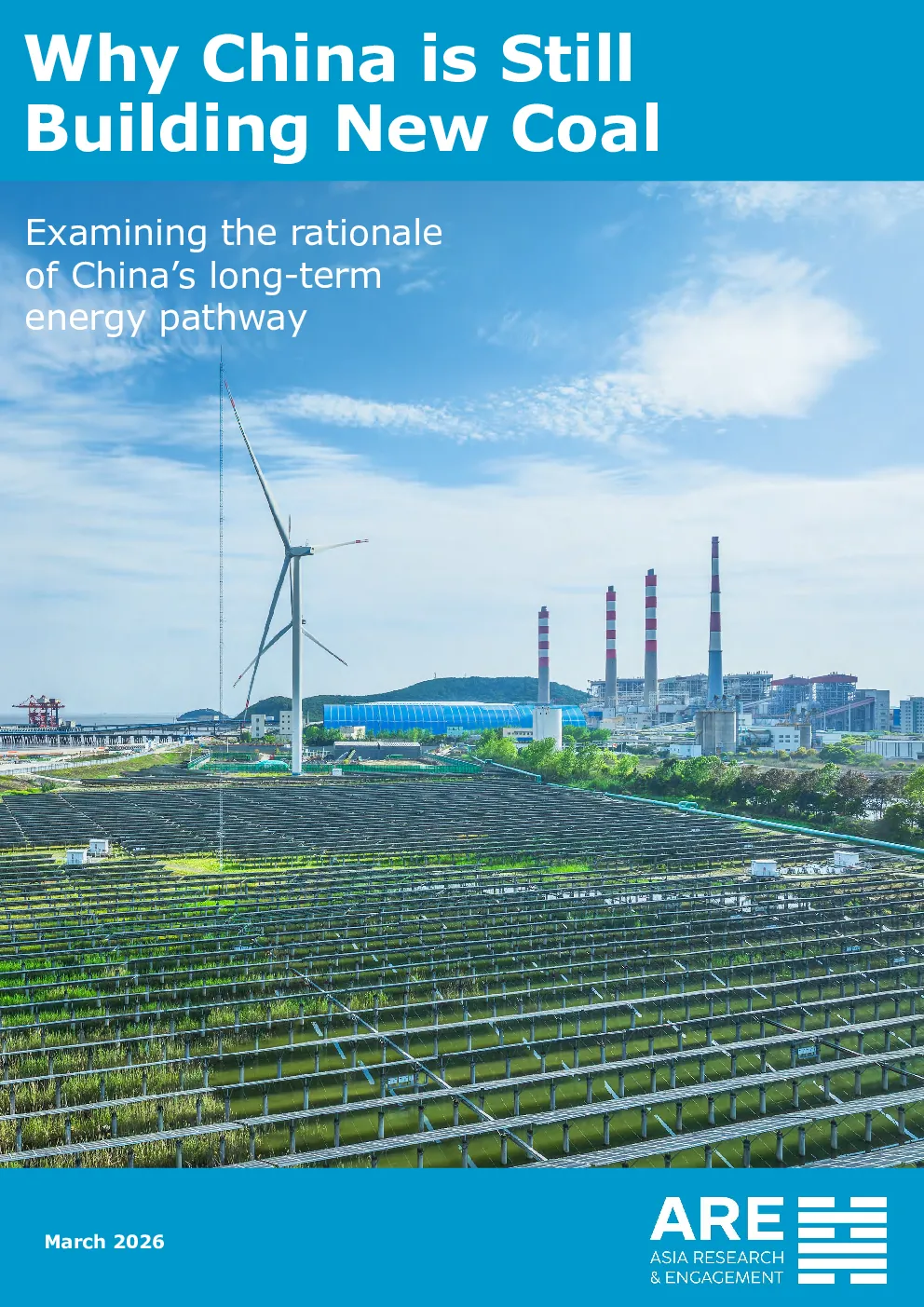
Examining the rationaleof China’s long-termenergy pathway March 2026 Asia Research & Engagement (ARE) Catalysing corporate change through investor-backed engagement. ARE brings leading investors into dialogue with Asian-listed companies to addresssustainable development challenges and help companies align with investor priorities.With decades of Asia experience, our cross-cultural team understands the region’s uniqueneeds. Our high-quality independent research, robust investor network, and engagementexpertise, provide corporate leaders and financial decision makers with insights leading toconcrete action. Current programmes and goals are: •Energy Transition: Credible transition pathways in alignment with the ParisAgreement.•Protein Transition: Transition pathways working towards our investor-aligned 2030 vision. Founded in 2013, ARE is headquartered in Singapore with an additional office in Beijing anda presence in India and Japan. Author Wang Ran Editing and CommentsMat Oakley, Wai-Shin Chan, Flora Wu, Ben McCarron Cover photo by Dongfang Zhao, iStock Executive Summary •Abundant coal reserves coupled with limited low-carbonflexibility resources make coal a critical component ofChina’s energy transition, providing flexibility and stability tothe grid as renewables scale up.•New coal capacity built specifically for flexibility during the14th Five-Year Plan accounted for 25% of total additions.•Despite the ongoing coal buildout, coal power capacity isprojected to peak by 2030 before declining to just 4.1% oftotal electricity mix by 2060.•Solar and wind on an inexorable path to becoming thedominant sources of China’s electricity generation.•Current cost and development barriers to alternativeflexibility resources make coal the only viable option untilthese technologies mature.•Significant opportunities exist in renewables, storage,pumped hydro, CCUS, and grid integration solutions tosupport China’s clean energy transition. China’s status among the world’s largest economies and the scale ofits greenhouse gas emissions makes the country’s energy transitionpivotal to global climate action. Despite leading the world in renewableenergy deployment, China continues to expand its coal power capacity,raising concerns about its commitment to achieving carbon neutralityby 2060. This report examines the rationale behind China’s continued coalbuildout, its trajectory toward carbon neutrality, and investmentopportunities along its dual-carbon pathways. China’s energy-related activities account for nearly 80% of its totalCO2emissions. The power-generation sector contributes more thanhalf of that share. While total solar and wind capacity surpassedthermal power for the first time in 2023, coal remains a dominantsource of electricity generation, driven by the need to ensure systemsecurity, meet rising electricity demand, and provide flexibility tosupport the integration of variable renewable energy sources. The country’s resource endowment, characterised by abundant coalreserves and limited oil and gas, has made coal a critical transitionalresource in providing flexibility to cover the intermittency of windand solar power, under China’s deterministic approach to resourceadequacy planning. In addition, low-carbon flexibility resources willstruggle to keep up with increasing renewables integration by 2030. Regional imbalances in power supply and demand, coupled withunderdeveloped interprovincial transmission infrastructure, haveled provinces to build new coal plants to address local electricityshortages. However, our analysis suggests that even though new plants continueto be built, coal capacity is set to peak by 2030 and steadily declinethereafter. By 2060, we estimate the share of coal capacity within totalpower generation will decline to about 4.1% and all remaining plantswill be retrofitted with carbon capture technologies. Already, newcoal plants are increasingly being repurposed to support renewableintegration, and approximately one-third of new capacity is aimed atenhancing system flexibility rather than extending fossil fuel reliance. By 2060, our analysis indicates that wind power will account for 35%of power generation, and solar for 32%, supported by the deploymentof about 1,660 gigawatts of storage technology and supplemented bya substantial increase in nuclear and hydropower. While these changes unfold, China’s economic growth and risingelectricity demand will continue to reinforce the need for coal capacityin the short to medium term. Until low-carbon solutions are readyto be widely adopted, coal is the only feasible and reliable flexibilityresource available to balance renewables and provide baseload power. But the broader trajectory is clear. China’s long-term energy strategyremains focused on achieving carbon neutrality, and the country’songoing clean energy transition represents a once-in-a-generationopportunity to align economic development with decarbonisation.For technology providers a