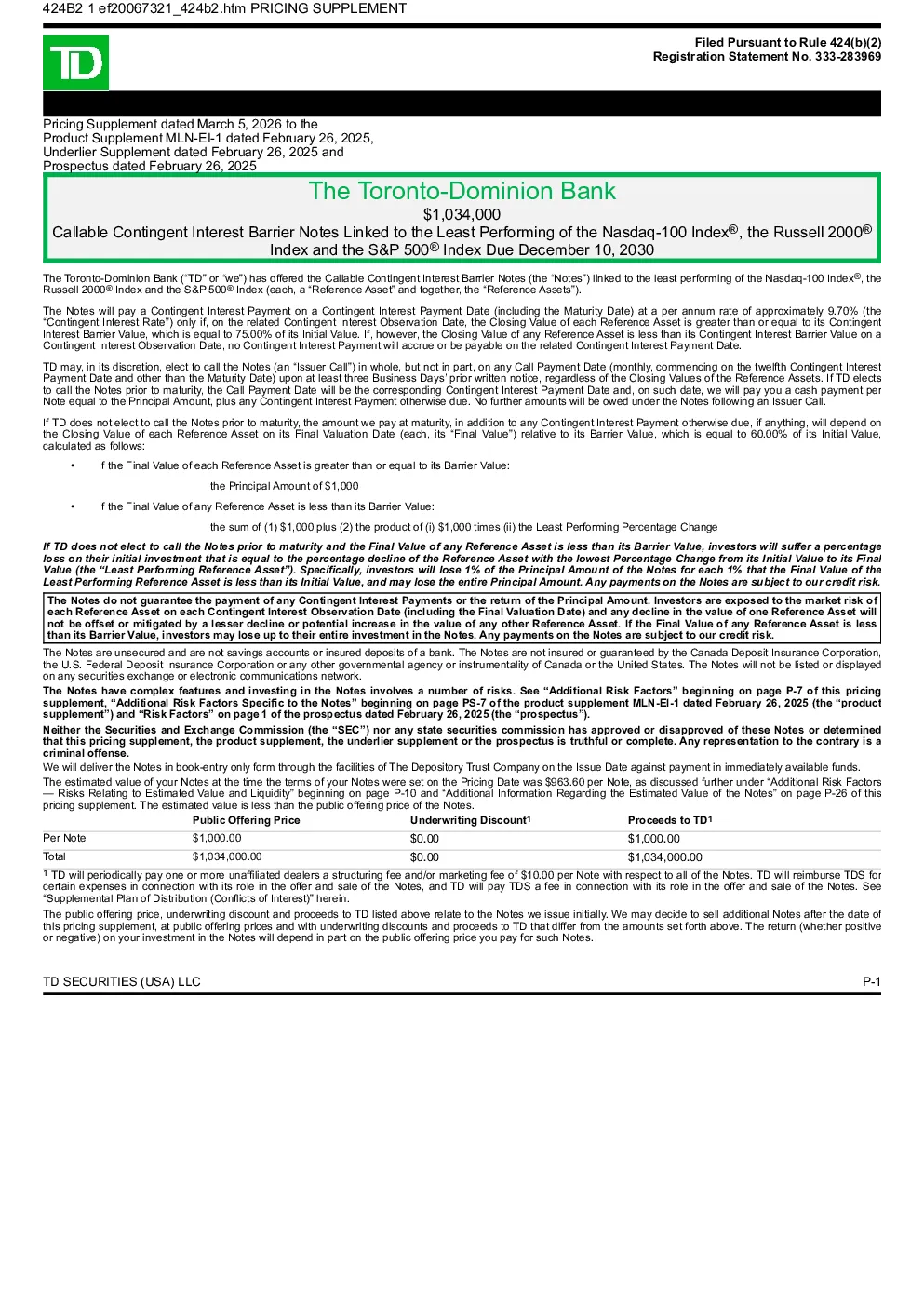
The Toronto-Dominion Bank (TD) has offered Callable Contingent Interest Barrier Notes linked to the least performing of the Nasdaq-100 Index®, the Russell 2000® Index and the S&P 500® Index. The Notes will pay a Contingent Interest Payment of approximately 9.70% per annum only if, on the related Contingent Interest Observation Date, the Closing Value of each Reference Asset is greater than or equal to its Contingent Interest Barrier Value, which is 75.00% of its Initial Value. If the Closing Value of any Reference Asset is less than its Contingent Interest Barrier Value on a Contingent Interest Observation Date, no Contingent Interest Payment will accrue or be payable.
Key Features:
- Term: Approximately 57 months, subject to an Issuer Call.
- Reference Assets: Nasdaq-100 Index® (NDX), Russell 2000® Index (RTY), S&P 500® Index (SPX).
- Principal Amount: $1,000 per Note.
- Contingent Interest Rate: Approximately 9.70% per annum.
- Contingent Interest Barrier Value: 75.00% of Initial Value.
- Barrier Value: 60.00% of Initial Value.
- Call Feature: TD may elect to call the Notes in whole on any Call Payment Date (monthly, commencing on the twelfth Contingent Interest Payment Date) upon at least three Business Days’ prior written notice.
Payment at Maturity:
- If TD does not elect to call the Notes prior to maturity, the payment will be:
- $1,000 (Principal Amount) if the Final Value of each Reference Asset is greater than or equal to its Barrier Value.
- $1,000 + ($1,000 × Least Performing Percentage Change) if the Final Value of any Reference Asset is less than its Barrier Value.
- The Least Performing Percentage Change is calculated as the difference between the Final Value and Initial Value of the Least Performing Reference Asset, expressed as a percentage.
Risks:
- Return Risk: The Notes do not guarantee the return of the Principal Amount and investors may lose up to their entire investment.
- Interest Rate Risk: The Notes are more sensitive to interest rate risk due to the contingent interest and Issuer Call features.
- Market Risk: Investors are exposed to the market risk of each Reference Asset on each Contingent Interest Observation Date.
- Liquidity Risk: There may not be an active trading market for the Notes, and secondary market sales may result in significant losses.
- Credit Risk: Investors are subject to TD’s credit risk, and any decrease in TD’s credit ratings or increase in the credit spreads charged by the market will likely adversely affect the market value of the Notes.
- Taxation Risk: The U.S. tax treatment of the Notes is uncertain, and it is possible that the Notes could be treated as a single contingent payment debt instrument, resulting in a different timing and character of income.
Hypothetical Returns:
- Example 1: TD elects to call the Notes on the first potential Call Payment Date, resulting in a total return of 8.8913%.
- Example 2: The Closing Value of at least one Reference Asset is less than its Contingent Interest Barrier Value on each Contingent Interest Observation Date prior to the Final Valuation Date, and TD does not elect to call the Notes prior to maturity. The total return is 0.8083%.
- Example 3: The Closing Value of at least one Reference Asset is less than its Contingent Interest Barrier Value on each Contingent Interest Observation Date prior to the Final Valuation Date, TD does not elect to call the Notes prior to maturity, the Final Value of each Reference Asset is greater than or equal to its Barrier Value and Contingent Interest Barrier Value. The total return is 0.00%.
- Example 4: The Closing Value of at least one Reference Asset is less than its Contingent Interest Barrier Value on each Contingent Interest Observation Date prior to the Final Valuation Date, TD does not elect to call the Notes prior to maturity, the Final Value of each Reference Asset is greater than or equal to its Barrier Value and the Final Value of any Reference Asset is less than its Contingent Interest Barrier Value. The total return is a loss of 60.00%.
Conclusion:
The Callable Contingent Interest Barrier Notes offer a potentially high return but come with significant risks, including the possibility of losing the entire investment, market risk, liquidity risk, and uncertain taxation. Investors should carefully consider these risks and consult with their financial advisors before investing.