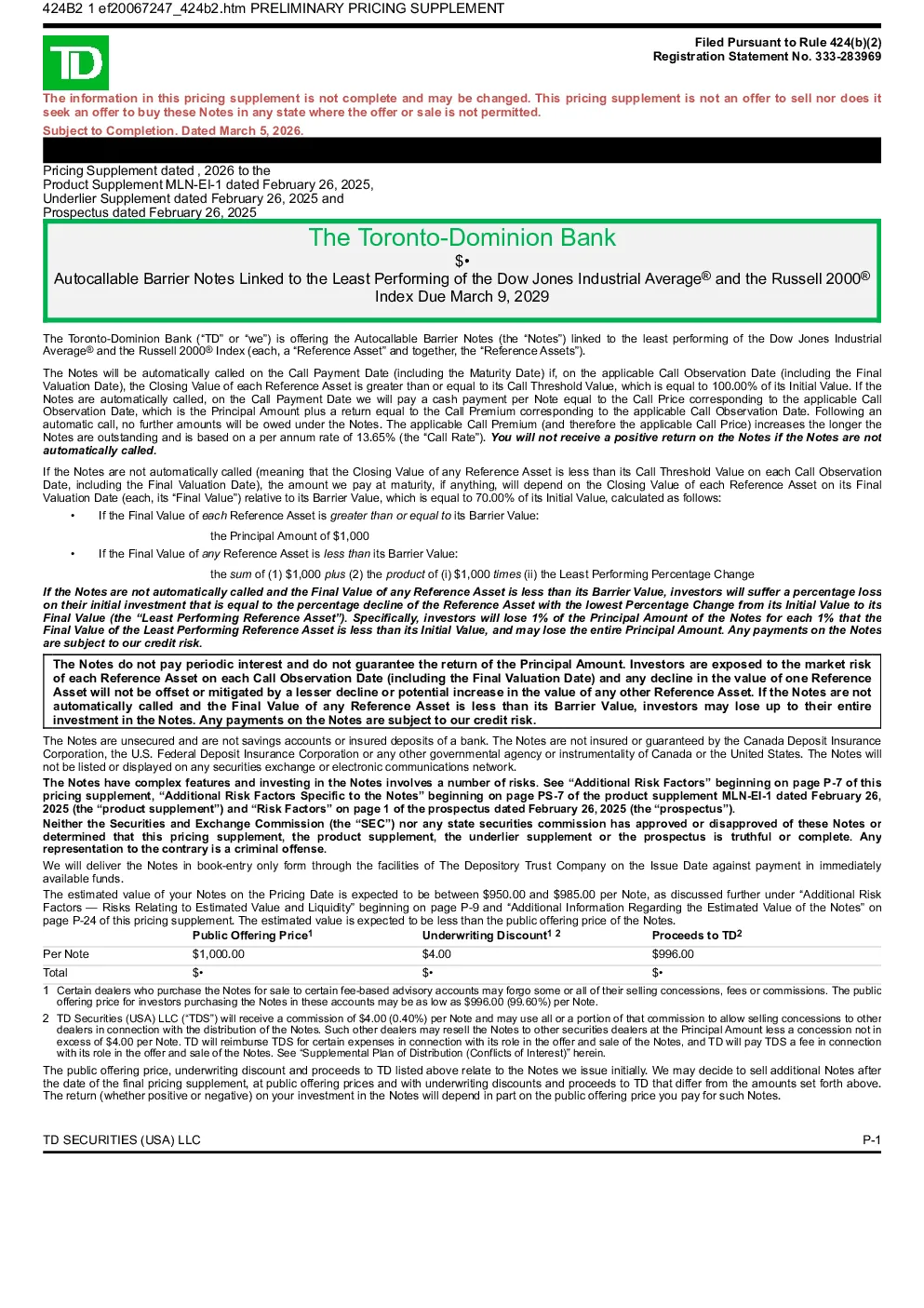
The Toronto-Dominion Bank (TD) is offering Autocallable Barrier Notes linked to the least performing of the Dow Jones Industrial Average® and the Russell 2000® Index, with a maturity date of March 9, 2029. The Notes will automatically call and pay a cash payment equal to the Principal Amount ($1,000) plus a Call Premium if the closing value of each Reference Asset is greater than or equal to its Call Threshold Value (100% of Initial Value) on the applicable Call Observation Date (including the Final Valuation Date). The applicable Call Premium increases the longer the Notes are outstanding, based on a Call Rate of 13.65% per annum.
If the Notes are not automatically called, the payment at maturity will depend on the Final Value of each Reference Asset relative to its Barrier Value (70% of Initial Value):
- If the Final Value of each Reference Asset is greater than or equal to its Barrier Value: the Principal Amount of $1,000.
- If the Final Value of any Reference Asset is less than its Barrier Value: $1,000 + ($1,000 × Least Performing Percentage Change).
The Notes do not pay periodic interest, and investors are exposed to the market risk of each Reference Asset. If the Notes are not automatically called and the Final Value of any Reference Asset is less than its Barrier Value, investors may lose up to their entire investment.
Key Risks:
- Return Characteristics: The Notes do not guarantee the return of the Principal Amount and may result in a loss. There is no periodic interest payment, and the potential positive return is limited to the Call Premium paid on the Notes, if any.
- Reference Asset Characteristics: Investors are exposed to the market risk of each Reference Asset on each Call Observation Date. The Notes are linked to the least performing of the two indices, increasing the risk of not receiving a positive return and losing a significant portion or all of the initial investment.
- Estimated Value and Liquidity: The estimated value of the Notes is expected to be between $950.00 and $985.00 per Note, less than the public offering price. There may not be an active secondary market for the Notes, and sales in the secondary market may result in significant losses.
- Hedging Activities and Conflicts of Interest: Potential conflicts of interest exist between investors and the Calculation Agent, as well as between investors and TD or its affiliates due to hedging activities and other business relationships.
- Credit Characteristics: Investors are subject to TD’s credit risk, and any decrease in TD’s credit ratings or increase in credit spreads may adversely affect the market value of the Notes.
- Taxation: Significant aspects of the tax treatment of the Notes are uncertain, particularly for U.S. holders. The Notes may be treated as prepaid derivative contracts for U.S. federal income tax purposes, with potential for ordinary income or short-term capital gain treatment. Non-U.S. holders may face reporting obligations under FATCA and potential U.S. withholding taxes.
Examples of Scenarios:
- Example 1: Both Reference Assets close above their Call Threshold Values on the first Call Observation Date, resulting in an automatic call and a payment of $1,136.50 per Note (13.65% return).
- Example 2: Both Reference Assets close above their Call Threshold Values on the second Call Observation Date, resulting in an automatic call and a payment of $1,273.00 per Note (27.30% return).
- Example 3: Both Reference Assets close above their Call Threshold Values on the Final Valuation Date, resulting in an automatic call and a payment of $1,409.50 per Note (40.95% return).
- Example 4: At least one Reference Asset closes below its Call Threshold Value on each Call Observation Date, and all Reference Assets close above their Barrier Values on the Final Valuation Date, resulting in a payment of $1,000.00 per Note (0.00% return).
- Example 5: At least one Reference Asset closes below its Call Threshold Value on each Call Observation Date, and at least one Reference Asset closes below its Barrier Value on the Final Valuation Date, resulting in a payment of $400.00 per Note (60.00% loss).
Conclusion: The Autocallable Barrier Notes offer a potentially high return but come with significant risks, including the possibility of losing the entire investment. Investors should carefully consider the risks and consult with their advisors before investing.