代理时代垂直软件的新增长引擎
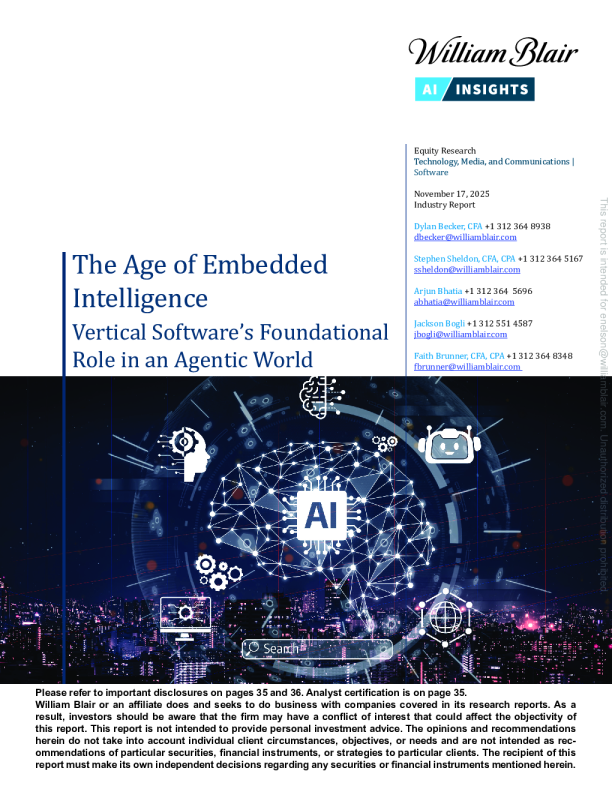
November 17, 2025Industry Report Dylan Becker, CFA+1 312 364 8938dbecker@williamblair.com The Age of EmbeddedIntelligenceVertical Software’s FoundationalRole in an Agentic World Stephen Sheldon, CFA, CPA+1 312 364 5167ssheldon@williamblair.com Arjun Bhatia+1 312 364 5696abhatia@williamblair.com Jackson Bogli+1 312 551 4587jbogli@williamblair.com Faith Brunner, CFA, CPA+1 312 364 8348fbrunner@williamblair.com Contents Introduction.......................................................................................................................3How Are Agents Different From Copilots?........................................................................5What Drives Value for an Agent?.......................................................................................6Why Vertical Software Is Favorably Positioned................................................................7Headcount Implications and How to Think About Sizing the OpportunityMore Broadly.............................................................................................................12Contextualizing the Case for Monetization.....................................................................14AI Also Allowing Software to Flex Own Operational Muscle..........................................16Summary..........................................................................................................................20Appendix – Public and Private Vendors..........................................................................21 Introduction Following the advent of generative AI tools, large language models, copilots, and now agentsover the past several quarters and years, investors have increasingly questioned the broader im-plications for businesses throughout the application software ecosystem. Investors and compa-nies alike have looked to stress-test historical barriers to entry and competitive differentiationunder this new paradigm, and a common question that continues to surface in our conversationscenters on a simple premise:Does AI disrupt the reliance on and ways that enterprises lever-age software applications?In addition, and more specifically, we are frequently askedwhatimpact AI has on vertical models and whether it disintermediates or enhances the valueproposition of industry-specific software applications. While our answer to both questions issteadfast and clear that we believe AI is both transformationally adding value to the overall ap-plication software universe and increasingly specialized and nuanced, throughout this report wehighlight multiple key attributes we believe are underappreciated related to vertical software’srole in an AI-oriented world. Most notably, we believe enterprise-grade agents, almost by definition, are foundationally builton industry-specific contextual data and highly nuanced, complex workflows—two key pillars ofthe vertical software value proposition and effectively rooted in business value at their core—toembed operational intelligence and enhance productivity across an enterprise. In addition, welook at why vertical software is well positioned relative to the ongoing debate of AI’s impact onseat-based pricing due to 1) AI’s ability to augment existing roles while automating mundanetasks, thus enhancing productivity at levels far greater than any potential job displacement, par-ticularly in relatively AI-proof end-markets like construction and physical trades (HVAC, plumb-ing, electrical, etc.), among others; 2) persistent labor shortages across many industries that havelagged in historical technology adoption; and 3) existing value-based pricing models that arehighly aligned with customer success (construction volume, direct written insurance premiums,gross transaction volume on trades spend, etc.). More broadly, we posit that through productiv-ity enhancements,software spend is likely to increasingly encapsulate a greater share of thelarger headcount-oriented spend across enterprises, thus effectively more than doubling theoverall addressable market and creating more efficient operating structures for applicationsoftware vendors over the coming years. Accordingly, we believe the increasing push toward more specialized agents serves as a significantopportunity for both existing and emerging vertical software businesses, including those in boththe public and private domain, and creates the potential for a notable uptick in vertical software in-vestment opportunities in the coming years. In addition, we believe value derived from these mod-els is likely to show up in several forms: 1) incremental revenue from individual AI-oriented SKUs;2) accelerated platform digitization and adoption attributable to embedded AI intelligence withincore system functionality; 3) improved retention and pricing power aligned with customer successafforded by the previous point (i.e., value-based pricing); 4) ecosystem enablement and the associ-ated value creation from more specialized