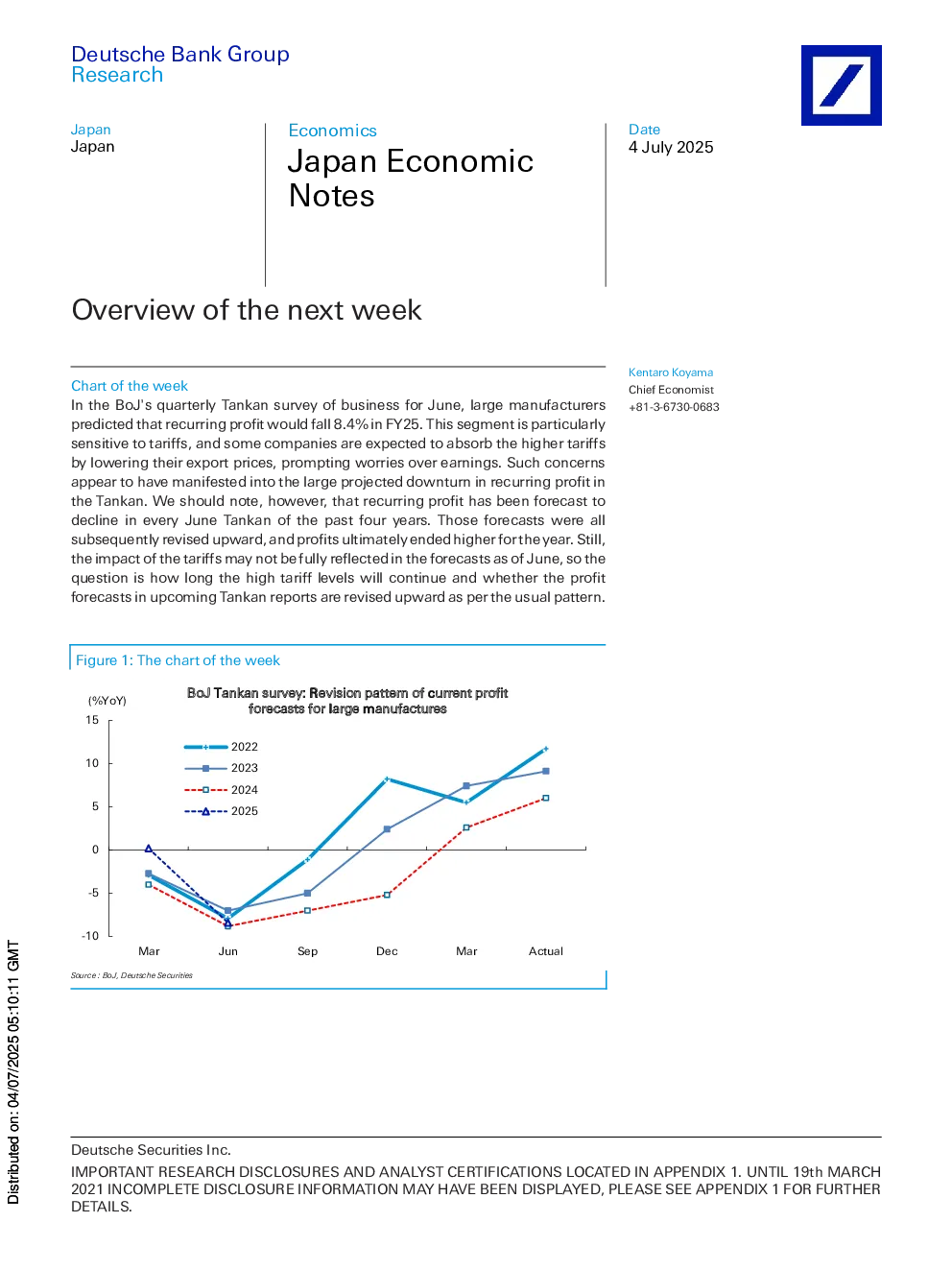
JapanJapan EconomicsJapan Economic Notes Overview of the next week Kentaro Koyama Chart of the week Chief Economist+81-3-6730-0683 In the BoJ's quarterly Tankan survey of business for June, large manufacturerspredicted that recurring profit would fall 8.4% in FY25. This segment is particularlysensitive to tariffs, and some companies are expected to absorb the higher tariffsby lowering their export prices, prompting worries over earnings. Such concernsappear to have manifested into the large projected downturn in recurring profit inthe Tankan. We should note, however, that recurring profit has been forecast todecline in every June Tankan of the past four years. Those forecasts were allsubsequently revised upward, and profits ultimately ended higher for the year. Still,the impact of the tariffs may not be fully reflected in the forecasts as of June, so thequestion is how long the high tariff levels will continue and whether the profitforecasts in upcoming Tankan reports are revised upward as per the usual pattern. 4 July 2025Japan Economic Notes Next week’s indicators We believe the Consumption Activity Index for May, due on 7 July, will grow 0.0%MoM. We anticipate spending to continue to be weighed down by food inflation. Atthe same time, services consumption should be buoyed by the Osaka Expo andrelated inbound spending. We estimate that consumption overall is trending slowlyhigher. The Economy Watchers Survey for June due on 8 July should show animprovement in both the current and future condition DI. Household sentimentshould benefit from the drop in rice prices. The Consumer Confidence Indexstrengthened in June, and we believe the Economy Watchers Survey should beconsistent with those results. The June domestic corporate goods price index willbe released on 10 July. We project a slowdown to 3.0% YoY (May: +3.2%). Theongoing decline in import prices should lead to a smaller rise in goods prices. Weforecast a 0.1% gain on a MoM basis. The key item in the simultaneously releasedexport prices will be prices for passenger car exports to North America. Thoseprices dropped a cumulative 17.7% in April and May, signifying that Japanese automakers are moving to absorb much of the tariff impact by lowering their exportprices. However, that strategy will ultimately damage profitability and is notsustainable in the long term. We will be watching the June data carefully for anysign of change in this pricing strategy. US-Japan trade talks The suspension of the increase in reciprocal tariff rates will end on 9 July. Multiplemedia reports suggest that US-Japan talks are at an impasse and a deal may not bereached in time. An agreement would at the very least reduce the uncertainty overtariffs. A reduction in the tariffs would be an additional plus. We believe that wouldraise the likelihood of a BoJ rate hike this month. On the other hand, if the parties fail to reach an agreement, we see two possibleoutcomes. One is a continuation of talks at the current tariff rates. In such a case,the uncertainty over the negotiations would persist as well. The other possibility isa hike in tariffs beyond the present levels and a discontinuation of the talks. Whilethe uncertainty would dissipate, this outcome would deliver a significant directblow to the Japanese economy. Either case would reduce the chances of a BoJ ratehike in the near future. A conclusion somewhere between those scenarios, such asa partial agreement alongside further negotiations, is also conceivable. Financialmarkets are keenly awaiting the results. Monetary policy events The BoJ will hold a branch managers' meeting on 10 July. The main point will be todiscuss how or whether the US tariff strategy is impacting regional economies. Themeeting will come just after the pause on tariff hikes is set to end, so we should bealert as well to any related comments by the BoJ. Figure 3: Important schedule Source : Sources: MoF, Deutsche Securities 4 July 2025Japan Economic Notes Sources: Haver Analytics, Deutsche Securities Sources: Haver Analytics, Deutsche Securities Appendix 1 Important Disclosures *Other information available upon request *Prices are current as of the end of the previous trading session unless otherwise indicated and are sourced from localexchanges via Reuters, Bloomberg and other vendors . Other information is sourced from Deutsche Bank, subject companies,and other sources. For further information regarding disclosures relevant to Deutsche Bank Research, please visit our globaldisclosure look-up page on our website at https://research.db.com/Research/Disclosures/FICCDisclosures. Aside from withinthis report, important risk and conflict disclosures can also be found at https://research.db.com/Research/Disclosures/Disclaimer. Investors are strongly encouraged to review this information before investing. Analyst Certification The views expressed in this report accurately reflect the personal views of the undersigned lead analyst(s).