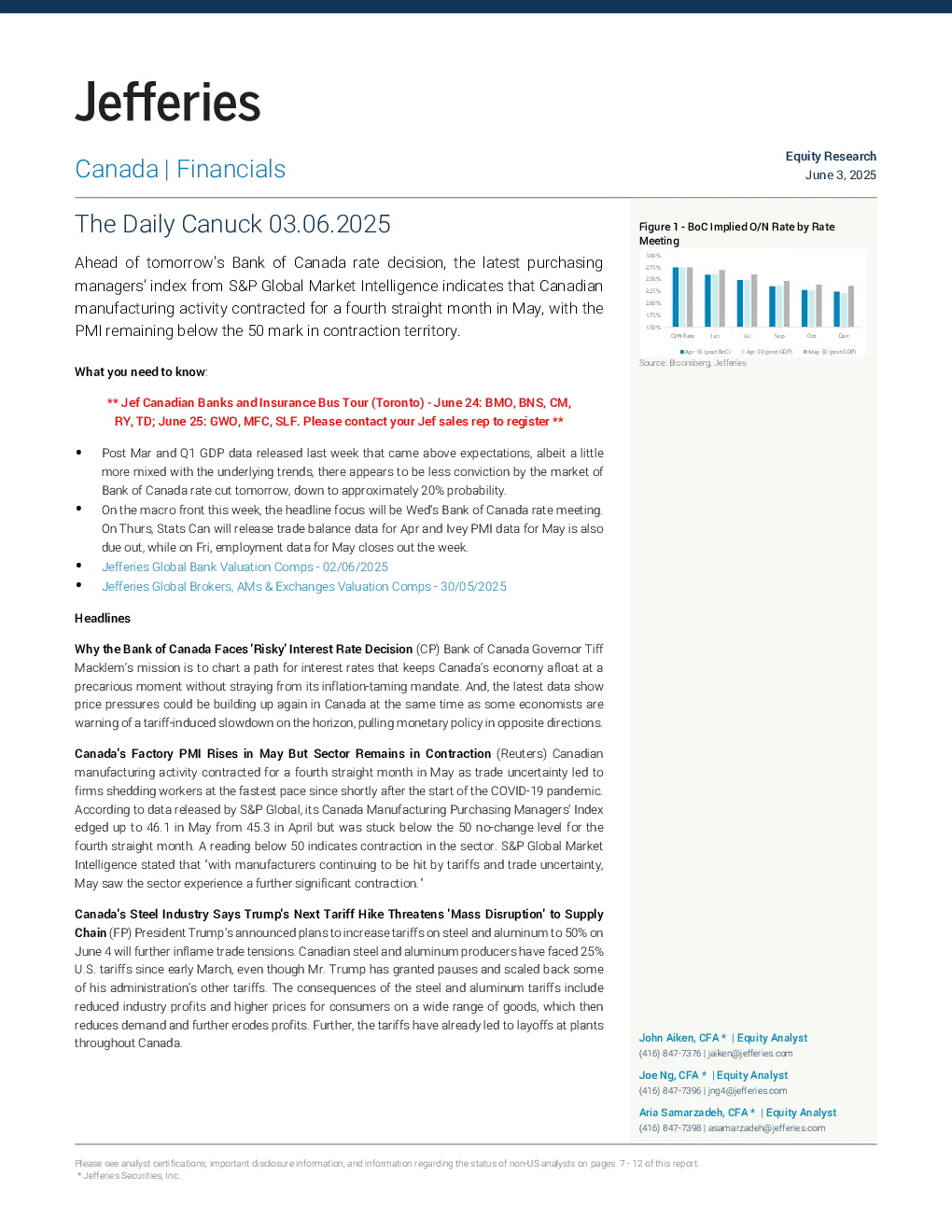
John Aiken, CFA * | Equity Analyst(416) 847-7376 | jaiken@jefferies.comJoe Ng, CFA * | Equity Analyst(416) 847-7396 | jng4@jefferies.comAria Samarzadeh, CFA * | Equity Analyst(416) 847-7398 | asamarzadeh@jefferies.comSource: Bloomberg, Jefferies Macroeconomic/GlobalWhy the Bank of Canada Faces 'Risky' Interest Rate Decision(CP) Yesterday, the Canadian Presshighlighted that Bank of Canada Governor Tiff Macklem’s mission is to chart a path for interest ratesthat keeps Canada’s economy afloat at a precarious moment without straying from its inflation-taming mandate. The latest data show price pressures could be building up again in Canada at thesame time as some economists are warning of a tariff-induced slowdown on the horizon, pullingmonetary policy in opposite directions. Most economists expect the central bank will hold ratesagain on Wednesday. In April, Mr. Macklem said the Bank of Canada would pause issuing anyformal forecasts and be less forward-looking than usual until it gained more certainty on how theeconomy would react to ever-shifting tariff threats. But the question for some economists isn’t whatthe economy has done, it’s what comes next. The Bank of Canada’s own surveys of businessespublished in early April showed sentiment was "sharply" lower amid the tariff uncertainty, with manyfirms putting investment and hiring plans on hold. Last Friday, Statistics Canada said the main reasonCanada’s economy was growing in the first quarter was because many businesses were trying torush ahead of the tariffs, ramping up exports and stockpiling inventories. In the G7 Finance Ministers'Summit meetings last month, Mr. Macklem noted that the central bank was expecting a run-up ineconomic activity in the first quarter, but that the months that follow "will be quite a bit weaker." On theemployment front, April job numbers showed the trade-sensitive manufacturing sector contractingby roughly 31,000 positions and the unemployment rate rising two ticks to 6.9%, while on the inflationside, April inflation data showed underlying price pressures were instead heating up. As such, whilecutting interest rates can encourage businesses and consumers to spend, mitigating an economichit, it also risks fuelling inflationary pressures. See also "Bank of Canada Expected to Remain onPause After Strong Economic Data", The Globe and Mail, June 2, 2025.Canada's Factory PMI Rises in May But Sector Remains in Contraction(Reuters) Yesterday,Reuters reported that Canadian manufacturing activity contracted for a fourth straight month in Mayas trade uncertainty led to firms shedding workers at the fastest pace since shortly after the startof the COVID-19 pandemic. According to data released by S&P Global, its Canada ManufacturingPurchasing Managers' Index (PMI) edged up to 46.1 in May from 45.3 in April but was stuck belowthe 50 no-change level for the fourth straight month. A reading below 50 indicates contraction in thesector. S&P Global Market Intelligence stated that "with manufacturers continuing to be hit by tariffsand trade uncertainty, May saw the sector experience a further significant contraction." Further,S&P Global adds that "the hard to predict nature of trade policies means the outlook for productionremains extremely uncertain and given the recent scale of the downturn in the sector, job losses aremounting." The employment component fell to 44.9 from 47.6 in April, marking the lowest level sinceJune 2020, while measures of output and new orders also remained in contraction. On the pricingside, the measure of input prices rose to 63.5 from 62.1 in April, leaving it just below the 31-monthpeak it touched in March, while the average lead times for the delivery of inputs lengthened for an11th straight month. The deterioration in vendor performance was linked to port congestion andchallenges at customs. "Unsurprisingly, tariffs remain the primary source of price pressures, whilstalso leading to an intensification of supply side delays," S&P Global said.Canada's Steel Industry Says Trump's Next Tariff Hike Threatens 'Mass Disruption' to SupplyChain(FP) Yesterday, the Financial Post reported that President Trump's announced plans toincrease tariffs on steel and aluminum to 50% on June 4 will further inflame trade tensions. Canadiansteel and aluminum producers have faced 25% U.S. tariffs since early March, even though Mr. Trumphas granted pauses and scaled back some of his administration’s other tariffs. The consequences ofthe steel and aluminum tariffs include reduced industry profits and higher prices for consumers on awide range of goods, which then reduces demand and further erodes profits. Further, the tariffs havealready led to layoffs at plants throughout Canada. The impact has been pronounced in Canada.Please see important disclosure information on pages 7 - 12 of this report.This report is intended for Jefferies clients only. Unauthorized distribution is prohibited. Sault Ste. Marie, Ont.-based Algoma Steel Inc. said in i