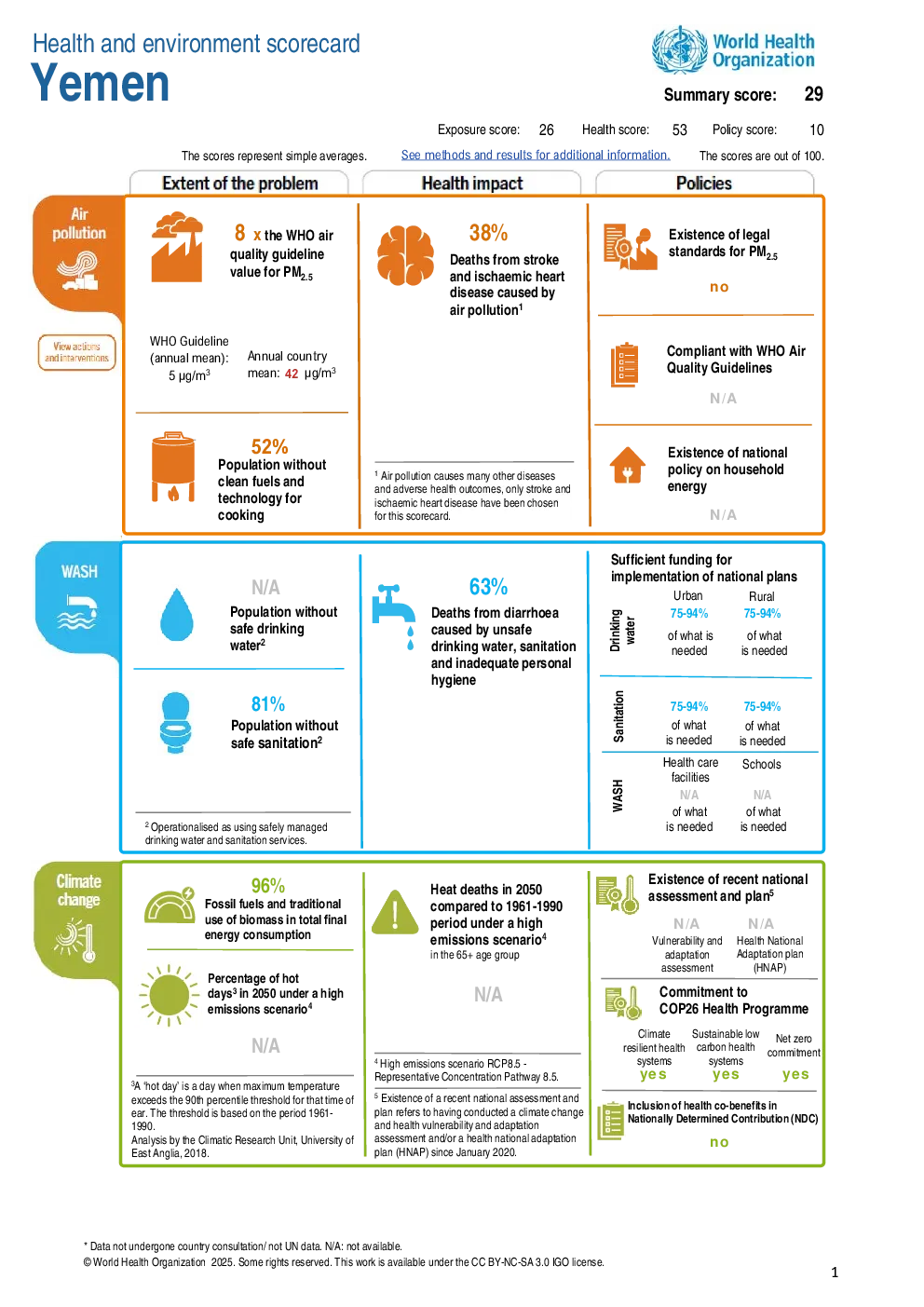
Yemen Health and Environment Scorecard
Summary Scorecard
- Overall Score: 29
- Exposure Score: 26
- Health Score: 53
- Policy Score: 10
Key Scores and Indicators
Air Quality
- WHO Air Quality Guideline Value for PM2.5: 5 μg/m³
- Annual Country Mean: 8 μg/m³
- Compliant with WHO Air Quality Guidelines: No
- Deaths from stroke and ischaemic heart disease caused by air pollution: N/A
Household Energy
- Population without clean fuels and technology for cooking:
- Existence of national policy on household energy: N/A
Water, Sanitation, and Hygiene (WASH)
- Population without safe drinking water: 52%
- Population without safe sanitation: 75-94%
- Deaths from diarrhoea caused by unsafe drinking water, sanitation and inadequate personal hygiene: N/A
Climate Change
- Percentage of hot days in 2050 under a high emissions scenario: 63%
- Heat deaths in 2050 compared to 1961-1990 period under a high emissions scenario: 75-94%
- Existence of a recent national assessment and plan: No
- Commitment to COP26 Health Programme: No
Biodiversity
- Terrestrial and marine area protected: N/A
- Change in forest area 1990-2020: N/A
- Post-COP15 National Biodiversity Strategy and Action Plans submitted: N/A
Chemicals
- Mean blood lead level in children under 5 years: N/A
- Existence of legal limit on lead paint: No
- Existence of a poison centre: No
- Party to the Minamata Convention on Mercury: No
- IHR capacity score for chemical events: 8%
- Poisoning deaths in 100,000 children under five, per year: N/A
Radiation
- Existence of standards on electromagnetic fields: No
- Existence of regulation of artificial tanning devices/sun beds: No
- Existence of national radon regulations for dwellings: No
- Number of deaths per 100,000 people from residential radon, per year: N/A
- IHR capacity score for radiation emergencies: N/A
- Deaths per 100,000 people from melanoma and other skin cancers, per year: N/A
Occupational Health
- Informal employment in total employment: 26%
- Working age population exposed to long working hours (≥55 hours/week): N/A
- Deaths per 100,000 people of working age from diseases due to occupational risks, per year: N/A
- Deaths per 100,000 people of working age from injuries due to occupational risks, per year: N/A
- Existence of national policy instruments for occupational health and safety for health workers: No
- Key international labour conventions on occupational safety and health ratified: C155, C161, C187
Health Care Facilities
- Health care facilities without basic services: N/A
- Health care facilities without reliable electricity supply: N/A
- Climate assessment conducted for: N/A
- Climate resilience: N/A
- Environmental sustainability: N/A
- Existence of standards for WASH health care facilities: N/A
- Existence of standards for health care waste management: N/A
References
The scorecard is based on published data from various sources including the WHO, IHME, UNEP, ILO, and others. The data covers air quality, household energy, water, sanitation, hygiene, climate change, biodiversity, chemicals, radiation, occupational health, and health care facilities.
Conclusion
Yemen's overall health and environment score is low, indicating significant challenges in air quality, household energy, water, sanitation, and hygiene, climate change, biodiversity, chemicals, radiation, and occupational health. The country lacks sufficient policies, funding, and infrastructure to address these issues effectively. Immediate action is needed to improve these areas to ensure better health outcomes and environmental sustainability.