世界就业与社会展望:2025年趋势
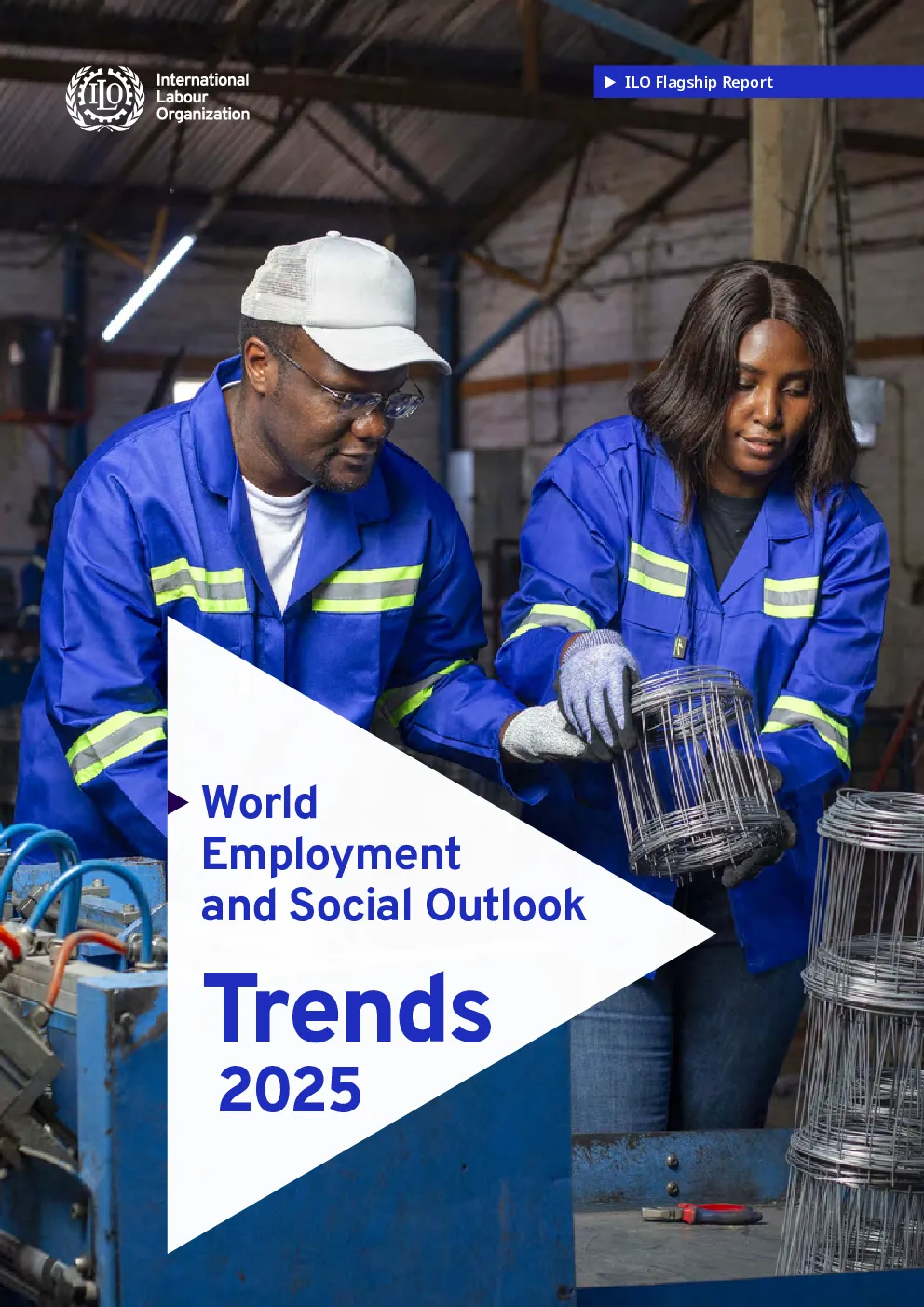
Trends2025 World Employmentand Social Outlook Trends2025 Attribution 4.0 International (CC BY 4.0) This work is licensed under the Creative Commons Attribution 4.0 International. To view a copy of thislicence, please visit (https://creativecommons.org/licenses/by/4.0/). The user is allowed to reuse, share(copy and redistribute), adapt (remix, transform and build upon the original work) as detailed in the licence.The user must clearly credit the ILO as the source of the material and indicate if changes were made tothe original content. Use of the emblem, name and logo of the ILO is not permitted in connection withtranslations, adaptations or other derivative works. Attribution –The user must indicate if changes were made and must cite the work as follows:WorldEmployment and Social Outlook: Trends 2025, Geneva: International Labour Office, 2025. © ILO. Translations –In the case of a translation of this work, the following disclaimer must be added alongwith the attribution:This is a translation of a copyrighted work of the International Labour Organization (ILO).This translation has not been prepared, reviewed or endorsed by the ILO and should not be considered an officialILO translation. The ILO disclaims all responsibility for its content and accuracy. Responsibility rests solely withthe author(s) of the translation. Adaptations –In the case of an adaptation of this work, the following disclaimer must be added alongwith the attribution:This is an adaptation of a copyrighted work of the International Labour Organization (ILO).This adaptation has not been prepared, reviewed or endorsed by the ILO and should not be considered an officialILO adaptation. The ILO disclaims all responsibility for its content and accuracy. Responsibility rests solely withthe author(s) of the adaptation. Third-party materials –This Creative Commons licence does not apply to non-ILO copyright materialsincluded in this publication. If the material is attributed to a third party, the user of such material is solelyresponsible for clearing the rights with the rights holder and for any claims of infringement. Any dispute arising under this licence that cannot be settled amicably shall be referred to arbitrationin accordance with the Arbitration Rules of the United Nations Commission on International Trade Law(UNCITRAL). The parties shall be bound by any arbitration award rendered as a result of such arbitrationas the final adjudication of such a dispute. Queries on rights and licensing should be addressed to the ILO Publishing Unit (Rights and Licensing) atrights@ilo.org. Information on ILO publications and digital products can be found at:www.ilo.org/publns. ISBN 9789220411575 (print); 9789220411582 (web pdf)ISSN 2709-7080 (print); 2709-7099 (online)DOI:https://doi.org/10.54394/IZLN1673 economic recovery / labour market / decent work / just transition / youth employment 03.04.3 ILO Cataloguing in Publication Data Also available in French:Emploi et questions sociales dans le monde: Tendances 2025, ISBN 9789220411599(print), 9789220411605 (web PDF); and in Spanish:Perspectivas Sociales y del Empleo en el Mundo: Tendencias2025, ISBN 9789220411612 (print), 9789220411629 (web PDF). The designations employed in ILO publications and databases, which are in conformity with UnitedNations practice, and the presentation of material therein do not imply the expression of any opinionwhatsoever on the part of the ILO concerning the legal status of any country, area or territory or of itsauthorities, or concerning the delimitation of its frontiers or boundaries. The opinions and views expressed in this publication are those of the author(s) and do not necessarilyreflect the opinions, views or policies of the ILO. Reference to names of firms and commercial products and processes does not imply their endorsementby the ILO, and any failure to mention a particular firm, commercial product or process is not a sign ofdisapproval. Cover photo Munya & Paida Shadaya, directors of Invictus Steel Africa. They are beneficiaries of the ILO Start andImprove Your Business (SIYB) training. Mutare, Zimbabwe, 8 October 2024. Photo: Shaun Chitsiga/ILO Produced by the Publications Production and Publishing Management Unit of the ILO. Preface As we celebrate the historically low global unemployment level, of 5per cent, one may assumethat this means that the labour market is thriving. But we live in a time of contradictionsand challenges, where meaningful progress exists side by side with entrenched economicobstacles. Beneath 2024’s encouraging figures lies a persistent reality: millions of people,particularly in less developed countries, remain trapped in cycles of informality, workingpoverty and economic marginalization. This reality, outlined in theWorld Employment andSocial Outlook: Trends 2025report, calls for a profound reckoning with the state of globalemployment and decent work. The closure of gender and skill gaps and the amelioration of wag