您的浏览器禁用了JavaScript(一种计算机语言,用以实现您与网页的交互),请解除该禁用,或者联系我们。 [世界银行]:Measuring the Local Economic Impacts of Nature-Based Tourism in Madagascar - 发现报告

Measuring the Local Economic Impacts of Nature-Based Tourism in Madagascar

综合 2025-02-19 世界银行 章嘉艺
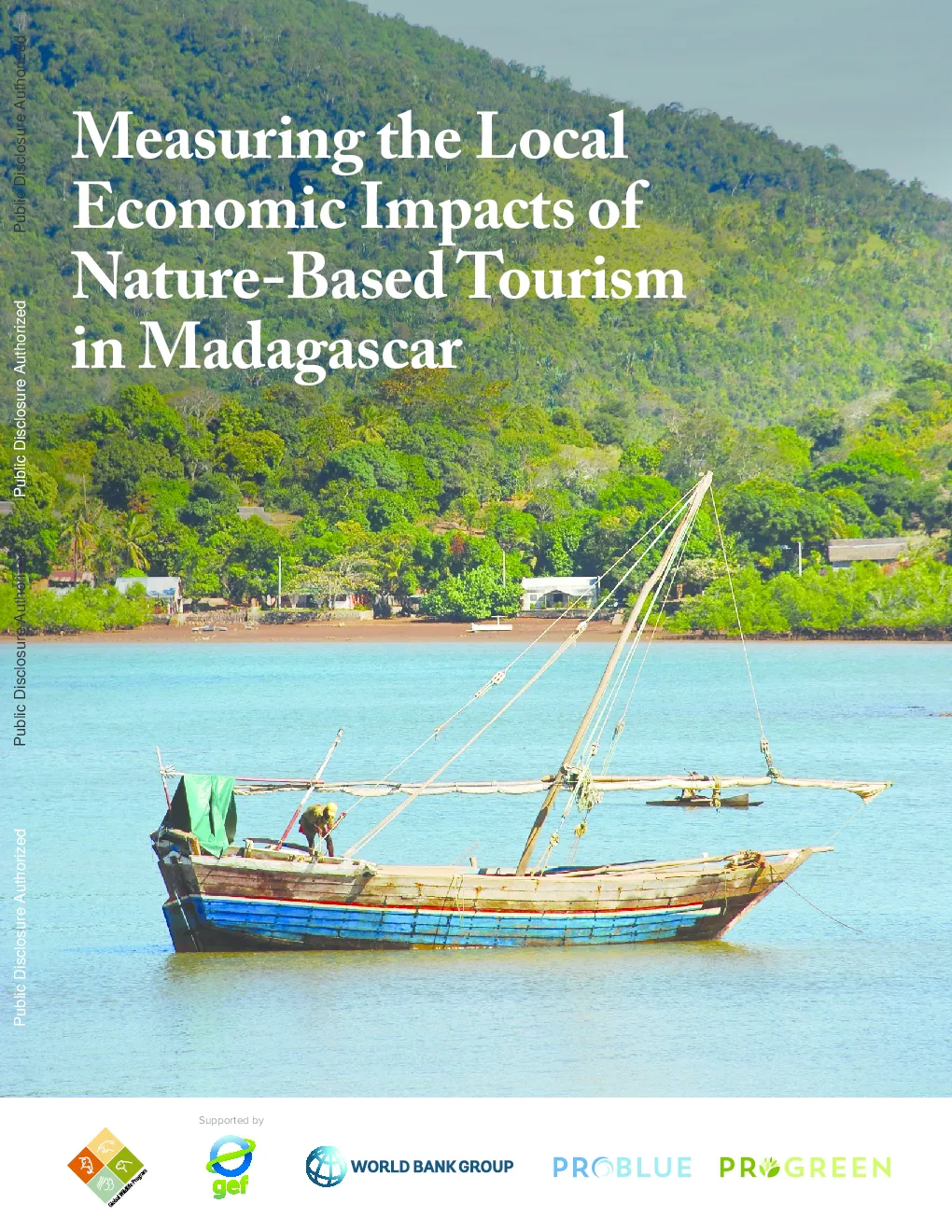
报告封面

This work is a product of the staff of The World Bank with external contributions. The findings,interpretations, and conclusions expressed in this work do not necessarily reflect the views of TheWorld Bank, its Board of Executive Directors, or the governments they represent. The World Bank does not guarantee the accuracy, completeness, or currency of the data includedin this work and does not assume responsibility for any errors, omissions, or discrepancies inthe information, or liability with respect to the use of or failure to use the information, methods,processes, or conclusions set forth. The boundaries, colors, denominations, and other informationshown on any map in this work do not imply any judgment on the part of The World Bankconcerning the legal status of any territory or the endorsement or acceptance of such boundaries. Nothing herein shall constitute or be construed or considered to be a limitation upon or waiver ofthe privileges and immunities of The World Bank, all of which are specifically reserved. Rights and Permissions The material in this work is subject to copyright. Because The World Bank encourages disseminationof its knowledge, this work may be reproduced, in whole or in part, for noncommercial purposes aslong as full attribution to this work is given. Any queries on rights and licenses, including subsidiary rights, should be addressed to World BankPublications, The World Bank Group, 1818 H Street NW, Washington, DC 20433, USA; fax: 202-522-2625; e-mail: pubrights@worldbank.org. Cover photo: © michelepautasso / ShutterstockDesign: Sergio Moreno Tellez / World Bank Group Acknowledgements This report was written by Justin Kagin (Founder, Kagin’s Consulting and Consultant,World Bank Group [WBG]), Vanessa Satur (Consultant, WBG), and Wendy Li (Environmentand Tourism Specialist, WBG). The LEWIE-LITE technical work and analysis was carriedout by Ed Taylor (Distinguished Professor Emeritus, University of California, Davis andConsultant, WBG), Justin Kagin, and Mateusz Filipski (Associate Professor, University ofGeorgia and Consultant, WBG). Urvashi Narain (Program Leader, WBG) and Lisa Farroway(Senior Environmental Specialist, WBG) provided technical oversight and guidance. SaraEnders Estupinan (Consultant, WBG) helped coordinate the production of this report. Datacollection and field work were conducted by CAETIC Developpement. The authors are grateful for inputs and technical review from Sachiko Kondo (SeniorNatural Resources Management Specialist, WBG), Amy Chamberlain (Consultant, WBG),and Laza Rakotondrasoa (Natural Resources Management Specialist, WBG). The teamthanks Cristian Quijada Torres (Senior Private Sector Specialist, WBG), Prisca Mamitiana(Private Sector Development Specialist, WBG), and Mirenty Raveloson (Consultant, WBG)from the Madagascar Economic Transformation for Inclusive Growth Project team, and theproject implementation unit for overall collaboration and facilitation of field work. Peer review was provided by Nicholas Zmijewski (Senior Environmental Engineer, WBG)and Cristian Quijada Torres. The team thanks Idah Pswarayi-Riddihough (Country Director,WBG), Africa Olojoba (Practice Manager, WBG), Atou Seck (Country Manager, WBG),Marie-Chantal Uwanyiligira (Country Director, WBG), and Diana Styvanley (External AffairsOfficer, WBG) for their support. Many other World Bank Group colleagues participated inLEWIE-LITE workshops and offered insights to improve the methodology and analysis. The team is also grateful for the support of the many ministries, agencies, andstakeholders within the government of Madagascar that enabled this work. This report was funded by PROBLUE, PROGREEN, and the Global Environment Facility-financed Global Wildlife Program. Table of Contents Abbreviations and Acronyms /9 Glossary of Terms /9 Executive Summary /10How Was the Study Done?/11What Did the Study Find?/ 13What Recommendations and Lessons Can Be Drawn from the Study?/ 15 SECTION 1.Introduction / 16Direct and Indirect Impacts of Tourism / 17Nature-based Tourism in Madagascar and the LEWIE-LITE Pilot / 19Structure of this Report/ 19 SECTION 2.Methodology /20Sampling Design / 23 SECTION 3.Data Collection and Analysis / 27Data Analysis and the LEWIE-LITE Dashboard /30 SECTION 4.Descriptive Statistics of Tourist Numbers and Spending atRanomafana and Nosy Tanikely National Parks / 33 SECTION 5.Using the Model to Simulate Impacts of Tourism / 45Local Economy Impacts of Tourist Spending ($) / 47Impacts of Future Growth in Tourism /54 SECTION 6.Testing the Robustness of Results and Analyzingthe Differences in Multipliers Between the TwoProtected Areas / 56 SECTION 7.Using the Model to Simulate Changes in Park andCommunity Projects and Local Government /60 Impacts of Changes in Park and Community Projects /61Impacts of Changes in Local Government Spending / 65 SECTION 8.Using the Model to Simulate ComplementaryInterventions / 67 Impacts of Increased Demand for Agricultural