应用健康沟通:规划指南(英)2026
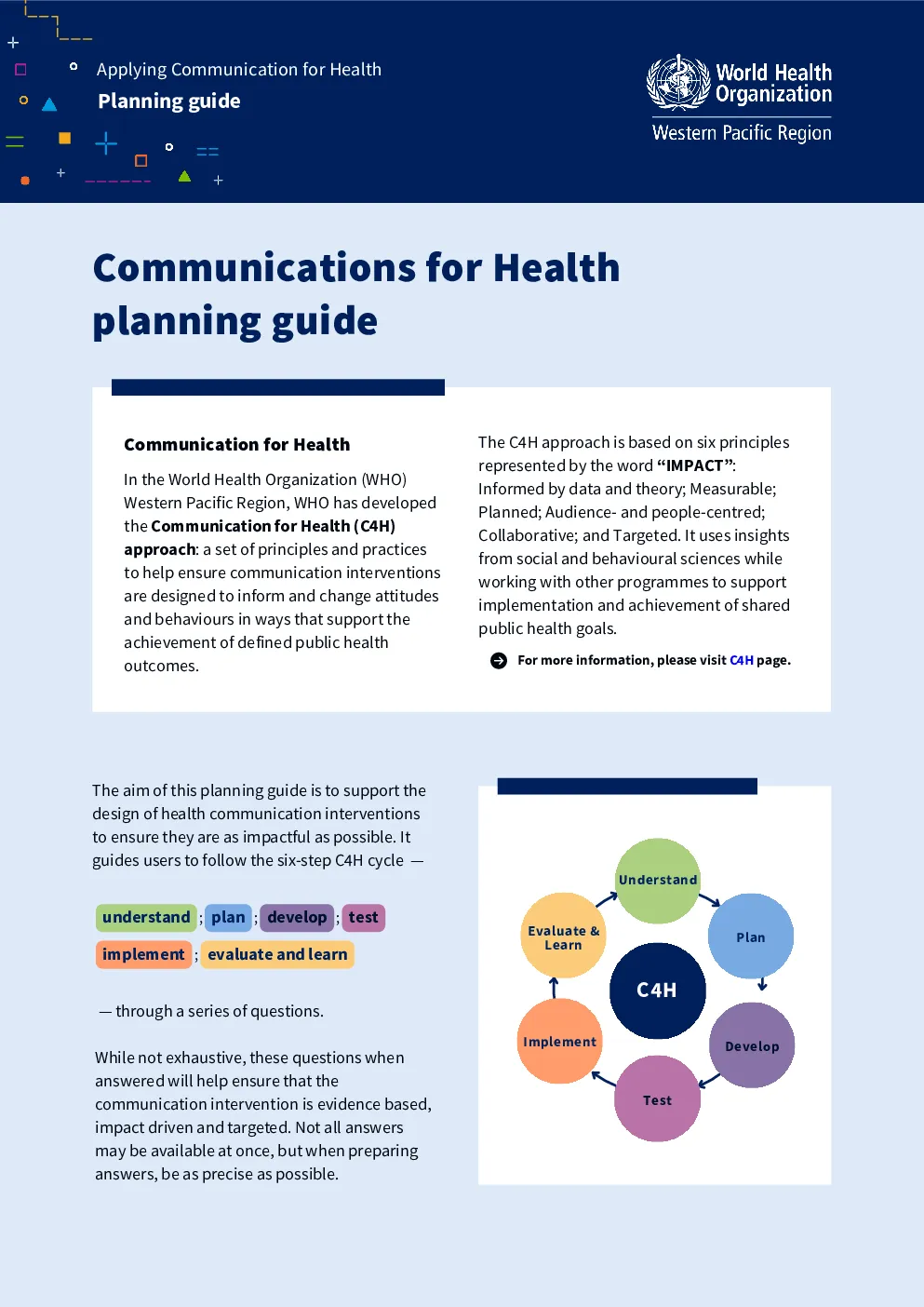
The C4H approach is based on six principlesrepresented by the word“IMPACT”:Informed by data and theory; Measurable;Planned; Audience- and people-centred;Collaborative; and Targeted. It uses insights Communication for Health In the World Health Organization (WHO)Western Pacific Region, WHO has developedtheCommunication for Health (C4H)approach: a set of principles and practices For more information, please visitC4Hpage. The aim of this planning guide is to support thedesign of health communication interventionsto ensure they are as impactful as possible. It understand;plan;develop;test implement;evaluate and learn — through a series of questions. While not exhaustive, these questions whenanswered will help ensure that thecommunication intervention is evidence based,impact driven and targeted. Not all answers STEP 1Understand Before planning any health communication intervention, it is important to conduct a situationanalysis to understand the full range of factors, including social, economic, environmental andpolicy-related elements, as well as individual behaviours, that contribute to the health issueyou aim to address. The evidence gathered at this stage also helps to establish a baselineof What is the healthissue you aim to What are its causes and why do they exist? What are its effects and howsevere are they? Can the issue be quantified? Why do you want to focuson this issue? Why focus on it now? Where do yourtarget audiences STEP 2Plan In this step, define your desired health outcome and objectives, along with key measurementindicators; develop a theory of change; and identify activities and products that will effectivelyinfluence your target audiences. While some tasks are outside the scope of this planning guide, What is the healthoutcome you want to What is the change you want to see in your target audiences? Whatimpact do you want your C4H intervention to have? STEP 3Develop There is no one-size-fits-all approach to C4H interventions. Each health issue requiresa targeted solution, combining specific techniques, channels and approaches to achieve thedesired health outcome. In this step, concepts, messages and products are developed. These What messages can improve your audiences’ knowledge about thehealth issue? What messages have personal relevance to them? Whatmessages will have an impact on their communities and society? Whatmessages will help them gain confidence in their capacity to changetheir behaviours or take actions? What is your call to action for the What are your key andsupporting messages? What behaviourchange prompts will2 How will you attract your target audiences? When developingcommunication products, consider the effects of colour, size,placement, legibility, etc. Think about how you will motivate youraudiences to act (e.g. by making the benefits feel immediate, invokingloss aversion by emphasizing that a vaccine is reserved for their child,highlighting costs and benefits, drawing on social norms). How can yousimplify your message (e.g. by chunking and ordering information, What communication approaches will best engage your audiences(e.g. print, digital, video, audio, animation, interactive materials such asapps, quizzes, chatbots, direct communication, live events, etc.)? What What communicationapproaches and STEP 4Test Testing helps determine whether the planned communication messages, products orconcepts will work or not and why. Where possible, conduct testing not only with your targetaudiences but also with non-target audiences and in diverse contexts, to ensure they convey the What do you plan to STEP 5Implement This is where you translate your plan into concrete actions and products. Make sureto track progress against your plan, baseline and indicators; address any issues that may arise How are they reacting? Are the responses positive or negative? Arethere any surprises? Are there any other audiences that should beadded? Do you need to explore other channels or activities? Is there What is the initialresponse from your Is progress being made towards the achievement of your objectives andhealth outcome? Is there anything else you can do to achieve them? STEP 6Evaluate and learn Now is the time to measure the extent to which you have achieved the health outcomeand to identify lessons learnt. Use these insights to inform the next phase of your intervention Have you achieved the health outcome defined during the planningstage? Do you have evidence demonstrating progress towards yourobjectives and outcome and the effectiveness of your C4H How effective wasyour C4H interventionin achieving the health What are the lessons What are the lessons − both positive and negative − from your C4Hintervention and the decisions you have made? What has worked, whathas not, and what could be improved? What learnings can you share