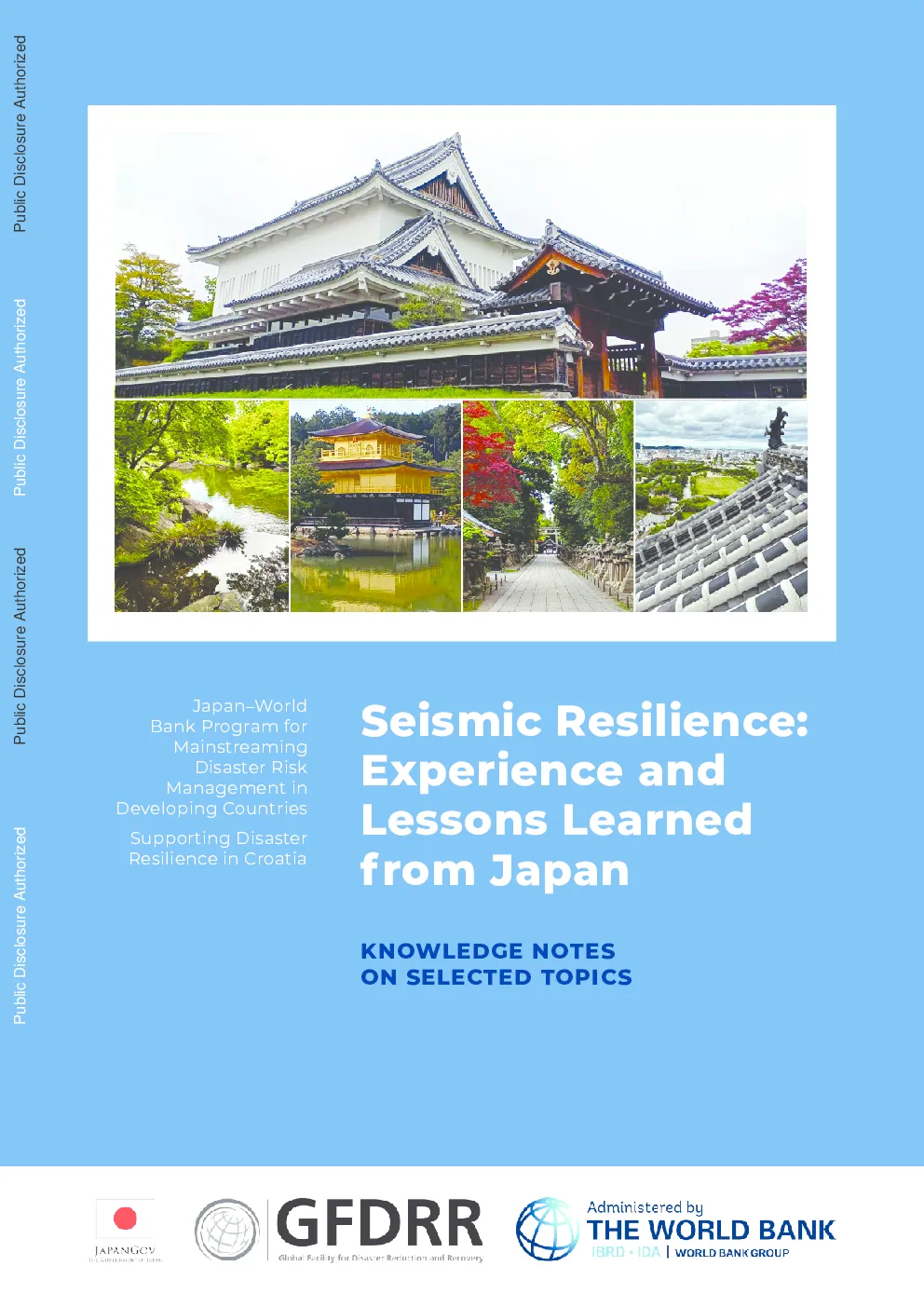
Japan–WorldBank Program forMainstreamingDisaster RiskManagement inDeveloping CountriesPublic Disclosure Authorized Supporting DisasterResilience in Croatia KNOWLEDGE NOTESON SELECTED TOPICS DISCLAIMER © 2025 International Bank for Reconstruction and Development / The World Bank1818 H Street NW, Washington, DC 20433Telephone: +1-202-473-1000; Internet: www.worldbank.org Some rights reserved. This work is a product of the staff of The World Bank and the Global Facility for Disaster Reduction andRecovery (GFDRR). The findings, interpretations, and conclusions expressed in this work do not necessarilyreflect the views of The World Bank, its Board of Executive Directors, or the governments they represent.The World Bank does not guarantee the accuracy, completeness, or currency of the data included in thiswork and does not assume responsibility for any errors, omissions, or discrepancies in the information, orliability with respect to the use of or failure to use the information, methods, processes, or conclusions setforth. The boundaries, colors, denominations, and other information shown on any map in this work donot imply any judgment on the part of The World Bank concerning the legal status of any territory or theendorsement or acceptance of such boundaries. Nothing herein shall constitute or be construed or considered to be a limitation upon or waiver of theprivileges and immunities of The World Bank, all of which are specifically reserved. Rights and Permissions.This work is subject to copyright. Because The World Bank encourages dissemi-nation of its knowledge, this work may be reproduced, in whole or in part, for noncommercial purposes aslong as full attribution to this work is given. Attribution.World Bank. 2025.Seismic Resilience: Experience and Lessons Learned from Japan: KnowledgeNotes on Selected Topics.Washington, D.C.: World Bank Group. Adaptations.If you create an adaptation of this work, please add the following disclaimer along with theattribution: This is an adaptation of an original work by The World Bank. Views and opinions expressed inthe adaptation are the sole responsibility of the author or authors of the adaptation and are not endorsedby The World Bank. Third-party content.The World Bank does not necessarily own each component of the content containedwithin the work. The World Bank therefore does not warrant that the use of any third-party-owned indi-vidual component or part contained in the work will not infringe on the rights of those third parties. Therisk of claims resulting from such infringements rests solely with you. If you wish to reuse a component ofthe work, it is your responsibility to determine whether permission is needed for that reuse and to obtainpermission from the copyright owner. Examples of components can include, but are not limited to, tables,figures, or images. All queries on rights and licenses, including subsidiary rights, should be addressed to World Bank Publications,The World Bank Group, 1818 H Street NW, Washington, DC 20433, USA; e-mail: pubrights@worldbank.org. ACKNOWLEDGMENTS This report was developed as part of technical assistance, “Supporting Disaster Resilience in Croatia”(P173998/TF0B9214), under the Japan–World Bank Program for Mainstreaming Disaster Risk Managementin Developing Countries,*1which is financed by the Government of Japan and receives technical supportfrom the World Bank Tokyo Disaster Risk Management Hub. This report was prepared by Zuzana Stanton-Geddes (Senior Disaster Risk Management Specialist), ShokoTakemoto (Disaster Risk Management Specialist), and Soraya Ridanovic (Disaster Risk Management Analyst),with inputs and comments from Krunoslav Katic (Senior Disaster Risk Management Expert), and MartinaVojkovic (Disaster Risk Management Expert). This report also benefited from comments and guidancefrom Alanna Simpson (Lead Disaster Risk Management Specialist), Keiko Sakoda (Senior Disaster RiskManagement Specialist), and Guillermo Siercke (Disaster Risk Management Specialist). The team would like to extend our gratitude to the Japanese institutions that reviewed the report andprovided invaluable inputs, including the Ministry of Education, Culture, Sports, Science and Technology; theAgency of Cultural Affairs; Kumamoto Prefecture, Kumamoto City; Sendai City; Asahi Kasei Homes; NikkenSekkei and the Japan International Cooperation Agency. The report was edited by Anne Himmelfarb and Lisa Ferraro Parmelee. The report was designed by AnamarijaPerić. Photo imagery was kindly provided by the Government of Japan, specifically the institutions thatcontributed valuable inputs and visuals to the report. Additional images were provided by Soraya Ridanovicand Nada Cohadzic. Cover Photo ©Soraya Ridanovic and Nada Cohadzic TABLE OF CONTENTS ABBREVIATIONSEXECUTIVE SUMMARYINTRODUCTION 8 About this reportCountry context: Key highlightsDisaster risk management policies and institutions: Key highlightsSeismic risk management polici