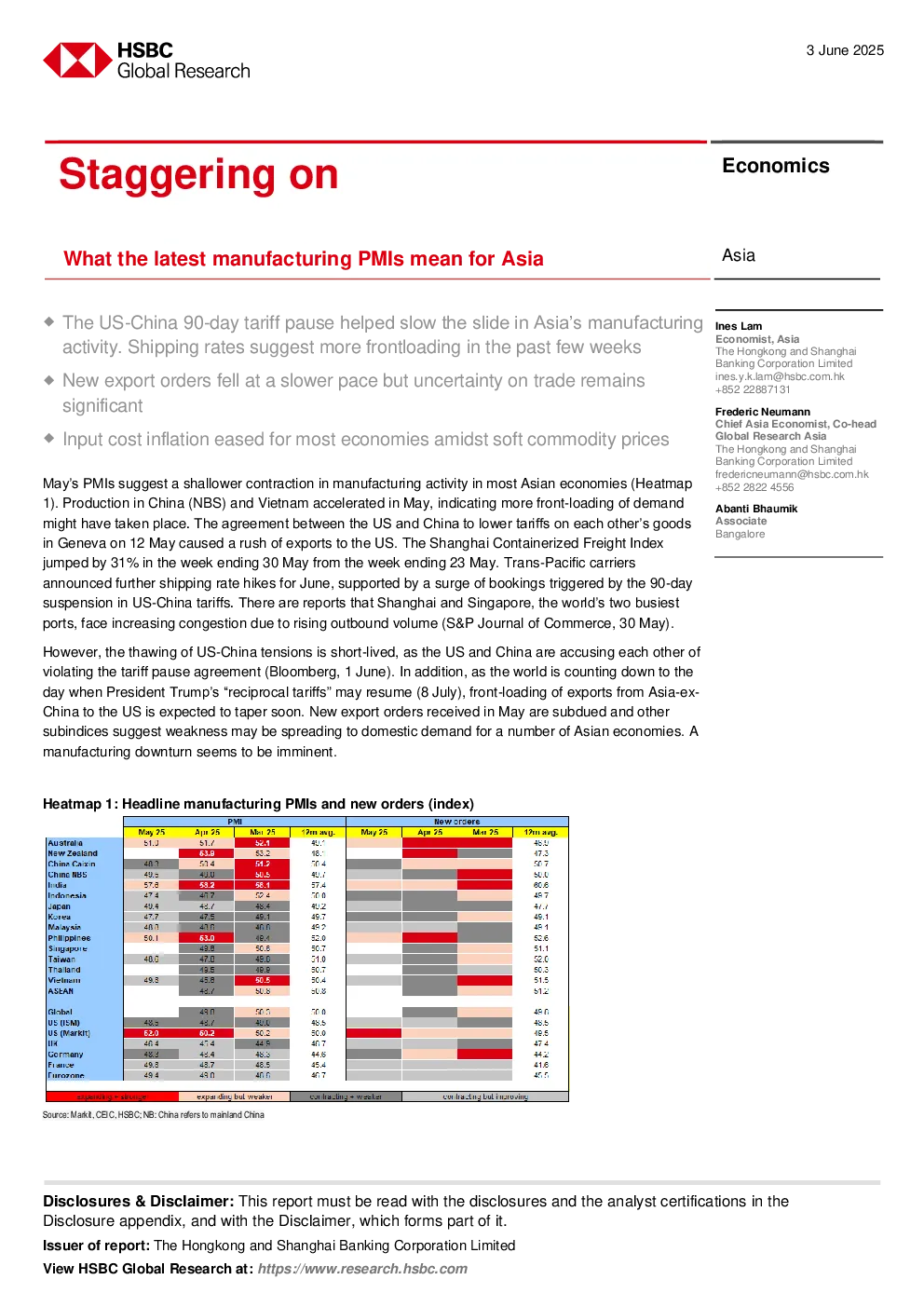
May’s PMIs indicate a shallower contraction in manufacturing activity across most Asian economies, with China and Vietnam showing accelerated production. The US-China tariff pause led to a surge in exports to the US, reflected in rising shipping rates and port congestion. However, the thawing of tensions is short-lived, as both sides accuse each other of violating the 90-day tariff suspension agreement, raising concerns about a potential export slowdown.
Key data highlights:
- Global PMI: Likely to stay below 50, signaling a contraction in global manufacturing.
- China: New export orders declined sharply, with imports plummeting to a 2009 low, indicating supply chain disruptions.
- Asia ex-Japan and China: New export orders remained above 50 due to India, but most economies saw slower declines. Korea’s exports held up slightly, supported by semiconductor shipments.
- Domestic demand: Weakness persists, with China’s new orders index hitting a June 2020 low. India’s input prices rose, suggesting cost pass-through to downstream customers.
The report concludes that while the tariff pause provided temporary relief, trade uncertainties and domestic demand weakness may lead to a manufacturing downturn soon. Vietnam’s exports are vulnerable due to reliance on the US market, while India’s labor market tightness could exacerbate inflationary pressures.