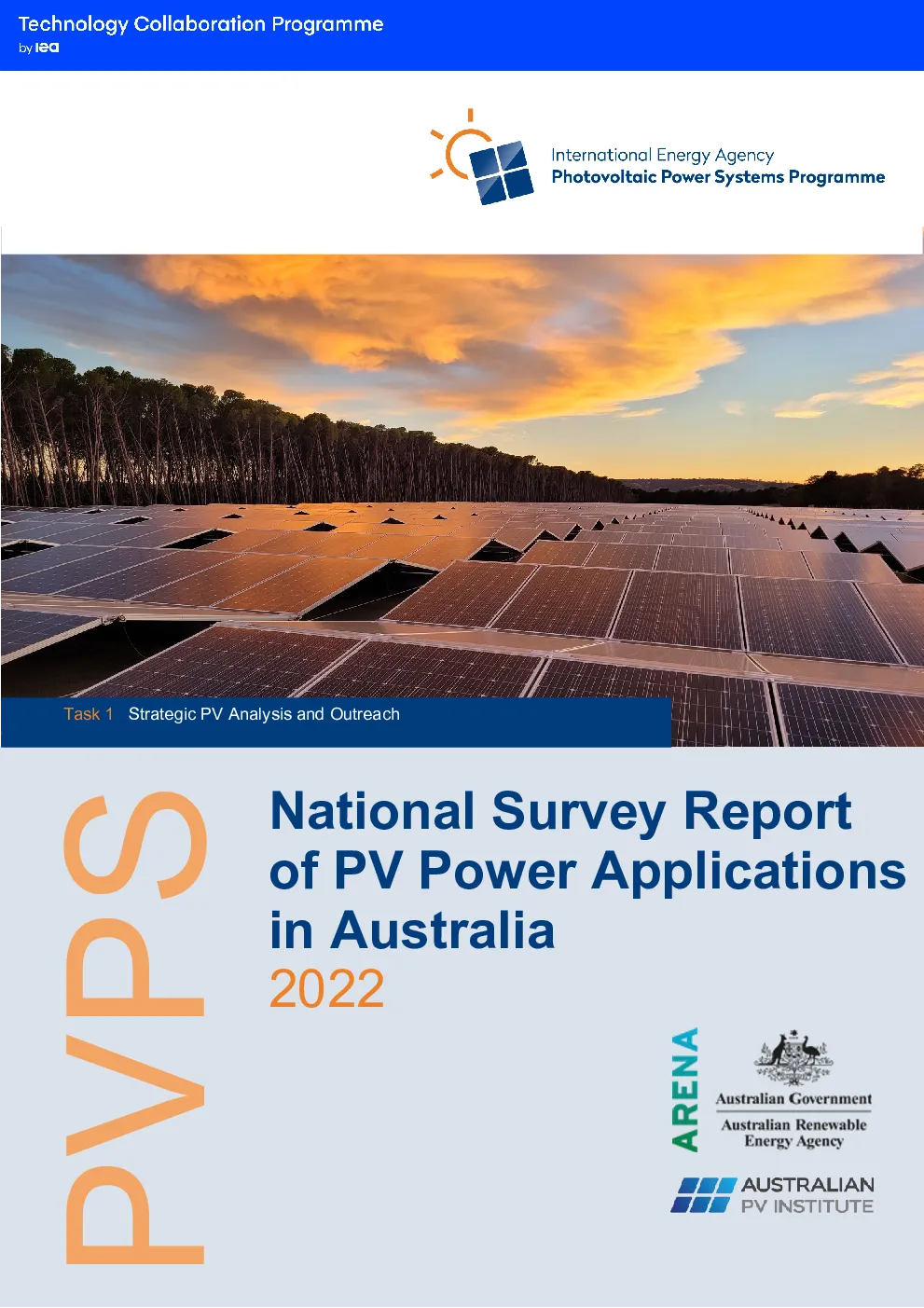
What is IEA PVPS TCP?The International Energy Agency (IEA), founded in 1974, is an autonomous body within the framework of the Organization for EconomicCooperation and Development (OECD). The Technology Collaboration Programme (TCP) was created with a belief that the future of energysecurity and sustainability starts with global collaboration. The programme is made up of 6.000 experts across government, academia, andindustry dedicated to advancing common research and the application of specific energy technologies.The IEA Photovoltaic Power Systems Programme (IEA PVPS) is one of the TCP’s within the IEA and was established in 1993. The missionof the programme is to “enhance the international collaborative efforts which facilitate the role of photovoltaic solar energy as a cornerstonein the transition to sustainable energy systems.” In order to achieve this, the Programme’s participants have undertaken a variety of jointresearch projects in PV power systems applications. The overall programme is headed by an Executive Committee, comprised of onedelegate from each country or organisation member, which designates distinct ‘Tasks,’ that may be research projects or activity areas.The IEA PVPS participating countries are Australia, Austria, Belgium, Canada, Chile, China, Denmark, Finland, France, Germany, Israel,Italy, Japan, Korea, Malaysia, Mexico, Morocco, the Netherlands, Norway, Portugal, South Africa, Spain, Sweden, Switzerland, Thailand,Turkey, and the United States of America. The European Commission, Solar Power Europe, the Smart Electric Power Alliance (SEPA), theSolar Energy Industries Association and the Cop- per Alliance are also members.Visit us at:www.iea-pvps.orgWhat is IEA PVPS Task 1?The objective of Task 1 of the IEA Photovoltaic Power Systems Programme is to promote and facilitate the exchange and dissemination ofinformation on the technical, economic, environmental and social aspects of PV power systems. Task 1 activities support the broader PVPSobjectives: to contribute to cost reduction of PV power applications, to increase awareness of the potential and value of PV power systems,to foster the removal of both technical and non-technical barriers and to enhance technology co-operation. An important deliverable of Task1 is the annual “Trends in photovoltaic applications” report. In parallel, National Survey Reports are produced annually by each Task 1participant. This document is the country National Survey Report for the year 2022. Information from this document will be used as input tothe annual Trends in photovoltaic applications report.AuthorsMain Content:RJ EganData:N Haghdadi, Australian PV Institute (APVI), R, Passey, A Bruce (UNSW)Analysis:RJ EganEditor: OAAshby, M WattDISCLAIMERThe IEA PVPS TCP is organised under the auspices of the International Energy Agency (IEA) but is functionally and legally autonomous.Views, findings and publications of the IEA PVPS TCP do not necessarily represent the views or policies of the IEA Secretariat or itsindividual member countriesCOVER PICTUREHappy Valley, South Australia - 12.8 MWp powering a water treatment plant. Image provided by 5B Pty Ltd, Australia Acknowledgements............................................................................................................. 4EXECUTIVE SUMMARY .................................................................................................... 51Installation Data....................................................................................................... 10Applications for Photovoltaics...................................................................... 10Total photovoltaic power installed................................................................ 10Key enablers of PV development ................................................................ 152Competitiveness of PV electricity ............................................................................ 16Module prices .............................................................................................. 16System prices .............................................................................................. 17Cost breakdown of PV installations ............................................................. 19Financial Parameters and specific financing programs ............................... 21Additional Country information..................................................................... 223Policy Framework.................................................................................................... 23National targets for PV................................................................................. 24Direct support policies for PV installations................................................... 24Self-consumption measures ........................................................................ 30Tenders, auctions & similar schemes .......................................................... 31Oth