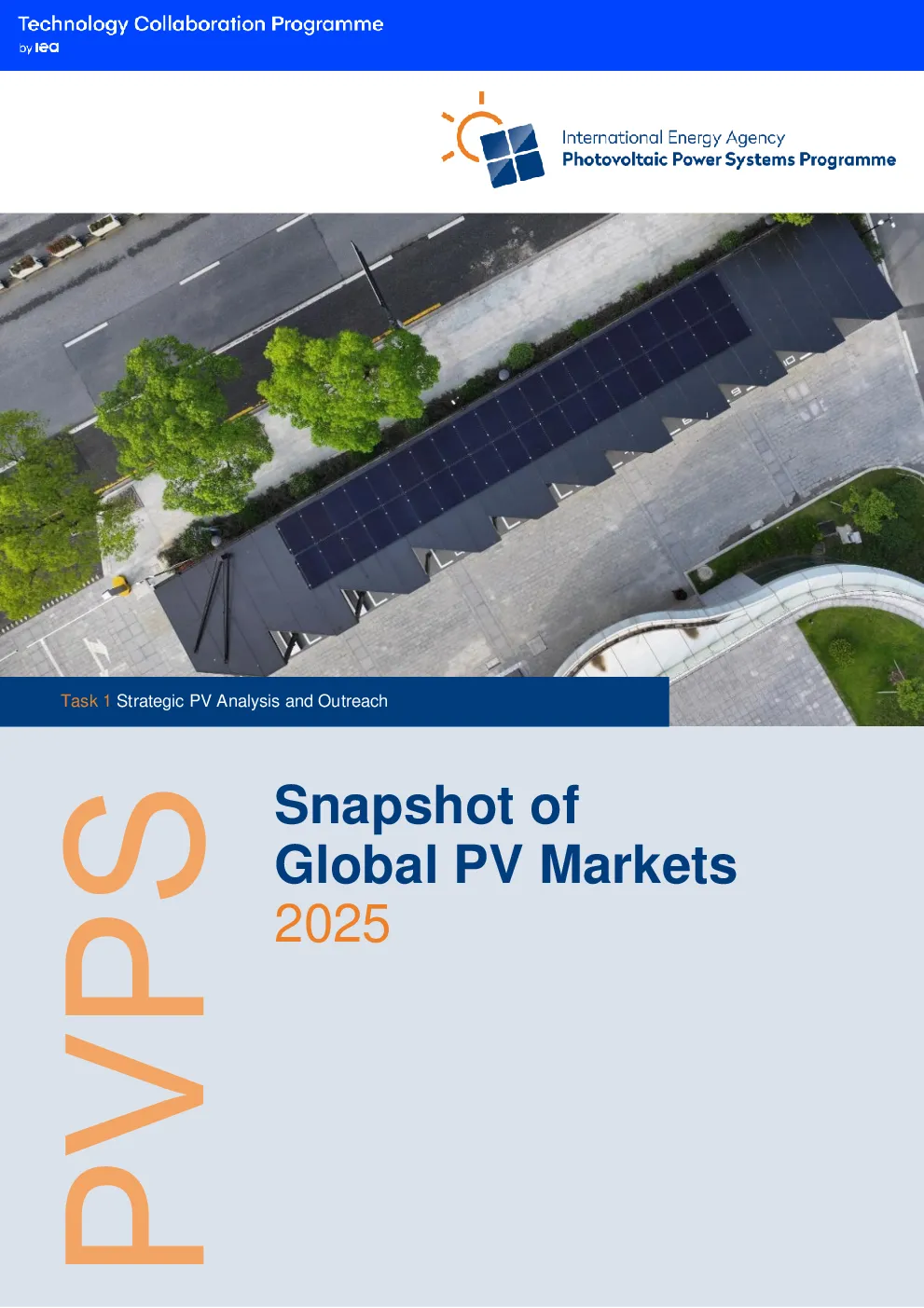
Snapshot ofGlobal PV Markets2025 WHAT IS IEA PVPS TCP? The International Energy Agency (IEA), founded in 1974, is an autonomous body within the framework of the Organizationfor Economic Cooperation and Development (OECD). The Technology Collaboration Programme (TCP) was created witha belief that the future of energy security and sustainability starts with global collaboration. The programme is made up of6000 experts across government, academia, and industry dedicated to advancing common research and the applicationof specific energy technologies. The IEA Photovoltaic Power Systems Programme (IEA PVPS) is one of the TCPs within the IEA and was established in1993. The mission of the programme is to “enhance the international collaborative efforts which facilitate the role ofphotovoltaic solar energy as a cornerstone in the transition to sustainable energy systems.” In order to achieve this, theProgramme’s participants have undertaken a variety of joint research projects in PV power systems applications. Theoverall programme is headed by an Executive Committee, comprised of one delegate from each country or organisationmember, which designates distinct ‘Tasks,’ that may be research projects or activity areas. The IEA PVPS participating members are Australia, Austria, Belgium, Canada, China, Denmark, Enercity SA, EuropeanUnion, Finland, France, Germany, India, Israel, Italy, Japan, Korea, Malaysia, Morocco, the Netherlands, Norway,Portugal, Solar Energy Research Institute of Singapore (SERIS), SolarPower Europe, South Africa, Spain, Sweden,Switzerland, Thailand, Türkiye, United States, and the United Kingdom. Visit us at:www.iea-pvps.org WHAT IS IEA PVPSTASK1? The objective of Task1of the IEA Photovoltaic Power Systems Programme ispromoting and facilitating the exchangeand dissemination of information on the technical, economic, environmental and social aspects of PV power systems.Task 1 activities support the broader PVPS objectives: to contribute to cost reduction of PV power applications, to increaseawareness of the potential and value of PV power systems, to foster the removal of both technical and non-technicalbarriers and to enhance technology co-operation. Authors ➢Data:IEA PVPS Reporting Countries, Becquerel Institute (BE). ➢Analysis:Gaëtan Masson, Adrien Van Rechem, Melodie de l’Epine (Becquerel Institute), Arnulf JÄGER-WALDAU(EC-JRC); IEA PVPS Task 1 members ➢Editor:Gaëtan Masson, IEA PVPS Task 1 Manager DISCLAIMER The IEA PVPS TCP is organised underthe auspices of the International Energy Agency (IEA) but is functionally and legally autonomous.Views, findings and publications of the IEA PVPS TCP do not necessarily represent the views or policies of the IEA Secretariat or itsindividual member countries Data for non-IEA PVPS countries are provided by official contacts or experts in the relevant countries. Dataare valid at the date of publication and should be considered as estimates in several countries due to the publication date. COVER PICTURE PV panelsin Lotus Parking canopiesin Hangzhou Chinacredit: LONGi 2025Snapshot of Global PV Markets IEA PVPSTask1StrategicPV Analysis and Outreach April2025 Executive Summary..........................................................................................................41Snapshot of the Global PV Market in 2024............................................................71.1Evolution of Annual Installations.................................................................71.2Impact of over-capacity in manufacturing...................................................91.3Focus on the Top Markets in 2024.............................................................101.4Market Segmentation.................................................................................102Cumulative Installed Capacity in the World............................................................112.1Evolution of Regional Share of PV Installations..........................................122.2Limits of Reporting Conventions.................................................................142.3Decommissioning, Repowering and Recycling...........................................142.4AC or DC Numbers?..................................................................................153Electricity Production from PV...............................................................................164Policy & Markets Trends........................................................................................174.1Policy Trends.............................................................................................174.2Remuneration mechanisms........................................................................174.3Prosumers Policies.....................................................................................184.4Grid Integration and Curtailment.................................................................194.5Local Manufacturing Policies.......................