2024年拉丁美洲经济展望
 AI智能总结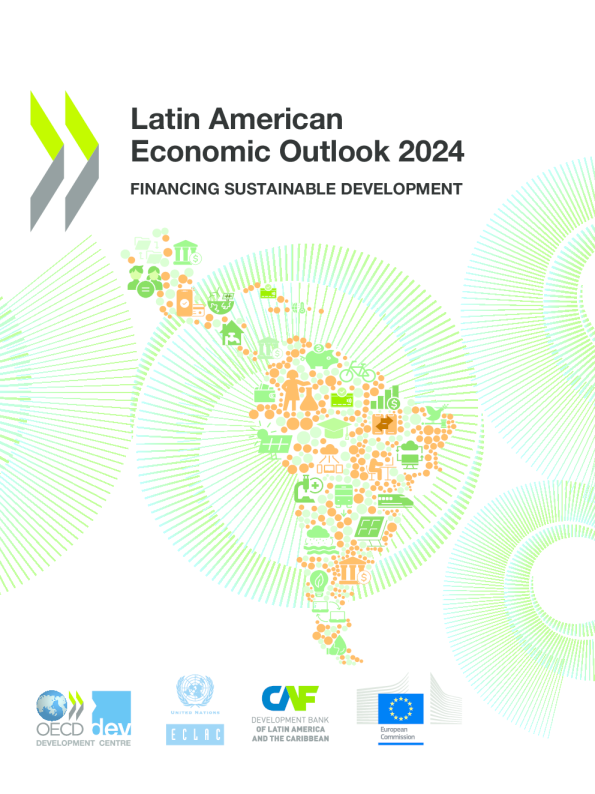
FINANCING SUSTAINABLE DEVELOPMENT Latin American EconomicOutlook2024 FINANCING SUSTAINABLE DEVELOPMENT This work is published under the responsibility of the Secretary-General of the OECD, the President of the CorporaciónAndina de Fomento (CAF) and the President of the European Commission. The opinions expressed and argumentsemployed herein do not necessarily reflect the official views of the Member countries of the OECD, the members of itsDevelopment Centre, those of the Corporación Andina de Fomento (CAF), or of the European Union and its MemberStates, or the Member States of the United Nations. The names of countries and territories and representation used in this joint publication follow the practice of the OECD. This document, as well as any data and map included herein, are without prejudice to the status of or sovereignty overany territory, to the delimitation of international frontiers and boundaries and to the name of any territory, city or area. ISBN 978-92-64-81213-0 (print)ISBN 978-92-64-57271-3 (PDF)ISBN 978-92-64-83786-7 (HTML) Latin American Economic OutlookISSN 2072-5159 (print)ISSN 2072-5140 (online) CAF Reference Number: CAF-513i-2024 ECLAC Reference Number: LC/TS.2024/125 European UnionISBN 978-92-68-22577-6 (PDF)Catalogue number: MN-01-24-008-EN-N (PDF)ISBN 978-92-68-22578-3 (print)Catalogue number: MN-01-24-008-EN-C (print) Photo credits:Cover design by Aida Buendía using images from © Shutterstock.com Corrigenda to OECD publications may be found at: https://www.oecd.org/en/publications/support/corrigenda.html. © OECD/CAF/EUROPEAN UNION 2024 Attribution 3.0 IGO (CC BY 3.0 IGO) This work is made available under the Creative Commons Attribution 3.0 IGO licence. By using this work, you accept to be bound by the terms of this licence(https://creativecommons.org/licenses/by/3.0/igo/).Attribution– you must cite the work.Translations– you must cite the original work, identify changes to the original and add the following text:In the event of any discrepancy between the original work and thetranslation, only the text of original work should be considered valid.Adaptations– you must cite the original work and add the following text:This is an adaptation of an original work by the OECD, CAF and the European Union. The opinionsexpressed and arguments employed in this adaptation should not be reported as representing the official views of the OECD or of its Member countries, those of the members ofCAF, or of the European Union and its Member States.Third-party material– the licence does not apply to third-party material in the work. If using such material, you are responsible for obtaining permission from the third party and forany claims of infringement.You must not use the OECD’s or CAF’s or European Union’s respective logo, visual identity or cover image without express permission or suggest the OECD or CAF or the EuropeanUnion endorse your use of the work.Any dispute arising under this licence shall be settled by arbitration in accordance with the Permanent Court of Arbitration (PCA) Arbitration Rules 2012. The seat of arbitration shallbe Paris (France). The number of arbitrators shall be one. Foreword Since 2007,each edition oftheannualLatinAmerican Economic Outlook(LEO) analyses one of themultiple challengesfaced bythe Latin America and the Caribbean (LAC) regionin itstransition towardssustainable and inclusive development,comparingLAC’s performance againstits peers, suggestingpolicyrecommendations and providingexamples for policy learning. The LEO benefits from the expertise and inputs ofseveral institutions.In2011, the United NationsEconomic Commission for Latin America and the Caribbeanjoined the OECD as co-author, as did theDevelopment Bank of Latin America and the Caribbeanin2013, andthe European Commissionin 2018. This 17th LEO,Financing Sustainable Development,mapsand analysestheregion’s varioussources offinancingina context of tight fiscal space, unpackingthe optionsforfundingdevelopment agendasbetterat national, regional and international levels.Itprovides policy recommendations for governments toimprovetax collection, fiscal expenditureandthe management ofpublic debt. It stresses the strategic roleof the private sector and how further developing financial markets can help channelmore privateinvestmenttowards development goals.Finally,the report underscores the necessity for strongerinternational partnerships toacceleratethe mobilisation ofinternational resources towardsthe region’ssustainable development. Acknowledgements Partners of this report are the United Nations Economic Commission for Latin America and the Caribbean(ECLAC), the Development Bank of Latin America and the Caribbean (CAF), the European Commission(EC) and the Development Centre of the Organisation for Economic Co-operation and Development(OECD). This report is supported by the Directorate-General for International Partnerships of the EuropeanCommission (INTPA). The contribution of the OECD De