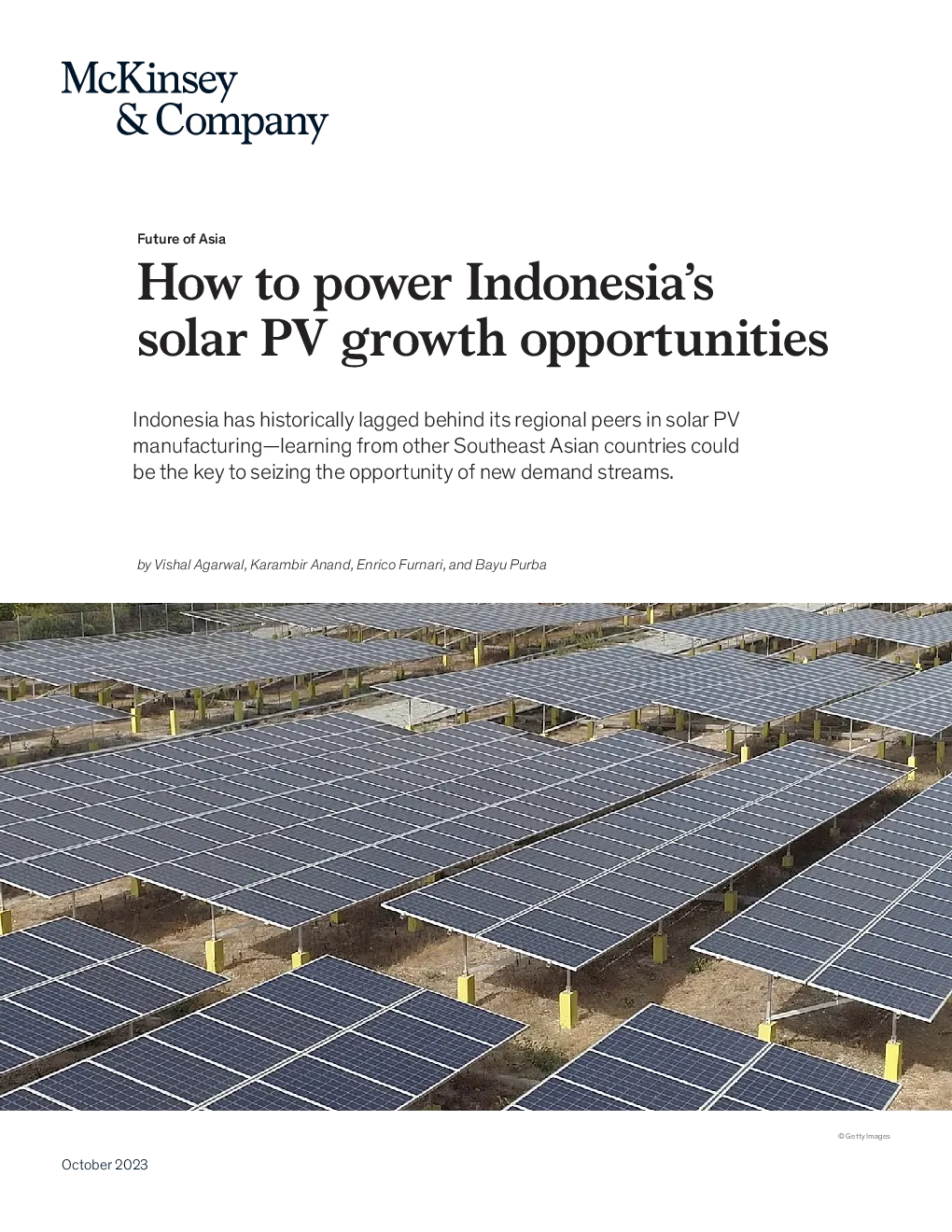
Future of Asia: Powering Indonesia's Solar PV Growth Opportunities
Executive Summary:
Indonesia, historically lagging in solar photovoltaic (PV) manufacturing, faces challenges in competing with its regional peers. To seize new demand streams and capitalize on the growing renewable energy sector, Indonesia must learn from successful strategies employed by other Southeast Asian countries. Key insights include:
- Southeast Asia's Renewable Energy Shift: The region is transitioning towards renewable energy, with solar PV expected to more than double between 2022 and 2030.
- Sluggish Solar PV Growth in Indonesia: Despite the country's abundant solar resources and commitment to reducing emissions, solar PV growth has been slower compared to its neighbors like Thailand and Vietnam.
- Challenges and Opportunities: Indonesia faces issues such as geographical complexity, coal and gas dominance, and import taxes, yet presents opportunities through partnerships and foreign investment in solar manufacturing.
- Singapore's EMA Import Plan: Offers a significant market opportunity for Indonesia to scale its solar PV production, especially considering the rising demand for low-carbon energy.
Main Points:
1. Regional Renewable Energy Trends: Southeast Asia is prioritizing renewable energy adoption, with solar PV poised for significant expansion. This shift is driven by environmental commitments and a desire to reduce carbon emissions.
2. Indonesia's Solar PV Landscape:
- Current Status: In 2022, Indonesia had a modest 0.3 GW of installed solar PV capacity, contrasting with Thailand's 3.1 GW and Vietnam's 18.5 GW.
- Target and Challenges: The country aims for 5 GW of installed solar PV capacity by 2030, facing challenges in scaling production without sufficient domestic demand.
3. Local Content Requirement (LCR): Indonesia's Electricity Business Plan includes a 40% LCR for solar PV components, increasing to 90% by 2025, posing a barrier for Original Equipment Manufacturers (OEMs).
4. Singapore's EMA Opportunity: Singapore's plan to import renewable energy presents a substantial market opportunity for Indonesia. This initiative could significantly boost Indonesia's solar PV capacity and exports.
5. Overcoming Challenges:
- Learning from Neighbors: Indonesia should adopt successful strategies used by other Southeast Asian countries to improve solar PV manufacturing competitiveness.
- Foreign Investment and OEM Attraction: Relaxing local content requirements and attracting foreign OEMs could accelerate the development of Indonesia's solar manufacturing sector.
Conclusion:
Indonesia has the potential to leverage its solar resources and regional partnerships to drive significant growth in solar PV production. By addressing key challenges and capitalizing on opportunities presented by Singapore's EMA, the country can achieve its renewable energy targets while fostering economic development. Collaboration, strategic partnerships, and policy adjustments will be crucial in realizing this vision.